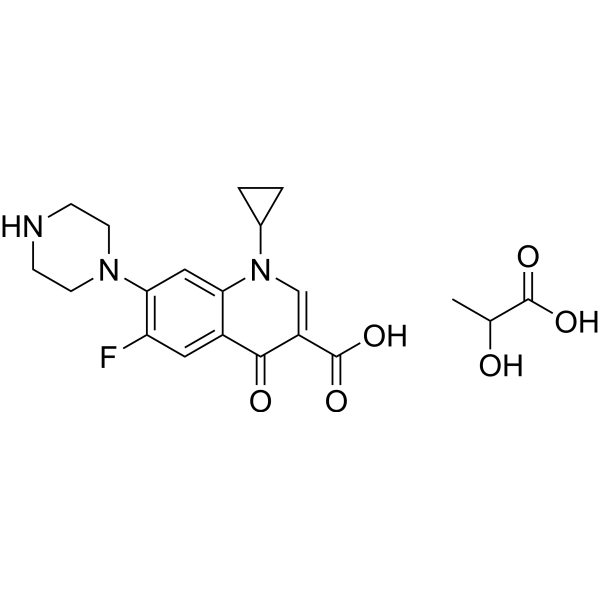
Physicochemical Properties
| Molecular Formula | C20H24FN3O6 |
| Molecular Weight | 421.4195 |
| Exact Mass | 403.154 |
| CAS # | 97867-33-9 |
| Related CAS # | Ciprofloxacin;85721-33-1 |
| PubChem CID | 149514 |
| Appearance | Typically exists as solid at room temperature |
| Density | 1.4±0.1 g/cm3 |
| Boiling Point | 656.4±55.0 °C at 760 mmHg |
| Melting Point | 255-257ºC |
| Flash Point | 350.8±31.5 °C |
| Vapour Pressure | 0.0±2.1 mmHg at 25°C |
| Index of Refraction | 1.624 |
| LogP | 0.04 |
| Hydrogen Bond Donor Count | 4 |
| Hydrogen Bond Acceptor Count | 10 |
| Rotatable Bond Count | 4 |
| Heavy Atom Count | 30 |
| Complexity | 631 |
| Defined Atom Stereocenter Count | 0 |
| SMILES | O=C(C1C(=O)C2C(=CC(N3CCNCC3)=C(C=2)F)N(C2CC2)C=1)O.O=C(C(C)O)O |
| InChi Key | NRBJWZSFNGZBFQ-UHFFFAOYSA-N |
| InChi Code | InChI=1S/C17H18FN3O3.C3H6O3/c18-13-7-11-14(8-15(13)20-5-3-19-4-6-20)21(10-1-2-10)9-12(16(11)22)17(23)24;1-2(4)3(5)6/h7-10,19H,1-6H2,(H,23,24);2,4H,1H3,(H,5,6) |
| Chemical Name | 1-cyclopropyl-6-fluoro-4-oxo-7-piperazin-1-ylquinoline-3-carboxylic acid;2-hydroxypropanoic acid |
| HS Tariff Code | 2934.99.9001 |
| Storage |
Powder-20°C 3 years 4°C 2 years In solvent -80°C 6 months -20°C 1 month |
| Shipping Condition | Room temperature (This product is stable at ambient temperature for a few days during ordinary shipping and time spent in Customs) |
Biological Activity
| ln Vitro | Ciprofloxacin (Bay-09867) Lactate (5-50 μg/mL; 0-24 hours; tenocytes) induces cell cycle arrest in the G2/M phase and suppresses cell division [1]. Yersinia pestis and Bacillus anthracis are effectively inhibited by ciprofloxacin lactate (Bay-09867), with MIC90s of 0.03 μg/mL and 0.12 μg/mL, respectively [2]. |
| ln Vivo | In a mouse model of pneumonic plague, ciprofloxacin lactate (Bay-09867) (30 mg/kg; i.p.; 24 hours; BALB/c mice) is protective against Y. pestis [3]. By lowering LOX levels and raising MMP levels and activity, ciprofloxacin lactate (Bay-09867) (100 mg/kg; ig; daily for 4 weeks; C57BL/6J mice) enhances and speeds up aortic root enlargement. The frequency of aortic wall rupture and arterial dissection [4]. Ciprofloxacin (Bay-09867) Lactate (100 mg/kg; ir; daily for 4 weeks; C57BL/6J mice) causes mitochondrial malfunction, activation of cytoplasmic DNA sensor signaling, and DNA damage and release into the cytoplasm. Apoptosis and necroptosis in the aorta wall are increased by ciprofloxacin lactate [4]. |
| Cell Assay |
Cell Cycle Analysis[1] Cell Types: Tenocytes Tested Concentrations: 5, 10, 20 and 50 μg/mL Incubation Duration: 24 hrs (hours) Experimental Results: diminished cellularity of tenocytes. Apoptosis analysis [1] Cell Types: Tenocytes Tested Concentrations: 50 μg/mL Incubation Duration: 24 hrs (hours) Experimental Results: The cell cycle was arrested in the G2/M phase and inhibited cell division of tenocytes. Western Blot Analysis [1] Cell Types: tenocytes Tested Concentrations: 50 μg/mL Incubation Duration: 0, 6, 12, 17 and 24 hrs (hours) Experimental Results: Down-regulated the expression of CDK-1 and cyclin B protein and mRNA. Upregulates the expression of PLK-1 protein. |
| Animal Protocol |
Animal/Disease Models: balb/c (Bagg ALBino) mouse [3] Doses: 30 mg/kg Route of Administration: intraperitoneal (ip) injection; 24-hour Experimental Results: diminished the bacterial load in the lungs of the plague mouse model. Animal/Disease Models: C57BL/6J mice [4] Doses: 100 mg/kg Route of Administration: po (oral gavage); one time/day for 4 weeks Experimental Results: The aorta was destroyed, accompanied by diminished LOX expression and MMP expression and activity Increase. Animal/Disease Models: C57BL/6J mice [4] Doses: 100 mg/kg Route of Administration: po (oral gavage); one time/day for 4 weeks Experimental Results: Causes mitochondrial DNA and nuclear DNA damage, leading to mitochondrial dysfunction and ROS production. Increased aortic wall cell apoptosis and necroptosis. |
| Toxicity/Toxicokinetics |
Effects During Pregnancy and Lactation ◉ Summary of Use during Lactation Amounts of ciprofloxacin in breastmilk are low. Fluoroquinolones such as ciprofloxacin have traditionally not been used in infants because of concern about adverse effects on the infants' developing joints. However, studies indicate little risk. The calcium in milk might decrease absorption of the small amounts of fluoroquinolones in milk, but insufficient data exist to prove or disprove this assertion. Use of ciprofloxacin is acceptable in nursing mothers with monitoring of the infant for possible effects on the gastrointestinal flora, such as diarrhea or candidiasis (thrush, diaper rash). Avoiding breastfeeding for 3 to 4 hours after a dose should decrease the exposure of the infant to ciprofloxacin in breastmilk. Maternal use of an ear drop or eye drop that contains ciprofloxacin presents negligible risk for the nursing infant. To substantially diminish the amount of drug that reaches the breastmilk after using eye drops, place pressure over the tear duct by the corner of the eye for 1 minute or more, then remove the excess solution with an absorbent tissue. ◉ Effects in Breastfed Infants A case of pseudomembranous colitis in a 2-month-old breastfed infant with a history of necrotizing enterocolitis was probably caused by maternal self-treatment with ciprofloxacin. Ciprofloxacin was used as part of multi-drug regimens to treat three pregnant women with multidrug-resistant tuberculosis throughout pregnancy and postpartum. Their three infants were breastfed (extent and duration not stated). At age 1.25, 1.8 and 3.9 years, the children were developing normally except for one who had failure to thrive, possibly due to tuberculosis contracted after birth. ◉ Effects on Lactation and Breastmilk Relevant published information was not found as of the revision date. |
| References |
[1]. Ciprofloxacin-mediated cell proliferation inhibition and G2/M cell cycle arrest in rat tendon cells. Arthritis Rheum. 2008 Jun;58(6):1657-63. [2]. In Vitro and In Vivo Activity of Omadacycline against Two Biothreat Pathogens, Bacillus anthracis and Yersinia pestis. Antimicrob Agents Chemother. 2017 Apr 24;61(5):e02434-16. [3]. Inhaled Liposomal Ciprofloxacin Protects against a Lethal Infection in a Murine Model of Pneumonic Plague. Front Microbiol. 2017 Feb 6;8:91. [4]. Effect of Ciprofloxacin on Susceptibility to Aortic Dissection and Rupture in Mice. JAMA Surg. 2018 Sep 1;153(9):e181804. |
Solubility Data
| Solubility (In Vitro) | May dissolve in DMSO (in most cases), if not, try other solvents such as H2O, Ethanol, or DMF with a minute amount of products to avoid loss of samples |
| Solubility (In Vivo) |
Note: Listed below are some common formulations that may be used to formulate products with low water solubility (e.g. < 1 mg/mL), you may test these formulations using a minute amount of products to avoid loss of samples. Injection Formulations (e.g. IP/IV/IM/SC) Injection Formulation 1: DMSO : Tween 80: Saline = 10 : 5 : 85 (i.e. 100 μL DMSO stock solution → 50 μL Tween 80 → 850 μL Saline) *Preparation of saline: Dissolve 0.9 g of sodium chloride in 100 mL ddH ₂ O to obtain a clear solution. Injection Formulation 2: DMSO : PEG300 :Tween 80 : Saline = 10 : 40 : 5 : 45 (i.e. 100 μL DMSO → 400 μLPEG300 → 50 μL Tween 80 → 450 μL Saline) Injection Formulation 3: DMSO : Corn oil = 10 : 90 (i.e. 100 μL DMSO → 900 μL Corn oil) Example: Take the Injection Formulation 3 (DMSO : Corn oil = 10 : 90) as an example, if 1 mL of 2.5 mg/mL working solution is to be prepared, you can take 100 μL 25 mg/mL DMSO stock solution and add to 900 μL corn oil, mix well to obtain a clear or suspension solution (2.5 mg/mL, ready for use in animals). Injection Formulation 4: DMSO : 20% SBE-β-CD in saline = 10 : 90 [i.e. 100 μL DMSO → 900 μL (20% SBE-β-CD in saline)] *Preparation of 20% SBE-β-CD in Saline (4°C,1 week): Dissolve 2 g SBE-β-CD in 10 mL saline to obtain a clear solution. Injection Formulation 5: 2-Hydroxypropyl-β-cyclodextrin : Saline = 50 : 50 (i.e. 500 μL 2-Hydroxypropyl-β-cyclodextrin → 500 μL Saline) Injection Formulation 6: DMSO : PEG300 : castor oil : Saline = 5 : 10 : 20 : 65 (i.e. 50 μL DMSO → 100 μLPEG300 → 200 μL castor oil → 650 μL Saline) Injection Formulation 7: Ethanol : Cremophor : Saline = 10: 10 : 80 (i.e. 100 μL Ethanol → 100 μL Cremophor → 800 μL Saline) Injection Formulation 8: Dissolve in Cremophor/Ethanol (50 : 50), then diluted by Saline Injection Formulation 9: EtOH : Corn oil = 10 : 90 (i.e. 100 μL EtOH → 900 μL Corn oil) Injection Formulation 10: EtOH : PEG300:Tween 80 : Saline = 10 : 40 : 5 : 45 (i.e. 100 μL EtOH → 400 μLPEG300 → 50 μL Tween 80 → 450 μL Saline) Oral Formulations Oral Formulation 1: Suspend in 0.5% CMC Na (carboxymethylcellulose sodium) Oral Formulation 2: Suspend in 0.5% Carboxymethyl cellulose Example: Take the Oral Formulation 1 (Suspend in 0.5% CMC Na) as an example, if 100 mL of 2.5 mg/mL working solution is to be prepared, you can first prepare 0.5% CMC Na solution by measuring 0.5 g CMC Na and dissolve it in 100 mL ddH2O to obtain a clear solution; then add 250 mg of the product to 100 mL 0.5% CMC Na solution, to make the suspension solution (2.5 mg/mL, ready for use in animals). Oral Formulation 3: Dissolved in PEG400 Oral Formulation 4: Suspend in 0.2% Carboxymethyl cellulose Oral Formulation 5: Dissolve in 0.25% Tween 80 and 0.5% Carboxymethyl cellulose Oral Formulation 6: Mixing with food powders Note: Please be aware that the above formulations are for reference only. InvivoChem strongly recommends customers to read literature methods/protocols carefully before determining which formulation you should use for in vivo studies, as different compounds have different solubility properties and have to be formulated differently. (Please use freshly prepared in vivo formulations for optimal results.) |
| Preparing Stock Solutions | 1 mg | 5 mg | 10 mg | |
| 1 mM | 2.3729 mL | 11.8646 mL | 23.7293 mL | |
| 5 mM | 0.4746 mL | 2.3729 mL | 4.7459 mL | |
| 10 mM | 0.2373 mL | 1.1865 mL | 2.3729 mL |