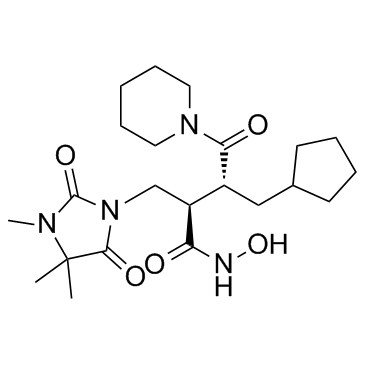
Cipemastat (Ro-32 3555; Ro323555) is a novel and potent inhibitor of collagenases and matrix metalloproteinase-1 with anti-arthritis activity. It inhibits human collagenases 1, 2 and 3 with Kis of 3.0, 4.4 and 3.4 nM, respectively.
Physicochemical Properties
| Molecular Formula | C₂₂H₃₆N₄O₅ |
| Molecular Weight | 436.55 |
| Exact Mass | 436.268 |
| CAS # | 190648-49-8 |
| PubChem CID | 9824350 |
| Appearance | Off-white to light yellow solid powder |
| Density | 1.2±0.1 g/cm3 |
| Index of Refraction | 1.541 |
| LogP | 1.38 |
| Hydrogen Bond Donor Count | 2 |
| Hydrogen Bond Acceptor Count | 5 |
| Rotatable Bond Count | 7 |
| Heavy Atom Count | 31 |
| Complexity | 713 |
| Defined Atom Stereocenter Count | 2 |
| SMILES | CC1(C(=O)N(C(=O)N1C)C[C@@H]([C@@H](CC2CCCC2)C(=O)N3CCCCC3)C(=O)NO)C |
| InChi Key | GFUITADOEPNRML-SJORKVTESA-N |
| InChi Code | InChI=1S/C22H36N4O5/c1-22(2)20(29)26(21(30)24(22)3)14-17(18(27)23-31)16(13-15-9-5-6-10-15)19(28)25-11-7-4-8-12-25/h15-17,31H,4-14H2,1-3H3,(H,23,27)/t16-,17+/m1/s1 |
| Chemical Name | (2R,3R)-3-(cyclopentylmethyl)-N-hydroxy-4-oxo-4-(piperidin-1-yl)-2-((3,4,4-trimethyl-2,5-dioxoimidazolidin-1-yl)methyl)butanamide |
| Synonyms | Ro 32-3555 Cipemastat Ro32-3555 Ro-32 3555 Ro-323555 |
| HS Tariff Code | 2934.99.9001 |
| Storage |
Powder-20°C 3 years 4°C 2 years In solvent -80°C 6 months -20°C 1 month |
| Shipping Condition | Room temperature (This product is stable at ambient temperature for a few days during ordinary shipping and time spent in Customs) |
Biological Activity
| ln Vitro | Human matrix metalloproteinases are effectively and competitively inhibited by cipemastat (Ro 32-3555). Comparing Cipemastat to comparable matrix metalloproteinases, it is selective for collagenase 1, 2, and 3. Additionally, rat collagenase exhibits strong inhibition from dipemastat (IC50=44.7±3.4 nM (n=4)). cartilage degradation +/- did not act cytotoxically on explant chondrocytes; rather, it reduced IL-1a-induced cartilage degradation in vitro in a concentration-dependent manner with an IC50=60 nM. Compared to explants cultivated in the presence of IL-La alone, cipemastat fails to alter glucose consumption at any of the tested concentrations[1]. |
| ln Vivo | Over the course of fourteen days, the amount of hydroxyproline in cartilage implanted in animals given a vehicle dose drops to 53.6±7.1 nM/mg from 119.3±4.2 nM/mg in non-implanted cartilage. Oral Cipemastat doses of 2.5, 5, 10, and 25 mg/kg resulted in statistically higher levels of implanted cartilage hydroxyproline in the animals. The lateral femoral condyle, which is the area under analysis, is the cartilage region most frequently damaged by pannus 14 days following the second challenge injection of P. acnes. The average cartilage area in non-arthritic animals is 0.17±0.02 mm2 (n=5). There is a considerable drop to a mean area of 0.086±0.01 mm2 (n=10) in animals with arthritis. With a mean value of 0.126±0.012 mm2 (n=9), the group of mice dosed with Cipemastat (50 mg/kg, po) exhibits a considerably larger cartilage area. Animals given a vehicle dose had a pannus area of 0.099±0.017 mm2, while those given cipemastat have a pannus area of 0.102±0.019 mm2. Rats given a vehicle dosage experienced two stages of paw edema following adjuvant arthritis injection. The initial phase of swelling happened from day 0 to day 5, increasing the volume of the paws by 1.9±0.1 mL; the second phase took place from day 9 to day 14, increasing the volume of the paws by 0.98±0.08 mL. The rats administered with 0.1 mg/kg of dexamethasone exhibit a noteworthy decrease in main (0.2±0.03 mL) and secondary (0.07±0.08 mL) inflammation, paw swelling, and overall lesion score inhibition[1]. |
| References |
[1]. Ro 32-3555, an orally active collagenase inhibitor, prevents cartilage breakdown in vitro and in vivo. Br J Pharmacol. 1997 May; 121(3): 540–546. |
Solubility Data
| Solubility (In Vitro) | DMSO : ~100 mg/mL (~229.07 mM) |
| Solubility (In Vivo) |
Solubility in Formulation 1: ≥ 2.5 mg/mL (5.73 mM) (saturation unknown) in 10% DMSO + 40% PEG300 + 5% Tween80 + 45% Saline (add these co-solvents sequentially from left to right, and one by one), clear solution. For example, if 1 mL of working solution is to be prepared, you can add 100 μL of 25.0 mg/mL clear DMSO stock solution to 400 μL PEG300 and mix evenly; then add 50 μL Tween-80 to the above solution and mix evenly; then add 450 μL normal saline to adjust the volume to 1 mL. Preparation of saline: Dissolve 0.9 g of sodium chloride in 100 mL ddH₂ O to obtain a clear solution. Solubility in Formulation 2: ≥ 2.5 mg/mL (5.73 mM) (saturation unknown) in 10% DMSO + 90% (20% SBE-β-CD in Saline) (add these co-solvents sequentially from left to right, and one by one), clear solution. For example, if 1 mL of working solution is to be prepared, you can add 100 μL of 25.0 mg/mL clear DMSO stock solution to 900 μL of 20% SBE-β-CD physiological saline solution and mix evenly. Preparation of 20% SBE-β-CD in Saline (4°C,1 week): Dissolve 2 g SBE-β-CD in 10 mL saline to obtain a clear solution. Solubility in Formulation 3: ≥ 2.5 mg/mL (5.73 mM) (saturation unknown) in 10% DMSO + 90% Corn Oil (add these co-solvents sequentially from left to right, and one by one), clear solution. For example, if 1 mL of working solution is to be prepared, you can add 100 μL of 25.0 mg/mL clear DMSO stock solution to 900 μL of corn oil and mix evenly. (Please use freshly prepared in vivo formulations for optimal results.) |
| Preparing Stock Solutions | 1 mg | 5 mg | 10 mg | |
| 1 mM | 2.2907 mL | 11.4534 mL | 22.9069 mL | |
| 5 mM | 0.4581 mL | 2.2907 mL | 4.5814 mL | |
| 10 mM | 0.2291 mL | 1.1453 mL | 2.2907 mL |