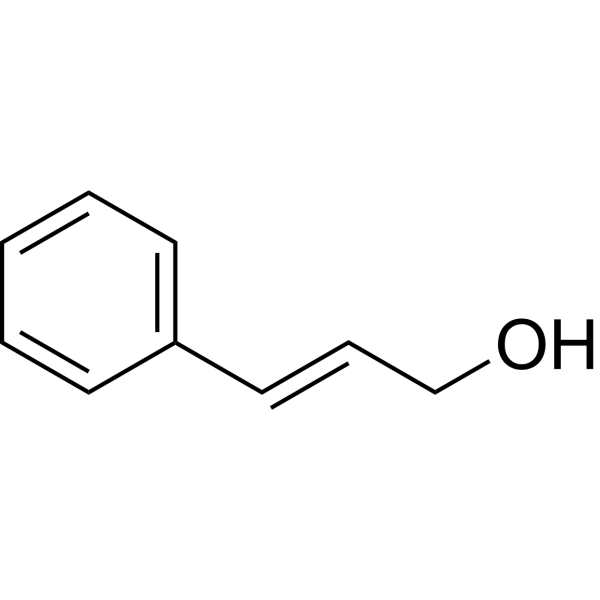
Physicochemical Properties
| Molecular Formula | C9H10O |
| Molecular Weight | 134.1751 |
| Exact Mass | 134.073 |
| CAS # | 104-54-1 |
| PubChem CID | 5315892 |
| Appearance | White to light yellow <30°C powder,>33°C liquid |
| Density | 1.0±0.1 g/cm3 |
| Boiling Point | 250.0±0.0 °C at 760 mmHg |
| Melting Point | 30-33 °C(lit.) |
| Flash Point | 124.8±14.5 °C |
| Vapour Pressure | 0.0±0.5 mmHg at 25°C |
| Index of Refraction | 1.599 |
| LogP | 1.7 |
| Hydrogen Bond Donor Count | 1 |
| Hydrogen Bond Acceptor Count | 1 |
| Rotatable Bond Count | 2 |
| Heavy Atom Count | 10 |
| Complexity | 101 |
| Defined Atom Stereocenter Count | 0 |
| SMILES | C1=CC=C(C=C1)/C=C/CO |
| InChi Key | OOCCDEMITAIZTP-QPJJXVBHSA-N |
| InChi Code | InChI=1S/C9H10O/c10-8-4-7-9-5-2-1-3-6-9/h1-7,10H,8H2/b7-4+ |
| Chemical Name | (E)-3-phenylprop-2-en-1-ol |
| HS Tariff Code | 2934.99.9001 |
| Storage |
Powder-20°C 3 years 4°C 2 years In solvent -80°C 6 months -20°C 1 month |
| Shipping Condition | Room temperature (This product is stable at ambient temperature for a few days during ordinary shipping and time spent in Customs) |
Biological Activity
| ADME/Pharmacokinetics |
Absorption, Distribution and Excretion Cinnamyl alcohol is 66% absorbed through the skin and shown to be rapidly absorbed from the gut. Cinnamyl alcohol is metabolized and excreted primarily in the urine and, to a minor extent, in the feces. After oral or intraperitoneal administration to rats and mice, 76–77% of the dose of cinnamyl alcohol was recovered in the urine and feces within 24 h. CINNAMYL ALC IS EXCRETED UNCHANGED IN NEUTRAL EXTRACT WHEN GIVEN TO RATS. Metabolism / Metabolites In general, esters containing an aromatic ring system are expected to be hydrolyzed in vivo. Cinnamyl alcohol is hydrolyzed to [DB14184]. ACIDIC & NEUTRAL URINARY METABOLITE OF CINNAMYL ALC WAS IDENTIFIED THROUGH A COMMON METABOLIC SCHEME. Cinnamyl alcohol is a known human metabolite of beta-methylstyrene. |
| References |
[1]. Cinnamyl Alcohol, the Bioactive Component of Chestnut Flower Absolute, Inhibits Adipocyte Differentiation in 3T3-L1 Cells by Downregulating Adipogenic Transcription Factors. Am J Chin Med. 2017;45(4):833-846. |
| Additional Infomation |
Cinnamyl alcohol is a primary alcohol comprising an allyl core with a hydroxy substituent at the 1-position and a phenyl substituent at the 3-position (geometry of the C=C bond unspecified). It has a role as a plant metabolite. Cinnamyl alcohol is a naturally occurring compound that is found within cinnamon. Due to the low levels found in cinnamon, cinnamyl alcohol is usually supplied as [DB14184] within commercial products. Cinnamyl alcohol has been shown to be a skin sensitizer, with a NOEL (No Effect Level) of ~4%. Sensitivity to cinnamyl alcohol may be identified with a clinical patch test. Cinnamyl alcohol is a Standardized Chemical Allergen. The physiologic effect of cinnamyl alcohol is by means of Increased Histamine Release, and Cell-mediated Immunity. Cinnamyl alcohol has been reported in Rhodiola sachalinensis, Cryptocarya amygdalina, and other organisms with data available. See also: Cinnamon (part of); Chinese Cinnamon (part of); Cinnamomum cassia twig (part of). Drug Indication Cinnamyl alcohol is approved by the FDA for use within allergenic epicutaneous patch tests which are indicated for use as an aid in the diagnosis of allergic contact dermatitis (ACD) in persons 6 years of age and older. |
Solubility Data
| Solubility (In Vitro) |
DMSO : ~250 mg/mL (~1863.17 mM) H2O : ~100 mg/mL (~745.27 mM) |
| Solubility (In Vivo) |
Solubility in Formulation 1: ≥ 6.25 mg/mL (46.58 mM) (saturation unknown) in 10% DMSO + 40% PEG300 + 5% Tween80 + 45% Saline (add these co-solvents sequentially from left to right, and one by one), clear solution. For example, if 1 mL of working solution is to be prepared, you can add 100 μL of 62.5 mg/mL clear DMSO stock solution to 400 μL PEG300 and mix evenly; then add 50 μL Tween-80 to the above solution and mix evenly; then add 450 μL normal saline to adjust the volume to 1 mL. Preparation of saline: Dissolve 0.9 g of sodium chloride in 100 mL ddH₂ O to obtain a clear solution. Solubility in Formulation 2: ≥ 6.25 mg/mL (46.58 mM) (saturation unknown) in 10% DMSO + 90% (20% SBE-β-CD in Saline) (add these co-solvents sequentially from left to right, and one by one), clear solution. For example, if 1 mL of working solution is to be prepared, you can add 100 μL of 62.5 mg/mL clear DMSO stock solution to 900 μL of 20% SBE-β-CD physiological saline solution and mix evenly. Preparation of 20% SBE-β-CD in Saline (4°C,1 week): Dissolve 2 g SBE-β-CD in 10 mL saline to obtain a clear solution. Solubility in Formulation 3: ≥ 6.25 mg/mL (46.58 mM) (saturation unknown) in 10% DMSO + 90% Corn Oil (add these co-solvents sequentially from left to right, and one by one), clear solution. For example, if 1 mL of working solution is to be prepared, you can add 100 μL of 62.5 mg/mL clear DMSO stock solution to 900 μL corn oil and mix evenly. (Please use freshly prepared in vivo formulations for optimal results.) |
| Preparing Stock Solutions | 1 mg | 5 mg | 10 mg | |
| 1 mM | 7.4527 mL | 37.2634 mL | 74.5268 mL | |
| 5 mM | 1.4905 mL | 7.4527 mL | 14.9054 mL | |
| 10 mM | 0.7453 mL | 3.7263 mL | 7.4527 mL |