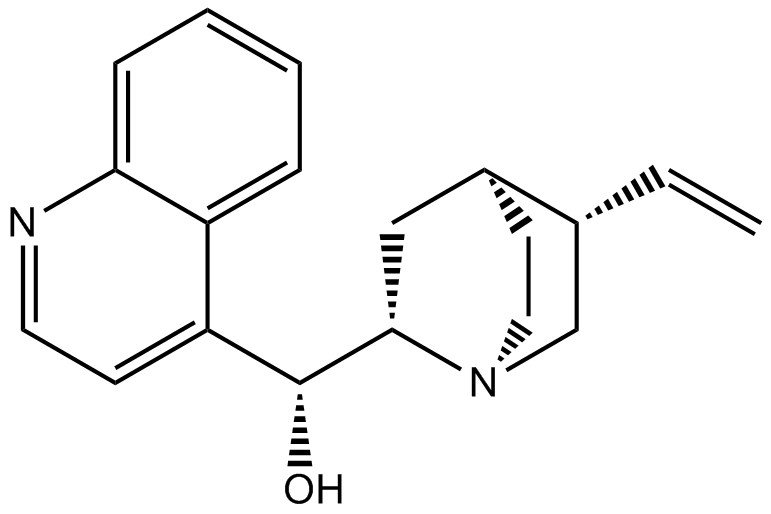
Physicochemical Properties
| Molecular Formula | C19H22N2O | |
| Molecular Weight | 294.39 | |
| Exact Mass | 294.173 | |
| CAS # | 485-71-2 | |
| Related CAS # | 485-71-2;524-54-9 (2HCl);524-57-2 (HCl);524-61-8 (sulfate); | |
| PubChem CID | 101744 | |
| Appearance | White to off-white solid powder | |
| Density | 1.2±0.1 g/cm3 | |
| Boiling Point | 464.5±30.0 °C at 760 mmHg | |
| Melting Point | 204-206ºC | |
| Flash Point | 234.7±24.6 °C | |
| Vapour Pressure | 0.0±1.2 mmHg at 25°C | |
| Index of Refraction | 1.652 | |
| LogP | 3.35 | |
| Hydrogen Bond Donor Count | 1 | |
| Hydrogen Bond Acceptor Count | 3 | |
| Rotatable Bond Count | 3 | |
| Heavy Atom Count | 22 | |
| Complexity | 412 | |
| Defined Atom Stereocenter Count | 4 | |
| SMILES | C=C[C@H]1CN2CC[C@H]1C[C@H]2[C@@H](C3=CC=NC4=CC=CC=C34)O |
|
| InChi Key | KMPWYEUPVWOPIM-KODHJQJWSA-N | |
| InChi Code | InChI=1S/C19H22N2O/c1-2-13-12-21-10-8-14(13)11-18(21)19(22)16-7-9-20-17-6-4-3-5-15(16)17/h2-7,9,13-14,18-19,22H,1,8,10-12H2/t13-,14-,18-,19+/m0/s1 | |
| Chemical Name | (R)-quinolin-4-yl((1S,2S,4S,5R)-5-vinylquinuclidin-2-yl)methanol | |
| Synonyms |
|
|
| HS Tariff Code | 2934.99.9001 | |
| Storage |
Powder-20°C 3 years 4°C 2 years In solvent -80°C 6 months -20°C 1 month Note: (1). This product requires protection from light (avoid light exposure) during transportation and storage.(2). Please store this product in a sealed and protected environment (e.g. under nitrogen), avoid exposure to moisture. |
|
| Shipping Condition | Room temperature (This product is stable at ambient temperature for a few days during ordinary shipping and time spent in Customs) |
Biological Activity
| Targets |
Serotonin Transporter (SERT, human) (Ki = 1.6 ± 0.2 μM) [1] |
| ln Vitro |
Gongronema latifolium and Cinchona contain the cinchoni alkaloid cinchonidine (α-Quinidine). Building blocks for organic chemistry's asymmetric synthesis. Serotonin transporter (SERT) weak inhibitors: 330, 4.2, 36, 196, and 15 μM for dSERT, hSERT, hSERT I172M, hSERT S438T, and hSERT Y95F, respectively [1]. Cinchonidine exhibited stereoselective inhibitory activity against the human serotonin transporter (SERT). It competitively inhibited the uptake of [³H]-serotonin into HEK293 cells stably expressing human SERT, with a Ki value of 1.6 ± 0.2 μM. This affinity was significantly higher than that of its enantiomer, cinchonine (Ki = 3.8 ± 0.5 μM). The inhibition was concentration-dependent, with no significant cross-reactivity against dopamine transporters (DAT) or norepinephrine transporters (NET) at concentrations up to 10 μM [1] |
| Enzyme Assay |
Radioligand binding assay: Membrane preparations from HEK293 cells expressing human SERT were incubated with [³H]-paroxetine (a selective SERT ligand) and increasing concentrations of Cinchonidine at 25°C for 60 minutes. Non-specific binding was determined in the presence of excess unlabeled paroxetine. Bound radioactivity was separated by vacuum filtration and quantified using a scintillation counter, and Ki values were calculated via nonlinear regression analysis of competition binding curves [1] - Serotonin uptake assay: HEK293-SERT cells were seeded in 24-well plates and preincubated with Cinchonidine for 15 minutes at 37°C in a CO₂ incubator. [³H]-serotonin was then added to each well at a final concentration of 50 nM, and the incubation continued for 10 minutes. The uptake reaction was terminated by washing the cells twice with ice-cold buffer. Cells were lysed, and intracellular radioactivity was measured by scintillation counting to assess the inhibitory effect of Cinchonidine on SERT-mediated serotonin transport [1] |
| References |
[1]. Stereoselective inhibition of serotonin transporters by antimalarial compounds. Neurochem Int. 2014 Jul;73:98-106. |
| Additional Infomation |
Cinchonidine is 8-epi-Cinchonan in which a hydrogen at position 9 is substituted by hydroxy (R configuration). A diasteroisomer of cinchonine, it occurs in the bark of most varieties of Cinchona shrubs, and is frequently used for directing chirality in asymmetric synthesis. It has a role as a metabolite. It is a cinchona alkaloid and an (8xi)-cinchonan-9-ol. It derives from a hydride of an (8S)-cinchonan. Cinchonidine has been reported in Cinchona calisaya, Cinchona, and other organisms with data available. Cinchonidine is a naturally occurring quinoline alkaloid isolated from Cinchona bark, with well-documented antimalarial activity. This study identifies it as a stereoselective inhibitor of SERT, a key target for modulating serotonergic neurotransmission. The competitive binding mode to SERT suggests potential applications in neurological disorders involving serotonin dysregulation, beyond its established antimalarial use [1] |
Solubility Data
| Solubility (In Vitro) |
|
|||
| Solubility (In Vivo) |
Solubility in Formulation 1: ≥ 2.5 mg/mL (8.49 mM) (saturation unknown) in 10% DMSO + 40% PEG300 + 5% Tween80 + 45% Saline (add these co-solvents sequentially from left to right, and one by one), clear solution. For example, if 1 mL of working solution is to be prepared, you can add 100 μL of 25.0 mg/mL clear DMSO stock solution to 400 μL PEG300 and mix evenly; then add 50 μL Tween-80 to the above solution and mix evenly; then add 450 μL normal saline to adjust the volume to 1 mL. Preparation of saline: Dissolve 0.9 g of sodium chloride in 100 mL ddH₂ O to obtain a clear solution. Solubility in Formulation 2: ≥ 2.5 mg/mL (8.49 mM) (saturation unknown) in 10% DMSO + 90% (20% SBE-β-CD in Saline) (add these co-solvents sequentially from left to right, and one by one), clear solution. For example, if 1 mL of working solution is to be prepared, you can add 100 μL of 25.0 mg/mL clear DMSO stock solution to 900 μL of 20% SBE-β-CD physiological saline solution and mix evenly. Preparation of 20% SBE-β-CD in Saline (4°C,1 week): Dissolve 2 g SBE-β-CD in 10 mL saline to obtain a clear solution. Solubility in Formulation 3: ≥ 2.5 mg/mL (8.49 mM) (saturation unknown) in 10% DMSO + 90% Corn Oil (add these co-solvents sequentially from left to right, and one by one), clear solution. For example, if 1 mL of working solution is to be prepared, you can add 100 μL of 25.0 mg/mL clear DMSO stock solution to 900 μL of corn oil and mix evenly. (Please use freshly prepared in vivo formulations for optimal results.) |
| Preparing Stock Solutions | 1 mg | 5 mg | 10 mg | |
| 1 mM | 3.3969 mL | 16.9843 mL | 33.9685 mL | |
| 5 mM | 0.6794 mL | 3.3969 mL | 6.7937 mL | |
| 10 mM | 0.3397 mL | 1.6984 mL | 3.3969 mL |