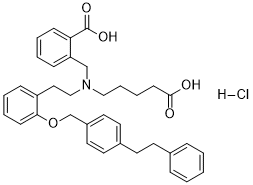
Cinaciguat HCl, the hydrochloride salt of Cinaciguat (formerly also known as BAY582667 or BAY58-2667), is a novel and potent activator of soluble guanylate cyclase (sGC) used for acute decompensated heart failure. In a rat model of type-1 diabetes mellitus, ciprofloxacin avoids cardiac dysfunction. Cinaciguat has no direct effects on the relaxation and contractility of cardiac myocytes from rats that are normal. By reducing the migration and proliferation of vascular smooth muscle cells following arterial injury, cipracapat inhibits the formation of neointima.
Physicochemical Properties
| Molecular Formula | C36H40CLNO5 |
| Molecular Weight | 602.1595 |
| Exact Mass | 601.259 |
| Elemental Analysis | C, 71.81; H, 6.70; Cl, 5.89; N, 2.33; O, 13.28 |
| CAS # | 646995-35-9 |
| Related CAS # | Cinaciguat; 329773-35-5 |
| PubChem CID | 10031513 |
| Appearance | White to off-white solid powder |
| Hydrogen Bond Donor Count | 3 |
| Hydrogen Bond Acceptor Count | 6 |
| Rotatable Bond Count | 17 |
| Heavy Atom Count | 43 |
| Complexity | 767 |
| Defined Atom Stereocenter Count | 0 |
| SMILES | Cl[H].O(C([H])([H])C1C([H])=C([H])C(=C([H])C=1[H])C([H])([H])C([H])([H])C1C([H])=C([H])C([H])=C([H])C=1[H])C1=C([H])C([H])=C([H])C([H])=C1C([H])([H])C([H])([H])N(C([H])([H])C1=C([H])C([H])=C([H])C([H])=C1C(=O)O[H])C([H])([H])C([H])([H])C([H])([H])C([H])([H])C(=O)O[H] |
| InChi Key | LLHMBJOVHATVSP-UHFFFAOYSA-N |
| InChi Code | InChI=1S/C36H39NO5.ClH/c38-35(39)12-6-7-24-37(26-30-19-21-33(22-20-30)36(40)41)25-23-32-10-4-5-11-34(32)42-27-31-17-15-29(16-18-31)14-13-28-8-2-1-3-9-28;/h1-5,8-11,15-22H,6-7,12-14,23-27H2,(H,38,39)(H,40,41);1H |
| Chemical Name | 4-[[4-carboxybutyl-[2-[2-[[4-(2-phenylethyl)phenyl]methoxy]phenyl]ethyl]amino]methyl]benzoic acid;hydrochloride |
| Synonyms | BAY 582667 HCl; BAY-582667 HCl; BAY582667 HCl; BAY 58-2667; BAY-58-2667; BAY58-2667; Cinaciguat HCl; Cinaciguat hydrochloride; |
| HS Tariff Code | 2934.99.9001 |
| Storage |
Powder-20°C 3 years 4°C 2 years In solvent -80°C 6 months -20°C 1 month Note: Please store this product in a sealed and protected environment, avoid exposure to moisture. |
| Shipping Condition | Room temperature (This product is stable at ambient temperature for a few days during ordinary shipping and time spent in Customs) |
Biological Activity
| Targets | Guanylate cyclase ( EC50 = 15 nM ) |
| ln Vitro | In the intermittent setting, cinaciguat hydrochloride (BAY 58-2667) is a potent GC activator (EC50 15 nM), but the maximum effect is around 1% of NO. The concentration response curve of cinaciguat hydrochloride in the presence of sildenafil in the absence of ODQ, with an EC50 of 18 nM, and in the presence of ODQ, there was no significant difference in the efficacy of cinaciguat hydrochloride, with an EC50 of 13 nM. The efficacy of cinaguat hydrochloride in the distal end (EC50 15 nM) was very similar to the estimate achieved for sealed recombinant GC. Cinaciguat hydrochloride at a maximum effective concentration of 1 μM stimulated control GC activity to approximately 25% of the activity observed with NO, and compared with stimulation with NO, this activity remained at lower levels as the proportion of ODQ-cut GC increased. Change[1]. |
| ln Vivo | Administration of cinaguat hydrochloride reduced blood pressure and increased heart rate in apo-sGC and WT mice. The antihypertensive effect of cinagua hydrochloride was more significant and longer-lasting in apo-sGC mice than in WT mice. In addition, cinagua hydrochloride reduced blood pressure in apo-sGC mice at a concentration that did not affect blood glucose in WT mice. In addition, the IC50 value of cinagua hydrochloride-induced ex vivo contraction of precontracted aortas was threefold lower in apo-sGC mice than in WT mice (IC50=0.2 nM and 0.7 nM, respectively). In summary, our results indicate that sGC activators like Cinaciguat hydrochloride activate apo-sGC as well as sGC stimulators like BAY 41-2272. Additionally, the observation that cinaciguat hydrochloride modulates vasodilation and blood pressure in WT mice suggests that even in healthy mice, a subset of the available sGC pool clears heme and is responsive to sGC activators [2]. |
| Enzyme Assay | Platelet suspension aliquots are taken out prior to and periodically following the addition of spermine NONOate or Cinaciguat. They are then promptly transferred into an inactivation buffer (50 mM Tris, 4 mM EDTA, pH 7.4) and kept at 100°C for a minimum of 10 minutes. When using, add 10 μM ODQ to the platelets 15 minutes prior to adding spermine NONOate. After being stimulated with either DEA/NO (10 μM) or Cinaciguat (1 μM), and with enzyme inactivation carried out as with platelets, purified GC activity is measured at a final concentration of 50 ng/mL in assay buffer (50 mM Tris, 100 μM EDTA, 1 mM NaGTP, 1.3 mM MgCl2, 50 μg/mL BSA, pH 7.4). Through the use of radioimmunoassay, the levels of cGMP are determined and expressed in relation to protein content. Each experiment consists of three independent runs, with the results shown as means±s.e.mean[1]. |
| Animal Protocol | Mice: The tail tip of 12 week old male and female mice is removed with a sharp razor blade, leaving 0.5 cm of tail tip exposed. The tail tip is then placed into freshly prepared, 37°C pre-warmed PBS. By using a chronometer and visual scoring, an observer who is blind to the genotype records the latency until the tail stops bleeding. With an awake mouse tail-cuff method, Hatteras MC4000 Blood Pressure Analysis System measures systolic blood pressure (SBP) and heart rate (HR) non-invasively. The BP measuring apparatus takes seven days to acclimate mice to. Mice are measured for five days, with 15 consecutive cycles per day, in order to establish basal BP. The following are administered intraperitoneally: L-NAME (100 mg/kg), SNP (1.5 mg/kg), DETA-NO (60 mg/kg), BAY 41-2772 (4 mg/kg), Cinaciguat (30 μg/kg), and the vehicle controls (PBS or, in the case of the BAY-compounds, 20% Cremophor+20% diethylene-glycol-monoethylether in PBS). SBP measurements are taken 5 to 15 minutes after SNP injection; L-NAME and DETA-NO recordings are taken 1 to 25 minutes after injection; and BAY-compounds recordings are taken 10 to 25 minutes after injection. |
| References |
[1]. Probing the presence of the ligand-binding haem in cellular nitric oxide receptors. Br J Pharmacol. 2008 Apr;153(7):1495-504. [2]. Cardiovascular and pharmacological implications of haem-deficient NO-unresponsive soluble guanylate cyclase knock-in mice. Nat Commun. 2015 Oct 7;6:8482. |
Solubility Data
| Solubility (In Vitro) |
DMSO: ~110 mg/mL (~182.7 mM) H2O: < 0.1 mg/mL |
| Solubility (In Vivo) |
Solubility in Formulation 1: ≥ 2.75 mg/mL (4.57 mM) (saturation unknown) in 10% DMSO + 90% Corn Oil (add these co-solvents sequentially from left to right, and one by one), clear solution. For example, if 1 mL of working solution is to be prepared, you can add 100 μL of 27.5 mg/mL clear DMSO stock solution to 900 μL of corn oil and mix evenly. (Please use freshly prepared in vivo formulations for optimal results.) |
| Preparing Stock Solutions | 1 mg | 5 mg | 10 mg | |
| 1 mM | 1.6607 mL | 8.3034 mL | 16.6069 mL | |
| 5 mM | 0.3321 mL | 1.6607 mL | 3.3214 mL | |
| 10 mM | 0.1661 mL | 0.8303 mL | 1.6607 mL |