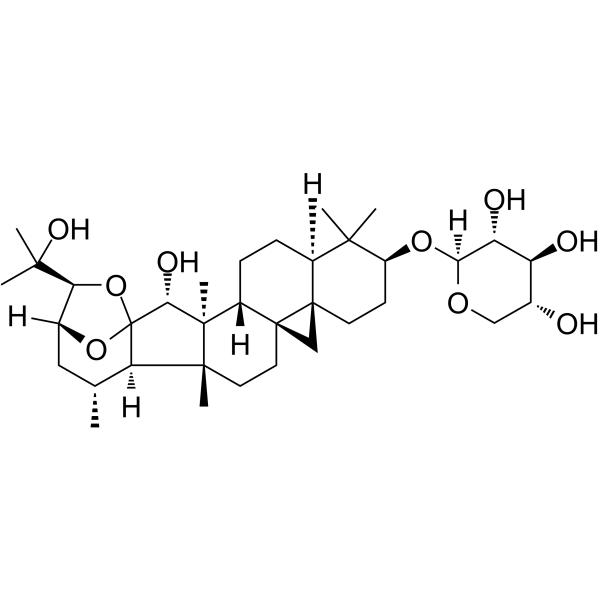
Physicochemical Properties
| Molecular Formula | C35H52O9 |
| Molecular Weight | 616.7820 |
| Exact Mass | 616.361 |
| CAS # | 27994-11-2 |
| PubChem CID | 16088242 |
| Appearance | White to off-white solid powder |
| Density | 1.4±0.1 g/cm3 |
| Index of Refraction | 1.626 |
| LogP | 6.3 |
| Hydrogen Bond Donor Count | 5 |
| Hydrogen Bond Acceptor Count | 9 |
| Rotatable Bond Count | 3 |
| Heavy Atom Count | 44 |
| Complexity | 1210 |
| Defined Atom Stereocenter Count | 17 |
| SMILES | C[C@@H]1C[C@@H]2[C@H](O[C@]3([C@H]1[C@]4(CC[C@@]56C[C@@]57CC[C@@H](C([C@@H]7CC[C@H]6[C@@]4([C@H]3O)C)(C)C)O[C@H]8[C@@H]([C@H]([C@@H](CO8)O)O)O)C)O2)C(C)(C)O |
| InChi Key | BTPYUWOBZFGKAI-XYGBCAHESA-N |
| InChi Code | InChI=1S/C35H56O9/c1-17-14-19-26(30(4,5)40)44-35(43-19)25(17)31(6)12-13-34-16-33(34)11-10-22(42-27-24(38)23(37)18(36)15-41-27)29(2,3)20(33)8-9-21(34)32(31,7)28(35)39/h17-28,36-40H,8-16H2,1-7H3/t17-,18-,19-,20+,21+,22+,23+,24-,25-,26+,27+,28-,31-,32-,33-,34+,35+/m1/s1 |
| Chemical Name | (2S,3R,4S,5R)-2-[[(1S,2R,3S,4R,7R,9S,12R,14S,17R,18R,19R,21R,22S)-2-hydroxy-22-(2-hydroxypropan-2-yl)-3,8,8,17,19-pentamethyl-23,24-dioxaheptacyclo[19.2.1.01,18.03,17.04,14.07,12.012,14]tetracosan-9-yl]oxy]oxane-3,4,5-triol |
| HS Tariff Code | 2934.99.9001 |
| Storage |
Powder-20°C 3 years 4°C 2 years In solvent -80°C 6 months -20°C 1 month Note: Please store this product in a sealed and protected environment (e.g. under nitrogen), avoid exposure to moisture and light. |
| Shipping Condition | Room temperature (This product is stable at ambient temperature for a few days during ordinary shipping and time spent in Customs) |
Biological Activity
| Targets |
- Nuclear factor-κB (NF-κB) signaling pathway [1] - Mitogen-activated protein kinase (MAPK) pathway [1] - Tumor cell proliferation-related targets [1] |
| ln Vitro |
- Cimigenoside is a triterpenoid saponin isolated from the genus Cimicifuga, with potent anti-inflammatory activity. It inhibited LPS-induced TNF-α and IL-6 secretion in RAW 264.7 macrophages by 52±4% and 48±3% at 20 μM, respectively [1] - It exhibited antiproliferative effects on various tumor cells: 50 μM Cimigenoside reduced the viability of HepG2 (hepatocellular carcinoma) and MCF-7 (breast cancer) cells by 63±5% and 57±4%, respectively, after 48-hour incubation [1] - It suppressed NF-κB and MAPK (ERK1/2, p38) phosphorylation in inflammatory cells, downregulating pro-inflammatory mediator expression [1] - It showed neuroprotective activity: 10 μM Cimigenoside improved the viability of H₂O₂-induced PC12 cells by 35±3% [1] |
| ln Vivo |
- In mouse acute inflammation model (xylene-induced ear edema): Oral administration of Cimigenoside (50 mg/kg) reduced ear edema by 58±4% compared to the control group [1] - In rat adjuvant-induced arthritis model: 30 mg/kg Cimigenoside (intraperitoneal injection, daily for 14 days) alleviated joint swelling by 45±3% and decreased serum TNF-α level by 51±4% [1] - In mouse H22 hepatoma xenograft model: 100 mg/kg Cimigenoside (oral gavage, every other day for 21 days) inhibited tumor growth by 59±5% without significant body weight loss [1] |
| Cell Assay |
- Anti-inflammatory cell assay: RAW 264.7 macrophages were seeded in 96-well plates (5×10³ cells/well), pretreated with Cimigenoside (5, 10, 20 μM) for 1 hour, then stimulated with LPS (1 μg/mL) for 24 hours. Cytokine (TNF-α, IL-6) levels in supernatants were measured by ELISA [1] - Antiproliferation assay: Tumor cells (HepG2, MCF-7) were seeded in 96-well plates (5×10³ cells/well), treated with Cimigenoside (10, 25, 50 μM) for 48 hours, and cell viability was detected by MTT assay [1] - Neuroprotection assay: PC12 cells were pretreated with Cimigenoside (5, 10, 20 μM) for 2 hours, then exposed to H₂O₂ (200 μM) for 24 hours. Cell viability was measured by CCK-8 assay [1] |
| Animal Protocol |
- Acute inflammation model: Male ICR mice (20–25 g) were randomly divided into control and Cimigenoside groups (25, 50 mg/kg, oral gavage). Xylene (20 μL) was applied to the right ear 1 hour after administration. Ear thickness was measured 4 hours later to calculate edema rate [1] - Arthritis model: Male SD rats (180–220 g) were induced with complete Freund's adjuvant (CFA) in the left hind paw. Cimigenoside (10, 30 mg/kg) was administered intraperitoneally daily from day 7 post-induction. Joint swelling was measured every 3 days [1] - Tumor xenograft model: BALB/c nude mice (4–6 weeks old) were subcutaneously inoculated with H22 hepatoma cells (5×10⁶ cells/mouse). Cimigenoside (50, 100 mg/kg) was given by oral gavage every other day for 21 days. Tumor volume and weight were recorded [1] |
| Toxicity/Toxicokinetics |
- Acute toxicity: The oral LD50 of Cimigenoside in mice was >500 mg/kg, indicating low acute toxicity [1] - Subchronic toxicity: No obvious (liver/kidney) function abnormalities or organ damage were observed in rats treated with 30 mg/kg Cimigenoside for 28 days [1] |
| References |
[1]. Traditional uses, phytochemistry, pharmacology and toxicology of the genus Cimicifuga: A review. J Ethnopharmacol. 2017 Sep 14;209:264-282. |
| Additional Infomation |
Cimigenol 3-O-beta-D-xylopyranoside is a cucurbitacin and a glycoside. It has a role as a metabolite. Cimigenoside has been reported in Actaea europaea, Actaea dahurica, and other organisms with data available. See also: Black Cohosh (part of). - Cimigenoside is a major bioactive triterpenoid saponin derived from Cimicifuga species (e.g., Cimicifuga foetida, Cimicifuga heracleifolia), which are traditionally used in Chinese medicine for treating inflammation, rheumatism, and menopausal symptoms [1] - Its core mechanisms include inhibiting NF-κB and MAPK signaling pathways to alleviate inflammation, inducing tumor cell apoptosis, and scavenging reactive oxygen species (ROS) for neuroprotection [1] - It shows potential therapeutic value in inflammatory diseases, cancer, and neurodegenerative disorders, with good safety profiles in preclinical studies [1] |
Solubility Data
| Solubility (In Vitro) | DMSO : ~100 mg/mL (~161.08 mM) |
| Solubility (In Vivo) |
Solubility in Formulation 1: ≥ 2.5 mg/mL (4.03 mM) (saturation unknown) in 10% DMSO + 90% (20% SBE-β-CD in Saline) (add these co-solvents sequentially from left to right, and one by one), clear solution. For example, if 1 mL of working solution is to be prepared, you can add 100 μL of 25.0 mg/mL clear DMSO stock solution to 900 μL of 20% SBE-β-CD physiological saline solution and mix evenly. Preparation of 20% SBE-β-CD in Saline (4°C,1 week): Dissolve 2 g SBE-β-CD in 10 mL saline to obtain a clear solution. Solubility in Formulation 2: ≥ 2.5 mg/mL (4.03 mM) (saturation unknown) in 10% DMSO + 90% Corn Oil (add these co-solvents sequentially from left to right, and one by one), clear solution. For example, if 1 mL of working solution is to be prepared, you can add 100 μL of 25.0 mg/mL clear DMSO stock solution to 900 μL of corn oil and mix evenly. (Please use freshly prepared in vivo formulations for optimal results.) |
| Preparing Stock Solutions | 1 mg | 5 mg | 10 mg | |
| 1 mM | 1.6213 mL | 8.1066 mL | 16.2132 mL | |
| 5 mM | 0.3243 mL | 1.6213 mL | 3.2426 mL | |
| 10 mM | 0.1621 mL | 0.8107 mL | 1.6213 mL |