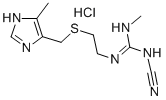
Physicochemical Properties
| Molecular Formula | C10H16N6S.HCL |
| Exact Mass | 288.092 |
| CAS # | 70059-30-2 |
| Related CAS # | Cimetidine;51481-61-9 |
| PubChem CID | 50963 |
| Appearance | Typically exists as solid at room temperature |
| Boiling Point | 488ºC at 760 mmHg |
| Flash Point | 248.9ºC |
| LogP | 2.181 |
| Hydrogen Bond Donor Count | 4 |
| Hydrogen Bond Acceptor Count | 4 |
| Rotatable Bond Count | 7 |
| Heavy Atom Count | 18 |
| Complexity | 296 |
| Defined Atom Stereocenter Count | 0 |
| SMILES | CC1=C(CSCCNC(=NC)NC#N)NC=N1.Cl |
| InChi Key | QJHCNBWLPSXHBL-UHFFFAOYSA-N |
| InChi Code | InChI=1S/C10H16N6S.ClH/c1-8-9(16-7-15-8)5-17-4-3-13-10(12-2)14-6-11;/h7H,3-5H2,1-2H3,(H,15,16)(H2,12,13,14);1H |
| Chemical Name | 1-cyano-2-methyl-3-[2-[(5-methyl-1H-imidazol-4-yl)methylsulfanyl]ethyl]guanidine;hydrochloride |
| HS Tariff Code | 2934.99.9001 |
| Storage |
Powder-20°C 3 years 4°C 2 years In solvent -80°C 6 months -20°C 1 month |
| Shipping Condition | Room temperature (This product is stable at ambient temperature for a few days during ordinary shipping and time spent in Customs) |
Biological Activity
| ln Vitro | Cimetidine (SKF-92334) hydrochloride is a partial agonist of H2R. Its anticancer effect against gastrointestinal malignancies may be attributed to its distinct pharmacological features from those of ranitidine and famotidine [1]. Cimetidine hydrochloride has no effect on cisplatin absorption and cytotoxicity in IGROV-1 cells, which are high OCT2 mRNA ovarian cancer cells [3]. 3LL cell migration, invasion, survival, and proliferation were all unaffected by cimetidine hydrochloride. Cimetidine hydrochloride stimulates the production of IFN-γ and reverses T cell inhibition mediated by MDSC [4]. The inhibition of NF-kappaB's nuclear translocation, a transcriptional activator of NCAM gene expression, is a necessary step in the imimetidine-mediated downregulation of NCAM [5]. |
| ln Vivo | Cimetidine hydrochloride (SKF-92334) can diminish the increase of CD11b(+)Gr-1(+) myeloid-derived suppressor cells (MDSC) in the spleen, blood and tumor tissue of tumor-bearing mice [4]. Cimetidine hydrochloride has a positive effect on periodontal disease in rats, lowering the RANKL/OPG ratio in gingival connective tissue and reducing alveolar bone resorption [6]. |
| References |
[1]. Inverse agonism of histamine H2 antagonist accounts for upregulation of spontaneously active histamine H2 receptors. Proc Natl Acad Sci U S A. 1996 Jun 25;93(13):6802-7. [2]. Cimetidine induces interleukin-18 production through H2-agonist activity in monocytes. Mol Pharmacol, 2006. 70(2): p. 450-3. [3]. Conjunctive therapy of cisplatin with the OCT2 inhibitor cimetidine: influence on antitumor efficacy and systemic clearance. Clin Pharmacol Ther, 2013. 94(5): p. 585-92. [4]. Cimetidine suppresses lung tumor growth in mice through proapoptosis of myeloid-derived suppressor cells. Mol Immunol, 2013. 54(1): p. 74-83. [5]. Fukuda, M., K. Kusama, and H. Sakashita, Cimetidine inhibits salivary gland tumor cell adhesion to neural cells and induces apoptosis by blocking NCAM expression. BMC Cancer, 2008. 8: p. 376. [6]. Cimetidine Reduces the Alveolar Bone Loss in Induced Periodontitis in Rat Molars. J Periodontol, 2013. |
| Additional Infomation |
A histamine congener, it competitively inhibits HISTAMINE binding to HISTAMINE H2 RECEPTORS. Cimetidine has a range of pharmacological actions. It inhibits GASTRIC ACID secretion, as well as PEPSIN and GASTRIN output. See also: Cimetidine (has active moiety). |
Solubility Data
| Solubility (In Vitro) | May dissolve in DMSO (in most cases), if not, try other solvents such as H2O, Ethanol, or DMF with a minute amount of products to avoid loss of samples |
| Solubility (In Vivo) |
Note: Listed below are some common formulations that may be used to formulate products with low water solubility (e.g. < 1 mg/mL), you may test these formulations using a minute amount of products to avoid loss of samples. Injection Formulations (e.g. IP/IV/IM/SC) Injection Formulation 1: DMSO : Tween 80: Saline = 10 : 5 : 85 (i.e. 100 μL DMSO stock solution → 50 μL Tween 80 → 850 μL Saline) *Preparation of saline: Dissolve 0.9 g of sodium chloride in 100 mL ddH ₂ O to obtain a clear solution. Injection Formulation 2: DMSO : PEG300 :Tween 80 : Saline = 10 : 40 : 5 : 45 (i.e. 100 μL DMSO → 400 μLPEG300 → 50 μL Tween 80 → 450 μL Saline) Injection Formulation 3: DMSO : Corn oil = 10 : 90 (i.e. 100 μL DMSO → 900 μL Corn oil) Example: Take the Injection Formulation 3 (DMSO : Corn oil = 10 : 90) as an example, if 1 mL of 2.5 mg/mL working solution is to be prepared, you can take 100 μL 25 mg/mL DMSO stock solution and add to 900 μL corn oil, mix well to obtain a clear or suspension solution (2.5 mg/mL, ready for use in animals). Injection Formulation 4: DMSO : 20% SBE-β-CD in saline = 10 : 90 [i.e. 100 μL DMSO → 900 μL (20% SBE-β-CD in saline)] *Preparation of 20% SBE-β-CD in Saline (4°C,1 week): Dissolve 2 g SBE-β-CD in 10 mL saline to obtain a clear solution. Injection Formulation 5: 2-Hydroxypropyl-β-cyclodextrin : Saline = 50 : 50 (i.e. 500 μL 2-Hydroxypropyl-β-cyclodextrin → 500 μL Saline) Injection Formulation 6: DMSO : PEG300 : castor oil : Saline = 5 : 10 : 20 : 65 (i.e. 50 μL DMSO → 100 μLPEG300 → 200 μL castor oil → 650 μL Saline) Injection Formulation 7: Ethanol : Cremophor : Saline = 10: 10 : 80 (i.e. 100 μL Ethanol → 100 μL Cremophor → 800 μL Saline) Injection Formulation 8: Dissolve in Cremophor/Ethanol (50 : 50), then diluted by Saline Injection Formulation 9: EtOH : Corn oil = 10 : 90 (i.e. 100 μL EtOH → 900 μL Corn oil) Injection Formulation 10: EtOH : PEG300:Tween 80 : Saline = 10 : 40 : 5 : 45 (i.e. 100 μL EtOH → 400 μLPEG300 → 50 μL Tween 80 → 450 μL Saline) Oral Formulations Oral Formulation 1: Suspend in 0.5% CMC Na (carboxymethylcellulose sodium) Oral Formulation 2: Suspend in 0.5% Carboxymethyl cellulose Example: Take the Oral Formulation 1 (Suspend in 0.5% CMC Na) as an example, if 100 mL of 2.5 mg/mL working solution is to be prepared, you can first prepare 0.5% CMC Na solution by measuring 0.5 g CMC Na and dissolve it in 100 mL ddH2O to obtain a clear solution; then add 250 mg of the product to 100 mL 0.5% CMC Na solution, to make the suspension solution (2.5 mg/mL, ready for use in animals). Oral Formulation 3: Dissolved in PEG400 Oral Formulation 4: Suspend in 0.2% Carboxymethyl cellulose Oral Formulation 5: Dissolve in 0.25% Tween 80 and 0.5% Carboxymethyl cellulose Oral Formulation 6: Mixing with food powders Note: Please be aware that the above formulations are for reference only. InvivoChem strongly recommends customers to read literature methods/protocols carefully before determining which formulation you should use for in vivo studies, as different compounds have different solubility properties and have to be formulated differently. (Please use freshly prepared in vivo formulations for optimal results.) |