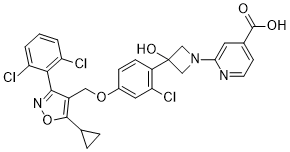
Cilofexor, formerly known as GS-9674, is a farnesoid X receptor (FXR) agonist. The nonsteroidal FXR agonist cilofexor (GS-9674) improves markers of cholestasis and liver injury in patients with PSC. In clinical study, cilofexor was well tolerated and led to significant improvements in liver biochemistries and markers of cholestasis in patients with PSC.
Physicochemical Properties
| Molecular Formula | C28H22CL3N3O5 |
| Molecular Weight | 586.85 |
| Exact Mass | 585.062 |
| CAS # | 1418274-28-8 |
| Related CAS # | 2253764-93-9 (tromethamine);1418274-28-8 (free acid); |
| PubChem CID | 71228883 |
| Appearance | Off-white to light yellow solid powder |
| Density | 1.5±0.1 g/cm3 |
| Boiling Point | 855.5±65.0 °C at 760 mmHg |
| Flash Point | 471.2±34.3 °C |
| Vapour Pressure | 0.0±0.3 mmHg at 25°C |
| Index of Refraction | 1.689 |
| LogP | 4.98 |
| Hydrogen Bond Donor Count | 2 |
| Hydrogen Bond Acceptor Count | 8 |
| Rotatable Bond Count | 8 |
| Heavy Atom Count | 39 |
| Complexity | 867 |
| Defined Atom Stereocenter Count | 0 |
| InChi Key | KZSKGLFYQAYZCO-UHFFFAOYSA-N |
| InChi Code | InChI=1S/C28H22Cl3N3O5/c29-20-2-1-3-21(30)24(20)25-18(26(39-33-25)15-4-5-15)12-38-17-6-7-19(22(31)11-17)28(37)13-34(14-28)23-10-16(27(35)36)8-9-32-23/h1-3,6-11,15,37H,4-5,12-14H2,(H,35,36) |
| Chemical Name | 2-(3-(2-chloro-4-((5-cyclopropyl-3-(2,6-dichlorophenyl)isoxazol-4-yl)methoxy)phenyl)-3-hydroxyazetidin-1-yl)isonicotinic acid |
| Synonyms | Cilofexor GS-9674 GS 9674 GS9674 |
| HS Tariff Code | 2934.99.9001 |
| Storage |
Powder-20°C 3 years 4°C 2 years In solvent -80°C 6 months -20°C 1 month |
| Shipping Condition | Room temperature (This product is stable at ambient temperature for a few days during ordinary shipping and time spent in Customs) |
Biological Activity
| ln Vivo | Cilofexor (GS-9674; 30 mg/kg; lateral wall gavage; once daily; for 10 weeks; stable Wistar stent) administration markedly enhanced Fgf15 expression in the ileum and decreased Cyp7a1 in the liver in non-alcoholic fatty liver disease (NASH). Significant reductions were observed in liver fibrosis and hepatic collagen expression. Without altering systemic hemodynamics, ciprofexor also considerably lowers portal pressure and hepatic stellate cell (HSC) activators [3]. |
| Animal Protocol |
Animal/Disease Models: Male Wistar rats received a choline-deficient high-fat diet (CDHFD) [3] Doses: 30 mg/kg Route of Administration: po (oral gavage); one time/day; for 10 weeks Experimental Results: Fgf15 expression in the ileum increased Dramatically, Cyp7a1 expression is diminished in the liver. Liver fibrosis and liver collagen expression were Dramatically diminished. |
| References |
[1]. The Nonsteroidal Farnesoid X Receptor Agonist Cilofexor (GS-9674) Improves Markers of Cholestasis and Liver Injury in Patients With Primary Sclerosing Cholangitis. Hepatology. 2019 Sep;70(3):788-801. [2]. Cilofexor, a Nonsteroidal FXR Agonist, in Non-Cirrhotic Patients with Nonalcoholic Steatohepatitis: A Phase 2 Randomized Controlled Trial. Hepatology. 2020 Mar 1. [3]. The FXR agonist GS-9674 reduces fibrosis and portal hypertension in a rat model of NASH. April 2018,Volume 68, Supplement 1, Pages S471-S472. |
| Additional Infomation |
Cilofexor is under investigation in clinical trial NCT02943447 (Safety, Tolerability, and Efficacy of Cilofexor in Adults With Primary Biliary Cholangitis Without Cirrhosis). Drug Indication Treatment of primary sclerosing cholangitis |
Solubility Data
| Solubility (In Vitro) | DMSO : ~50 mg/mL (~85.20 mM) |
| Solubility (In Vivo) |
Solubility in Formulation 1: ≥ 2.08 mg/mL (3.54 mM) (saturation unknown) in 10% DMSO + 40% PEG300 + 5% Tween80 + 45% Saline (add these co-solvents sequentially from left to right, and one by one), clear solution. For example, if 1 mL of working solution is to be prepared, you can add 100 μL of 20.8 mg/mL clear DMSO stock solution to 400 μL PEG300 and mix evenly; then add 50 μL Tween-80 to the above solution and mix evenly; then add 450 μL normal saline to adjust the volume to 1 mL. Preparation of saline: Dissolve 0.9 g of sodium chloride in 100 mL ddH₂ O to obtain a clear solution. Solubility in Formulation 2: ≥ 2.08 mg/mL (3.54 mM) (saturation unknown) in 10% DMSO + 90% Corn Oil (add these co-solvents sequentially from left to right, and one by one), clear solution. For example, if 1 mL of working solution is to be prepared, you can add 100 μL of 20.8 mg/mL clear DMSO stock solution to 900 μL of corn oil and mix evenly. (Please use freshly prepared in vivo formulations for optimal results.) |
| Preparing Stock Solutions | 1 mg | 5 mg | 10 mg | |
| 1 mM | 1.7040 mL | 8.5201 mL | 17.0401 mL | |
| 5 mM | 0.3408 mL | 1.7040 mL | 3.4080 mL | |
| 10 mM | 0.1704 mL | 0.8520 mL | 1.7040 mL |