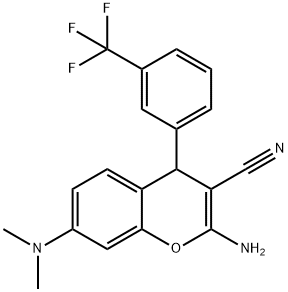
Physicochemical Properties
| Molecular Formula | C19H16F3N3O |
| Molecular Weight | 359.3522 |
| Exact Mass | 359.125 |
| Elemental Analysis | C, 63.51; H, 4.49; F, 15.86; N, 11.69; O, 4.45 |
| CAS # | 331859-86-0 |
| Related CAS # | 331859-86-0 |
| PubChem CID | 3113922 |
| Appearance | White to light yellow solid powder |
| LogP | 4.689 |
| Hydrogen Bond Donor Count | 1 |
| Hydrogen Bond Acceptor Count | 7 |
| Rotatable Bond Count | 2 |
| Heavy Atom Count | 26 |
| Complexity | 607 |
| Defined Atom Stereocenter Count | 0 |
| SMILES | NC1=C(C#N)C(C2C=CC=C(C(F)(F)F)C=2)C2C=CC(N(C)C)=CC=2O1 |
| InChi Key | GVINXTXGDDSXFQ-UHFFFAOYSA-N |
| InChi Code | InChI=1S/C19H16F3N3O/c1-25(2)13-6-7-14-16(9-13)26-18(24)15(10-23)17(14)11-4-3-5-12(8-11)19(20,21)22/h3-9,17H,24H2,1-2H3 |
| Chemical Name | 2-amino-7-(dimethylamino)-4-[3-(trifluoromethyl)phenyl]-4H-chromene-3-carbonitrile |
| Synonyms | 94G6; Chromeceptin |
| HS Tariff Code | 2934.99.9001 |
| Storage |
Powder-20°C 3 years 4°C 2 years In solvent -80°C 6 months -20°C 1 month |
| Shipping Condition | Room temperature (This product is stable at ambient temperature for a few days during ordinary shipping and time spent in Customs) |
Biological Activity
| Targets |
Chromeceptin (94G6) is described as a synthetic small benzochrome derivative that inhibits the IGF (Insulin-like Growth Factor) signaling pathway in cancer, including hepatocellular carcinoma (HCC). [1] |
| ln Vitro |
Time-blocked inhibition of IGF2 expression in Hep3B TS cells is observed with chromeceptin (94G6) (5 μM) [1]. Rapamycin (mTOR) and protein regulatory B (AKT, Ser463 of AKT, TS cells) are both decreased by chromececeptin. The phosphorylation of the ser371 site in the mTOR effector ribosomal protein S6 rest (p70S6K) is inhibited by chromeceptin [1]. Treatment of Hep3B-derived tumorsphere (TS) cells with Chromeceptin inhibited IGF2 expression in a time-dependent manner. [1] Chromeceptin treatment decreased the number of spheres formed by Hep3B cells in a dose-dependent manner. [1] Chromeceptin treatment decreased the viability of Hep3B-derived TS cells in a dose-dependent manner. [1] In Hep3B-derived TS cells, Chromeceptin treatment decreased the phosphorylation levels of downstream signaling molecules: protein kinase B (AKT at Ser473) and mammalian target of rapamycin (mTOR at Ser2481 and Ser2448). It also repressed phosphorylation at Ser371 in the mTOR effector ribosomal protein S6 kinase (p70S6K). [1] Chromeceptin treatment suppressed the viability of TS cells derived from primary hepatocellular carcinoma cells of four HCC patients. [1] |
| Cell Assay |
Tumorsphere Formation Assay: Hep3B cells were cultured under tumorsphere (TS) culture conditions (in ultra-low attachment dishes with CSC culture medium) to enrich cancer stem cells. The sphere-forming ability was assessed after treatment with different concentrations of Chromeceptin. The number of spheres was enumerated by microscopic examination. [1] Cell Viability Assay: The viability of tumorsphere (TS) cells after Chromeceptin treatment was estimated using a luminescent cell viability assay kit. Luminescence, proportional to the amount of ATP present (an indicator of metabolically active cells), was measured using a multilabel counter. [1] Immunoblot Analysis: Cells (2D adherent or TS cultures) treated with Chromeceptin were lysed. Proteins were resolved by SDS-PAGE, transferred to a membrane, and probed with specific antibodies against target proteins (e.g., IGF2, p-AKT, total AKT, p-mTOR, total mTOR, p-p70S6K). Beta-actin was used as a loading control. Proteins were visualized using enhanced chemiluminescence. This method was used to detect changes in IGF2 expression and phosphorylation status of signaling pathway components. [1] |
| References |
[1]. Loss of miR-100 and miR-125b results in cancer stem cell properties through IGF2 upregulation in hepatocellular carcinoma. Sci Rep. 2020 Dec 8;10(1):21412. |
| Additional Infomation |
Chromeceptin (94G6) is cited as a compound previously reported to suppress IGF2 at both mRNA and protein levels in hepatocyte and HCC cells. [1] In this study, Chromeceptin was used as a pharmacological tool to inhibit the IGF2 pathway. The data suggested that IGF2 plays a role in maintaining cancer stem cell properties and tumorsphere viability through the pAKT and p-mTOR pathway in Hep3B cells. [1] |
Solubility Data
| Solubility (In Vitro) | DMSO: ~100 mg/mL (~278.3 mM) |
| Solubility (In Vivo) |
Solubility in Formulation 1: 10 mg/mL (27.83 mM) in 50% PEG300 +50% Saline (add these co-solvents sequentially from left to right, and one by one), suspension solution; with sonication. Preparation of saline: Dissolve 0.9 g of sodium chloride in 100 mL ddH₂ O to obtain a clear solution. (Please use freshly prepared in vivo formulations for optimal results.) |
| Preparing Stock Solutions | 1 mg | 5 mg | 10 mg | |
| 1 mM | 2.7828 mL | 13.9140 mL | 27.8280 mL | |
| 5 mM | 0.5566 mL | 2.7828 mL | 5.5656 mL | |
| 10 mM | 0.2783 mL | 1.3914 mL | 2.7828 mL |