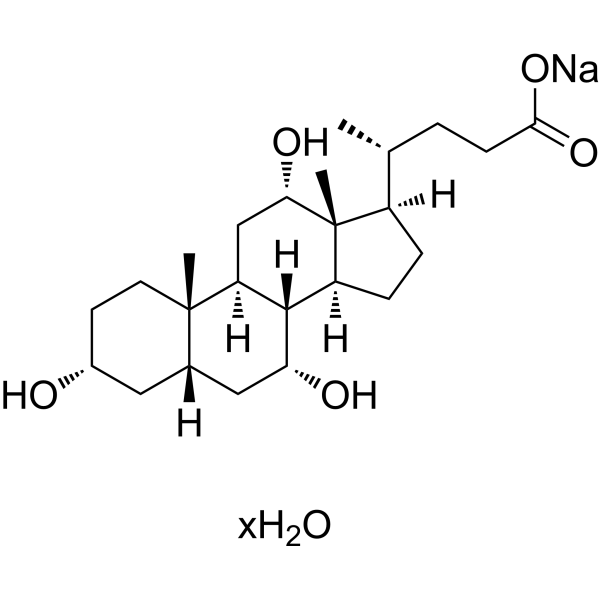
Physicochemical Properties
| Molecular Formula | C24H39NAO5 |
| Molecular Weight | 430.5532 |
| Exact Mass | 430.269 |
| CAS # | 206986-87-0 |
| Related CAS # | 81-25-4; 361-09-1; 206986-87-0; 52886-36-9; 52886-36-9; 116380-66-6; 53007-09-3 |
| PubChem CID | 23668194 |
| Appearance | Typically exists as solid at room temperature |
| LogP | 2.114 |
| Hydrogen Bond Donor Count | 3 |
| Hydrogen Bond Acceptor Count | 5 |
| Rotatable Bond Count | 4 |
| Heavy Atom Count | 30 |
| Complexity | 643 |
| Defined Atom Stereocenter Count | 11 |
| SMILES | [Na+].O([H])[C@@]1([H])C([H])([H])[C@]2([H])[C@@]3(C([H])([H])[H])C([H])([H])C([H])([H])[C@]([H])(C([H])([H])[C@@]3([H])C([H])([H])[C@]([H])([C@@]2([H])[C@]2([H])C([H])([H])C([H])([H])[C@]([H])([C@]([H])(C([H])([H])[H])C([H])([H])C([H])([H])C(=O)[O-])[C@]21C([H])([H])[H])O[H])O[H] |
| InChi Key | MUVVIYFKOVLQHL-RCVKHMDESA-M |
| InChi Code | InChI=1S/C24H40O5.Na.H2O/c1-13(4-7-21(28)29)16-5-6-17-22-18(12-20(27)24(16,17)3)23(2)9-8-15(25)10-14(23)11-19(22)26;;/h13-20,22,25-27H,4-12H2,1-3H3,(H,28,29);;1H2/q;+1;/p-1/t13-,14+,15-,16-,17+,18+,19-,20+,22+,23+,24-;;/m1../s1 |
| Chemical Name | sodium;(4R)-4-[(3R,5S,7R,8R,9S,10S,12S,13R,14S,17R)-3,7,12-trihydroxy-10,13-dimethyl-2,3,4,5,6,7,8,9,11,12,14,15,16,17-tetradecahydro-1H-cyclopenta[a]phenanthren-17-yl]pentanoate;hydrate |
| Synonyms | Sodium cholate hydrate; 206986-87-0; Sodium cholate hydrate(1:1:1); 73163-53-8; sodium;(4R)-4-[(3R,5S,7R,8R,9S,10S,12S,13R,14S,17R)-3,7,12-trihydroxy-10,13-dimethyl-2,3,4,5,6,7,8,9,11,12,14,15,16,17-tetradecahydro-1H-cyclopenta[a]phenanthren-17-yl]pentanoate;hydrate; SMR000875232; MFCD00150749; Cholalicacidsodiumsaltxhydrate; |
| HS Tariff Code | 2934.99.9001 |
| Storage |
Powder-20°C 3 years 4°C 2 years In solvent -80°C 6 months -20°C 1 month |
| Shipping Condition | Room temperature (This product is stable at ambient temperature for a few days during ordinary shipping and time spent in Customs) |
Biological Activity
| Targets | Endogenous Metabolite; Na+/taurocholate cotransporting polypeptide (NTCP) |
| ln Vitro | The competitive binding of cholic acid (1 mg/mL, 30 min) to Na+/taurocholic acid co-transporting polypeptide (NTCP) on HepG2 cells results in a significant inhibition of cholic acid (CA)-nanoliposomes (LPs)-A. The uptake of DOX-HCl revealed that the NTCP-mediated endocytosis pathway was also used to take up CA-LPs-DOX-HCl [1]. |
| ln Vivo | Cholic acid (1% (w/w) cholic acid-supplemented diet; oral; 14 days) lowered SHP (small heterodimer chaperone) protein expression probably by upregulating miR142-3p. Cholic acid raises CYP2D6 expression and activity [2]. |
| Cell Assay | Endocytosis pathway activity using uptake inhibitors[1] HepG2 cells were pretreated with the inhibitors NaN3 (1 mg/mL), genistein (50 μg/mL), MβCD (10 mM), nystatin (50 μg/mL), chlorpromazine (10 μg/mL), and cholic acid (1 mg/mL) for 30 min. After removing the inhibitors, the cells were incubated with CA-LPs for 2 h, and the cellular uptake of LPs was determined as described in the “In vitro cellular uptake assays” section. |
| Animal Protocol |
Animal/Disease Models: Tg-CYP2D6 adult male mice (8 weeks old, body weight 20-25 g) [2] Doses: 1% (w/w) Dietary administration of bile acid supplementation: po (po (oral gavage)) 14 days Experimental Results: diminished SHP Expression and diminished SHP expression increased CYP2D6 activity. |
| References |
[1]. Mechanism of hepatic targeting via oral administration of DSPE-PEG-Cholic acid-modified nanoliposomes. Int J Nanomedicine. 2017 Feb 28;12:1673-1684. [2]. Cholic acid Feeding Leads to Increased CYP2D6 Expression in CYP2D6-Humanized Mice. Drug Metab Dispos. 2017 Apr;45(4):346-352. |
| Additional Infomation |
Sodium cholate is a cholate salt and an organic sodium salt. A trihydroxy bile salt that is used as a digestive aid in dietary supplements. It is used in culture media and in conjunction with PAPAIN and PANCREATIN. |
Solubility Data
| Solubility (In Vitro) | May dissolve in DMSO (in most cases), if not, try other solvents such as H2O, Ethanol, or DMF with a minute amount of products to avoid loss of samples |
| Solubility (In Vivo) |
Note: Listed below are some common formulations that may be used to formulate products with low water solubility (e.g. < 1 mg/mL), you may test these formulations using a minute amount of products to avoid loss of samples. Injection Formulations (e.g. IP/IV/IM/SC) Injection Formulation 1: DMSO : Tween 80: Saline = 10 : 5 : 85 (i.e. 100 μL DMSO stock solution → 50 μL Tween 80 → 850 μL Saline) *Preparation of saline: Dissolve 0.9 g of sodium chloride in 100 mL ddH ₂ O to obtain a clear solution. Injection Formulation 2: DMSO : PEG300 :Tween 80 : Saline = 10 : 40 : 5 : 45 (i.e. 100 μL DMSO → 400 μLPEG300 → 50 μL Tween 80 → 450 μL Saline) Injection Formulation 3: DMSO : Corn oil = 10 : 90 (i.e. 100 μL DMSO → 900 μL Corn oil) Example: Take the Injection Formulation 3 (DMSO : Corn oil = 10 : 90) as an example, if 1 mL of 2.5 mg/mL working solution is to be prepared, you can take 100 μL 25 mg/mL DMSO stock solution and add to 900 μL corn oil, mix well to obtain a clear or suspension solution (2.5 mg/mL, ready for use in animals). Injection Formulation 4: DMSO : 20% SBE-β-CD in saline = 10 : 90 [i.e. 100 μL DMSO → 900 μL (20% SBE-β-CD in saline)] *Preparation of 20% SBE-β-CD in Saline (4°C,1 week): Dissolve 2 g SBE-β-CD in 10 mL saline to obtain a clear solution. Injection Formulation 5: 2-Hydroxypropyl-β-cyclodextrin : Saline = 50 : 50 (i.e. 500 μL 2-Hydroxypropyl-β-cyclodextrin → 500 μL Saline) Injection Formulation 6: DMSO : PEG300 : castor oil : Saline = 5 : 10 : 20 : 65 (i.e. 50 μL DMSO → 100 μLPEG300 → 200 μL castor oil → 650 μL Saline) Injection Formulation 7: Ethanol : Cremophor : Saline = 10: 10 : 80 (i.e. 100 μL Ethanol → 100 μL Cremophor → 800 μL Saline) Injection Formulation 8: Dissolve in Cremophor/Ethanol (50 : 50), then diluted by Saline Injection Formulation 9: EtOH : Corn oil = 10 : 90 (i.e. 100 μL EtOH → 900 μL Corn oil) Injection Formulation 10: EtOH : PEG300:Tween 80 : Saline = 10 : 40 : 5 : 45 (i.e. 100 μL EtOH → 400 μLPEG300 → 50 μL Tween 80 → 450 μL Saline) Oral Formulations Oral Formulation 1: Suspend in 0.5% CMC Na (carboxymethylcellulose sodium) Oral Formulation 2: Suspend in 0.5% Carboxymethyl cellulose Example: Take the Oral Formulation 1 (Suspend in 0.5% CMC Na) as an example, if 100 mL of 2.5 mg/mL working solution is to be prepared, you can first prepare 0.5% CMC Na solution by measuring 0.5 g CMC Na and dissolve it in 100 mL ddH2O to obtain a clear solution; then add 250 mg of the product to 100 mL 0.5% CMC Na solution, to make the suspension solution (2.5 mg/mL, ready for use in animals). Oral Formulation 3: Dissolved in PEG400 Oral Formulation 4: Suspend in 0.2% Carboxymethyl cellulose Oral Formulation 5: Dissolve in 0.25% Tween 80 and 0.5% Carboxymethyl cellulose Oral Formulation 6: Mixing with food powders Note: Please be aware that the above formulations are for reference only. InvivoChem strongly recommends customers to read literature methods/protocols carefully before determining which formulation you should use for in vivo studies, as different compounds have different solubility properties and have to be formulated differently. (Please use freshly prepared in vivo formulations for optimal results.) |
| Preparing Stock Solutions | 1 mg | 5 mg | 10 mg | |
| 1 mM | 2.3226 mL | 11.6131 mL | 23.2261 mL | |
| 5 mM | 0.4645 mL | 2.3226 mL | 4.6452 mL | |
| 10 mM | 0.2323 mL | 1.1613 mL | 2.3226 mL |