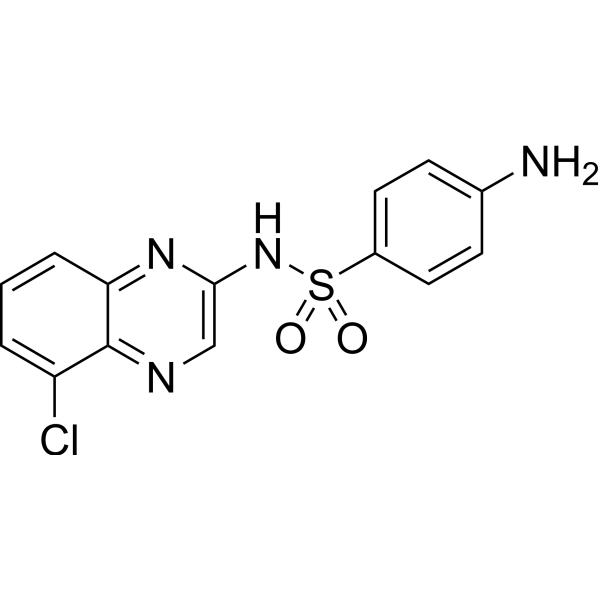
Physicochemical Properties
| Molecular Formula | C14H11N4O2SCL |
| Molecular Weight | 334.78074 |
| Exact Mass | 334.029 |
| Elemental Analysis | C, 50.23; H, 3.31; Cl, 10.59; N, 16.74; O, 9.56; S, 9.58 |
| CAS # | 97919-22-7 |
| PubChem CID | 72462 |
| Appearance | Light yellow to yellow solid powder |
| Density | 1.569g/cm3 |
| Boiling Point | 576.3ºC at 760mmHg |
| Flash Point | 302.3ºC |
| Index of Refraction | 1.734 |
| LogP | 4.401 |
| Hydrogen Bond Donor Count | 2 |
| Hydrogen Bond Acceptor Count | 6 |
| Rotatable Bond Count | 3 |
| Heavy Atom Count | 22 |
| Complexity | 476 |
| Defined Atom Stereocenter Count | 0 |
| SMILES | O=S(C1C=CC(N)=CC=1)(NC1C=NC2C(=CC=CC=2Cl)N=1)=O |
| InChi Key | CTSNHMQGVWXIEG-UHFFFAOYSA-N |
| InChi Code | InChI=1S/C14H11ClN4O2S/c15-11-2-1-3-12-14(11)17-8-13(18-12)19-22(20,21)10-6-4-9(16)5-7-10/h1-8H,16H2,(H,18,19) |
| Chemical Name | 4-amino-N-(5-chloroquinoxalin-2-yl)benzenesulfonamide |
| Synonyms | Chlorsulfaquinoxaline; chloroquinoxaline sulfonamide; 97919-22-7; 4-Amino-N-(5-chloro-2-quinoxalinyl)benzenesulfonamide; 4-amino-N-(5-chloroquinoxalin-2-yl)benzenesulfonamide; NSC-339004; 5-Chloroquinoxaline-2-sulfanilamide; CCRIS 689; |
| HS Tariff Code | 2934.99.9001 |
| Storage |
Powder-20°C 3 years 4°C 2 years In solvent -80°C 6 months -20°C 1 month |
| Shipping Condition | Room temperature (This product is stable at ambient temperature for a few days during ordinary shipping and time spent in Customs) |
Biological Activity
| Targets | Topoisomerase II alpha/beta; Coccidia |
| ln Vitro | Using the MTT cytotoxicity assay, the IC50 of chloroquinoxaline sulfonamide against CV-1 cells was found to be 1.8 mM. When drug treatment is stopped by GuHCl cleavage, chloroquinoxaline sulfonamide induces dose-dependent protein-DNA cross-linking of chromosomal DNA in kidney cells of CV-1 monkeys. In CV-1 cells, chloroquinoxaline sulfonamide-induced protein-DNA cross-linking. DNA cross-linking of topoisomerase II produced by chloroquinoxaline sulfonamide [1]. Mouse B16 melanoma cell growth can be inhibited by chloroquinoxaline, a chlorinated derivative of sulfaquinoxaline, but only at relatively high drug concentrations (1 mM) [2]. |
| Enzyme Assay | Chloroquinoxaline sulfonamide (chlorosulfaquinoxaline, CQS, NSC 339004) is active against murine and human solid tumors. On the basis of its structural similarity to the topoisomerase IIbeta-specific drug XK469, CQS was tested and found to be both a topoisomerase-IIalpha and a topoisomerase-IIbeta poison. Topoisomerase II poisoning by CQS is essentially undetectable in assays using the common protein denaturant SDS, but easily detectable with strong chaotropic protein denaturants. The finding that detection of topoisomerase poisoning can be so dependent on the protein denaturant used in the assay has implications for drug discovery efforts and for our understanding of topoisomerase poisons[1]. |
| Cell Assay |
Cell proliferation assay [2] Cell Types: B16 mouse melanoma cells Tested Concentrations: 10 μM, 100 μM, 1 mM Incubation Duration: 24, 48, 72 hrs (hours) Experimental Results: Inhibited the proliferation of mouse B16 melanoma cells, but only at relatively high drug concentrations higher (use 1mM). Chloroquinoxaline sulfonamide (CQS), a chlorinated derivative of sulfaquinoxaline (SQ), inhibited proliferation of murine B16 melanoma cells, but only when relatively high drug concentrations (1 mM) were used. The inhibition of cell growth by CQS was at least partially reversible by incubation in drug-free medium. Incubation of melanoma cells with CQS was associated with an arrest of the cell cycle in G0/G1 as measured by flow cytometry. The drug slightly decreased uptake of radiolabeled deoxyuridine and thymidine after 24- and 48-hr incubation periods but increased nucleoside incorporation at 72 hr. No evidence of intercalation with DNA was found. Because SQ previously was reported to inhibit an aspect of folate metabolism, we investigated the possibility that CQS limits tumor cell growth by altering folate homeostasis. This appears unlikely, however, in view of the following observations: (1) the cytotoxic effects of CQS could not be reversed by folinic acid; (2) deoxyuridine suppression of thymidine incorporation was not affected by CQS treatment; (3) CQS did not inhibit dihydrofolate reductase from mammalian or bacterial sources; and (4) CQS toxicity in mice was not reduced by folinic acid. Experiments performed with analogues modified in the quinoxaline and para-amino phenyl functions indicated that tumor cell inhibition did not require preservation of the conventional sulfonamide structure[2]. |
| Toxicity/Toxicokinetics |
rat LDLo intravenous 600 mg/kg GASTROINTESTINAL: OTHER CHANGES; SKIN AND APPENDAGES (SKIN): PRIMARY IRRITATION: AFTER TOPICAL EXPOSURE National Technical Information Service., PB87-128658 mouse LD50 intravenous 607 mg/kg GASTROINTESTINAL: OTHER CHANGES; SKIN AND APPENDAGES (SKIN): PRIMARY IRRITATION: AFTER TOPICAL EXPOSURE National Technical Information Service., PB87-128658 dog LDLo intravenous 12 mg/kg GASTROINTESTINAL: OTHER CHANGES; SKIN AND APPENDAGES (SKIN): PRIMARY IRRITATION: AFTER TOPICAL EXPOSURE National Technical Information Service., PB87-128658 |
| References |
[1]. Gao H, et al. Chloroquinoxaline sulfonamide (NSC 339004) is a topoisomerase IIalpha/beta poison. Cancer Res. 2000 Nov 1;60(21):5937-40. [2]. Branda RF, et al. Cellular pharmacology of chloroquinoxaline sulfonamide and a related compound in murine B16 melanoma cells. Biochem Pharmacol. 1988 Dec 1;37(23):4557-64. |
| Additional Infomation |
Chlorsulfaquinoxaline has been used in trials studying the treatment of Lung Cancer and Colorectal Cancer. Chloroquinoxaline Sulfonamide is a chlorinated heterocyclic sulfanilamide with potential antineoplastic activity and potential immunosuppressive activity. Chloroquinoxaline sulfonamide poisons topoisomerase II alpha and topoisomerase II beta, thereby causing double-stranded breaks in DNA, accumulation of unrepaired DNA, and apoptosis. This agent also exhibits lymphotoxicity by inhibiting lymphocyte activation in a cell cycle-specific manner. (NCI04) |
Solubility Data
| Solubility (In Vitro) | DMSO : ~125 mg/mL (~373.38 mM) |
| Solubility (In Vivo) |
Solubility in Formulation 1: ≥ 2.08 mg/mL (6.21 mM) (saturation unknown) in 10% DMSO + 40% PEG300 + 5% Tween80 + 45% Saline (add these co-solvents sequentially from left to right, and one by one), clear solution. For example, if 1 mL of working solution is to be prepared, you can add 100 μL of 20.8 mg/mL clear DMSO stock solution to 400 μL PEG300 and mix evenly; then add 50 μL Tween-80 to the above solution and mix evenly; then add 450 μL normal saline to adjust the volume to 1 mL. Preparation of saline: Dissolve 0.9 g of sodium chloride in 100 mL ddH₂ O to obtain a clear solution. Solubility in Formulation 2: ≥ 2.08 mg/mL (6.21 mM) (saturation unknown) in 10% DMSO + 90% (20% SBE-β-CD in Saline) (add these co-solvents sequentially from left to right, and one by one), clear solution. For example, if 1 mL of working solution is to be prepared, you can add 100 μL of 20.8 mg/mL clear DMSO stock solution to 900 μL of 20% SBE-β-CD physiological saline solution and mix evenly. Preparation of 20% SBE-β-CD in Saline (4°C,1 week): Dissolve 2 g SBE-β-CD in 10 mL saline to obtain a clear solution. (Please use freshly prepared in vivo formulations for optimal results.) |
| Preparing Stock Solutions | 1 mg | 5 mg | 10 mg | |
| 1 mM | 2.9870 mL | 14.9352 mL | 29.8704 mL | |
| 5 mM | 0.5974 mL | 2.9870 mL | 5.9741 mL | |
| 10 mM | 0.2987 mL | 1.4935 mL | 2.9870 mL |