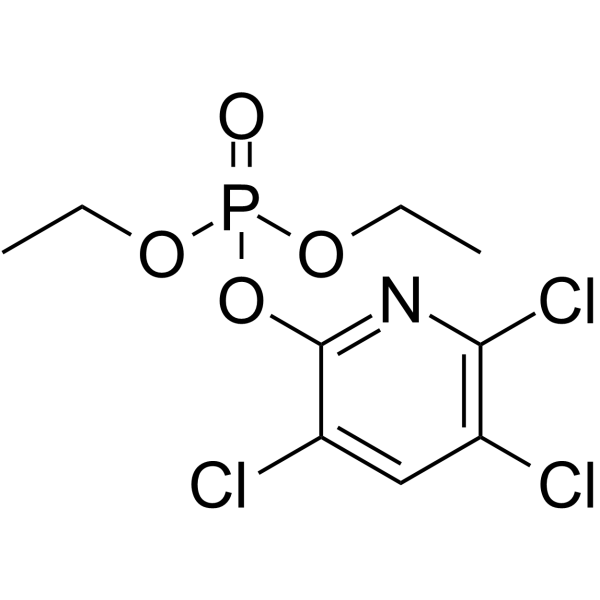
Physicochemical Properties
| Molecular Formula | C9H11CL3NO4P |
| Molecular Weight | 334.52 |
| Exact Mass | 332.949 |
| CAS # | 5598-15-2 |
| Related CAS # | Chlorpyrifos-oxon-d10;1794779-85-3 |
| PubChem CID | 21804 |
| Appearance | White to off-white <43°C powder,>53°C liquid |
| Density | 1.461g/cm3 |
| Boiling Point | 357.8ºC at 760mmHg |
| Flash Point | 170.2ºC |
| Index of Refraction | 1.523 |
| LogP | 4.601 |
| Hydrogen Bond Donor Count | 0 |
| Hydrogen Bond Acceptor Count | 5 |
| Rotatable Bond Count | 6 |
| Heavy Atom Count | 18 |
| Complexity | 300 |
| Defined Atom Stereocenter Count | 0 |
| SMILES | CCOP(OC1=NC(Cl)=C(Cl)C=C1Cl)(=O)OCC |
| InChi Key | OTMOUPHCTWPNSL-UHFFFAOYSA-N |
| InChi Code | InChI=1S/C9H11Cl3NO4P/c1-3-15-18(14,16-4-2)17-9-7(11)5-6(10)8(12)13-9/h5H,3-4H2,1-2H3 |
| Chemical Name | diethyl (3,5,6-trichloropyridin-2-yl) phosphate |
| HS Tariff Code | 2934.99.9001 |
| Storage |
Powder-20°C 3 years 4°C 2 years In solvent -80°C 6 months -20°C 1 month Note: Please store this product in a sealed and protected environment (e.g. under nitrogen), avoid exposure to moisture. |
| Shipping Condition | Room temperature (This product is stable at ambient temperature for a few days during ordinary shipping and time spent in Customs) |
Biological Activity
| ln Vitro | Protein aggregation occurs when 1.5 mM chlorpyrifos-oxon (CPO) is applied to tubulin. Nonetheless, cross-linked trimers between chlorpyrifos and oxon are visible even at 1.5 μM. Chlorpyrifos-oxon facilitates tubulin monomers' isopeptide bond cross-linking to form multimers[2]. Neurite outgrowth was hindered in PC12 cells cultured for 24 hours when exposed to chlorpyrifos at a dosage 10-fold lower than that which inhibits AChE activity (3.0 μM), but neurite outgrowth is inhibited at 1.0 nM by chlorpyrifos-oxon[3]. |
| ln Vivo | Human liver microsomes quickly detoxify chlorpyrifos-oxon (CPO) by glutathione-S-transferase and CYP-dependent deethylation and dearylation. Furthermore, Chlorpyrifos-oxon may be quickly degraded or scavenged in the liver by interactions with A-esterases like paraoxonase 1 (PON 1) or B-esterases such carboxylesterase and butyrylcholinesterase (BChE)[1]. Following treatment with Chlorpyrifos-oxon (3 mg/kg, ip; once); wild-type mice, the microtubule dimensions of the treated mice resemble those of the control mice by almost 60%. Mice exposed to chlorpyrifos-oxon had microtubules with aberrant structures and covalently changed amino acids, which may indicate a disruption in microtubule function[4]. |
| ADME/Pharmacokinetics |
Metabolism / Metabolites Chlorpyrifos-oxon has known human metabolites that include Diethyl phosphorothioate and 3,5,6-Trichloro-2-pyridinol. Chlorpyrifos-oxon is a known human metabolite of Chlorpyrifos. Metabolism of organophosphates occurs principally by oxidation, by hydrolysis via esterases and by reaction with glutathione. Demethylation and glucuronidation may also occur. Oxidation of organophosphorus pesticides may result in moderately toxic products. In general, phosphorothioates are not directly toxic but require oxidative metabolism to the proximal toxin. The glutathione transferase reactions produce products that are, in most cases, of low toxicity. Paraoxonase (PON1) is a key enzyme in the metabolism of organophosphates. PON1 can inactivate some organophosphates through hydrolysis. PON1 hydrolyzes the active metabolites in several organophosphates insecticides as well as, nerve agents such as soman, sarin, and VX. The presence of PON1 polymorphisms causes there to be different enzyme levels and catalytic efficiency of this esterase, which in turn suggests that different individuals may be more susceptible to the toxic effect of organophosphate exposure. |
| References |
[1]. Extreme variability in the formation of chlorpyrifos oxon (CPO) in patients poisoned by chlorpyrifos (CPF). Biochem Pharmacol. 2009 Sep 1;78(5):531-7. [2]. Chlorpyrifos oxon promotes tubulin aggregation via isopeptide cross-linking between diethoxyphospho-Lys and Glu or Asp: Implications for neurotoxicity. J Biol Chem. 2018 Aug 31;293(35):13566-13577. [3]. Chlorpyrifos and chlorpyrifos oxon impair the transport of membrane bound organelles in rat cortical axons. Neurotoxicology. 2017 Sep;62:111-123. [4]. Mice treated with chlorpyrifos or chlorpyrifos oxon have organophosphorylated tubulin in the brain and disrupted microtubule structures, suggesting a role for tubulin in neurotoxicity associated with exposure to organophosphorus agents. |
| Additional Infomation | Chlorpyrifos oxon examines the risk of acute toxicity in soil microbes by comparing data on environmental concentrations of these pesticides to toxic concentrations. In animals, chlorpyrifos transforms to chlorpyrifos-oxon, which is about 3000 times as potent against the nervous system as chlorpyrifos itself. |
Solubility Data
| Solubility (In Vitro) | DMSO: 100 mg/mL (298.94 mM) |
| Solubility (In Vivo) |
Solubility in Formulation 1: ≥ 2.5 mg/mL (7.47 mM) (saturation unknown) in 10% DMSO + 40% PEG300 + 5% Tween80 + 45% Saline (add these co-solvents sequentially from left to right, and one by one), clear solution. For example, if 1 mL of working solution is to be prepared, you can add 100 μL of 25.0 mg/mL clear DMSO stock solution to 400 μL PEG300 and mix evenly; then add 50 μL Tween-80 to the above solution and mix evenly; then add 450 μL normal saline to adjust the volume to 1 mL. Preparation of saline: Dissolve 0.9 g of sodium chloride in 100 mL ddH₂ O to obtain a clear solution. Solubility in Formulation 2: ≥ 2.5 mg/mL (7.47 mM) (saturation unknown) in 10% DMSO + 90% (20% SBE-β-CD in Saline) (add these co-solvents sequentially from left to right, and one by one), clear solution. For example, if 1 mL of working solution is to be prepared, you can add 100 μL of 25.0 mg/mL clear DMSO stock solution to 900 μL of 20% SBE-β-CD physiological saline solution and mix evenly. Preparation of 20% SBE-β-CD in Saline (4°C,1 week): Dissolve 2 g SBE-β-CD in 10 mL saline to obtain a clear solution. Solubility in Formulation 3: ≥ 2.5 mg/mL (7.47 mM) (saturation unknown) in 10% DMSO + 90% Corn Oil (add these co-solvents sequentially from left to right, and one by one), clear solution. For example, if 1 mL of working solution is to be prepared, you can add 100 μL of 25.0 mg/mL clear DMSO stock solution to 900 μL of corn oil and mix evenly. (Please use freshly prepared in vivo formulations for optimal results.) |
| Preparing Stock Solutions | 1 mg | 5 mg | 10 mg | |
| 1 mM | 2.9894 mL | 14.9468 mL | 29.8936 mL | |
| 5 mM | 0.5979 mL | 2.9894 mL | 5.9787 mL | |
| 10 mM | 0.2989 mL | 1.4947 mL | 2.9894 mL |