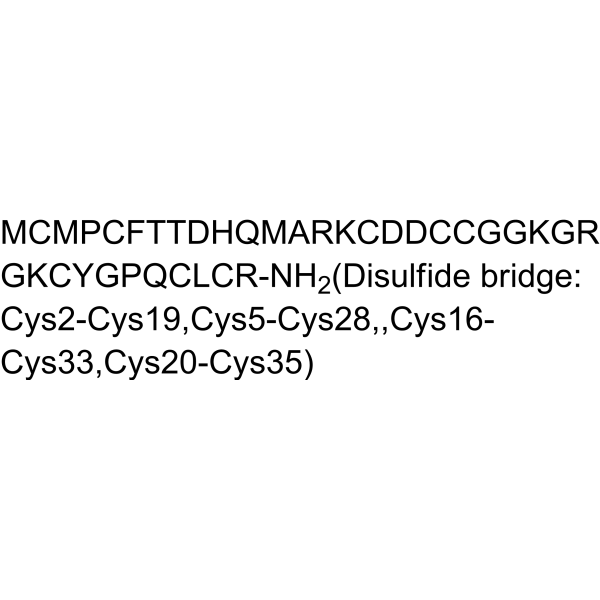
Physicochemical Properties
| Molecular Formula | C158H249N53O47S11 |
| Molecular Weight | 3995.70955999997 |
| Exact Mass | 3992.5 |
| CAS # | 163515-35-3 |
| Related CAS # | Chlorotoxin(linear);Chlorotoxin TFA |
| PubChem CID | 86278273 |
| Appearance | Colorless to light yellow liquid |
| LogP | -22 |
| Hydrogen Bond Donor Count | 56 |
| Hydrogen Bond Acceptor Count | 66 |
| Rotatable Bond Count | 63 |
| Heavy Atom Count | 269 |
| Complexity | 9210 |
| Defined Atom Stereocenter Count | 33 |
| SMILES | NCCCC[C@@H]1NC(=O)CNC(=O)CNC(=O)[C@H]2NC([C@@H]3CSSC[C@H](NC([C@H](CCSC)N)=O)C(=O)N[C@@H](CCSC)C(=O)N4CCC[C@@H]4C(=O)N[C@H]4CSSC[C@H](C(N[C@H](C(NCC(N5CCC[C@H]5C(N[C@H](C(N[C@@H](CSSC[C@@H](NC([C@@H](NC([C@@H](NC([C@@H](NC([C@@H](NC([C@@H](NC([C@@H](NC([C@@H](NC([C@@H](NC([C@@H](NC([C@@H](NC4=O)CC4=CC=CC=C4)=O)[C@H](O)C)=O)[C@H](O)C)=O)CC(=O)O)=O)CC4=CN=CN4)=O)CCC(=O)N)=O)CCSC)=O)C)=O)CCCNC(=N)N)=O)CCCCN)=O)C(=O)N[C@@H](CC(=O)O)C(=O)N[C@@H](CC(=O)O)C(=O)N3)C(N[C@H](C(N[C@H](C(N[C@H](C(=O)N)CCCNC(=N)N)=O)CSSC2)=O)CC(C)C)=O)=O)CCC(=O)N)=O)=O)=O)CC2=CC=C(O)C=C2)=O)NC(=O)[C@H](CCCCN)NC(=O)CNC(=O)[C@H](CCCNC(=N)N)NC(=O)CNC1=O)=O |
| InChi Key | QPAKKWCQMHUHNI-GQIQPHNSSA-N |
| InChi Code | InChI=1S/C158H249N53O47S11/c1-77(2)55-96-138(241)205-105(144(247)186-86(125(165)228)28-18-47-173-156(166)167)70-264-262-68-103-131(234)177-63-115(217)176-64-116(218)183-87(25-12-15-44-159)128(231)178-65-117(219)184-88(29-19-48-174-157(168)169)129(232)179-66-118(220)185-89(26-13-16-45-160)133(236)202-107-72-267-269-75-110-149(252)195-98(56-81-23-10-9-11-24-81)143(246)208-124(80(5)213)154(257)209-123(79(4)212)153(256)199-102(61-122(226)227)141(244)196-99(58-83-62-172-76-181-83)139(242)189-92(37-39-113(163)215)136(239)190-94(42-53-260-7)132(235)182-78(3)126(229)187-91(30-20-49-175-158(170)171)134(237)188-90(27-14-17-46-161)135(238)203-108(73-266-265-71-106(146(249)193-96)204-137(240)93(38-40-114(164)216)191-151(254)111-31-21-50-210(111)119(221)67-180-130(233)97(194-147(107)250)57-82-33-35-84(214)36-34-82)148(251)198-100(59-120(222)223)140(243)197-101(60-121(224)225)142(245)206-109(150(253)201-103)74-268-263-69-104(200-127(230)85(162)41-52-259-6)145(248)192-95(43-54-261-8)155(258)211-51-22-32-112(211)152(255)207-110/h9-11,23-24,33-36,62,76-80,85-112,123-124,212-214H,12-22,25-32,37-61,63-75,159-162H2,1-8H3,(H2,163,215)(H2,164,216)(H2,165,228)(H,172,181)(H,176,217)(H,177,234)(H,178,231)(H,179,232)(H,180,233)(H,182,235)(H,183,218)(H,184,219)(H,185,220)(H,186,247)(H,187,229)(H,188,237)(H,189,242)(H,190,239)(H,191,254)(H,192,248)(H,193,249)(H,194,250)(H,195,252)(H,196,244)(H,197,243)(H,198,251)(H,199,256)(H,200,230)(H,201,253)(H,202,236)(H,203,238)(H,204,240)(H,205,241)(H,206,245)(H,207,255)(H,208,246)(H,209,257)(H,222,223)(H,224,225)(H,226,227)(H4,166,167,173)(H4,168,169,174)(H4,170,171,175)/t78-,79+,80+,85-,86-,87-,88-,89-,90-,91-,92-,93-,94-,95-,96-,97-,98-,99-,100-,101-,102-,103-,104-,105-,106-,107-,108-,109-,110-,111-,112-,123-,124-/m0/s1 |
| Chemical Name | 2-[(1R,4R,5aR,8aS,9R,12S,17aS,18S,20aS,21R,24S,27S,30S,33S,36S,39S,42S,45S,48S,51S,54R,59R,62S,65S,74S,77R,80S,86S,92S)-51,80,92-tris(4-aminobutyl)-5a-[[(2S)-1-amino-5-carbamimidamido-1-oxopentan-2-yl]carbamoyl]-9-[[(2S)-2-amino-4-methylsulfanylbutanoyl]amino]-39,62-bis(3-amino-3-oxopropyl)-24-benzyl-48,86-bis(3-carbamimidamidopropyl)-20a,33-bis(carboxymethyl)-27,30-bis[(1R)-1-hydroxyethyl]-74-[(4-hydroxyphenyl)methyl]-36-(1H-imidazol-4-ylmethyl)-45-methyl-8a-(2-methylpropyl)-12,42-bis(2-methylsulfanylethyl)-a,3,7a,10,10a,13,15a,18a,19,21a,22,25,28,31,34,37,40,43,46,49,52,61,64,70,73,76,79,82,85,88,91,94,97-tritriacontaoxo-2a,3a,6,7,12a,13a,56,57-octathia-2,6a,9a,11,14,16a,19a,20,22a,23,26,29,32,35,38,41,44,47,50,53,60,63,69,72,75,78,81,84,87,90,93,96,99-tritriacontazahexacyclo[57.41.10.84,54.421,77.014,18.065,69]docosahectan-17a-yl]acetic acid |
| HS Tariff Code | 2934.99.9001 |
| Storage |
Powder-20°C 3 years 4°C 2 years In solvent -80°C 6 months -20°C 1 month Note: Please store this product in a sealed and protected environment, avoid exposure to moisture. |
| Shipping Condition | Room temperature (This product is stable at ambient temperature for a few days during ordinary shipping and time spent in Customs) |
Biological Activity
| ln Vitro | Because chlorotoxin binds to tumor cells preferentially, it has been used to create an imaging agent that makes tumors easier to see during surgical resection. Furthermore, chlorotoxin may be used as a vehicle to deliver anticancer medications to cancer cells only. Glioma cells bind to chlorotoxin, while normal rat astrocytes and the human rhabdomyosarcoma cell line Te671 are unaffected. With an IC50 of 600 nM, chlorotoxin prevents U251MG (glioma) cells from migrating[2]. Chlorotoxin binds specifically to glioma cells through both low-affinity (Kd=660 nM) and high-affinity (Kd=4.2 nM) binding sites [3]. Chlorotoxins have the ability to effectively block small conductance chloride channels. Chloride channel function has been studied using general pharmacological tools, such as chlorotoxins [4]. |
| ln Vivo | Invertebrates, including insects, are susceptible to the insecticidal effects of chlorotoxins. The peptide accumulated in the tumors of mice bearing tumors after they were injected with I-chlorotoxin [2]. When compared to control animals, the brain:muscle ratio of tumor-bearing mice was found to be 36.4% of the injected dose/g (ID/g), indicating that the accumulation of chlorotoxin was specific to their brains [3]. |
| References |
[1]. Purification and characterization of chlorotoxin, a chloride channel ligand from the venom of the scorpion. Am J Physiol. 1993 Feb;264(2 Pt 1):C361-9. [2]. Chlorotoxin: Structure, activity, and potential uses in cancer therapy. Biopolymers. 2016 Jan;106(1):25-36. [3]. Use of chlorotoxin for targeting of primary brain tumors. Cancer Res. 1998 Nov 1;58(21):4871-9. [4]. Chlorotoxin: a helpful natural scorpion peptide to diagnose glioma and fight tumor invasion. Toxins (Basel). 2015 Mar 27;7(4):1079-101. |
| Additional Infomation |
Chlorotoxin is under investigation in clinical trial NCT00733798 (A Safety and Efficacy Study of Intravenous 131I-TM601 in Adult Patients With Malignant Melanoma). Chlorotoxin is a neurotoxin with potential anticancer property. Chlorotoxin (CTX) is a 36-amino acid peptide found in the venom of the deathstalker scorpion, and a chloride channel blocker. This toxin binds preferentially to glioma cells via the transmembrane endopeptidase matrix metalloproteinase-2 (MMP-2), and thereby prevents the spread of tumor cells. MMP-2 is specifically up-regulated in gliomas and related cancers, but is not normally expressed in brain. |
Solubility Data
| Solubility (In Vitro) | May dissolve in DMSO (in most cases), if not, try other solvents such as H2O, Ethanol, or DMF with a minute amount of products to avoid loss of samples |
| Solubility (In Vivo) |
Note: Listed below are some common formulations that may be used to formulate products with low water solubility (e.g. < 1 mg/mL), you may test these formulations using a minute amount of products to avoid loss of samples. Injection Formulations (e.g. IP/IV/IM/SC) Injection Formulation 1: DMSO : Tween 80: Saline = 10 : 5 : 85 (i.e. 100 μL DMSO stock solution → 50 μL Tween 80 → 850 μL Saline) *Preparation of saline: Dissolve 0.9 g of sodium chloride in 100 mL ddH ₂ O to obtain a clear solution. Injection Formulation 2: DMSO : PEG300 :Tween 80 : Saline = 10 : 40 : 5 : 45 (i.e. 100 μL DMSO → 400 μLPEG300 → 50 μL Tween 80 → 450 μL Saline) Injection Formulation 3: DMSO : Corn oil = 10 : 90 (i.e. 100 μL DMSO → 900 μL Corn oil) Example: Take the Injection Formulation 3 (DMSO : Corn oil = 10 : 90) as an example, if 1 mL of 2.5 mg/mL working solution is to be prepared, you can take 100 μL 25 mg/mL DMSO stock solution and add to 900 μL corn oil, mix well to obtain a clear or suspension solution (2.5 mg/mL, ready for use in animals). Injection Formulation 4: DMSO : 20% SBE-β-CD in saline = 10 : 90 [i.e. 100 μL DMSO → 900 μL (20% SBE-β-CD in saline)] *Preparation of 20% SBE-β-CD in Saline (4°C,1 week): Dissolve 2 g SBE-β-CD in 10 mL saline to obtain a clear solution. Injection Formulation 5: 2-Hydroxypropyl-β-cyclodextrin : Saline = 50 : 50 (i.e. 500 μL 2-Hydroxypropyl-β-cyclodextrin → 500 μL Saline) Injection Formulation 6: DMSO : PEG300 : castor oil : Saline = 5 : 10 : 20 : 65 (i.e. 50 μL DMSO → 100 μLPEG300 → 200 μL castor oil → 650 μL Saline) Injection Formulation 7: Ethanol : Cremophor : Saline = 10: 10 : 80 (i.e. 100 μL Ethanol → 100 μL Cremophor → 800 μL Saline) Injection Formulation 8: Dissolve in Cremophor/Ethanol (50 : 50), then diluted by Saline Injection Formulation 9: EtOH : Corn oil = 10 : 90 (i.e. 100 μL EtOH → 900 μL Corn oil) Injection Formulation 10: EtOH : PEG300:Tween 80 : Saline = 10 : 40 : 5 : 45 (i.e. 100 μL EtOH → 400 μLPEG300 → 50 μL Tween 80 → 450 μL Saline) Oral Formulations Oral Formulation 1: Suspend in 0.5% CMC Na (carboxymethylcellulose sodium) Oral Formulation 2: Suspend in 0.5% Carboxymethyl cellulose Example: Take the Oral Formulation 1 (Suspend in 0.5% CMC Na) as an example, if 100 mL of 2.5 mg/mL working solution is to be prepared, you can first prepare 0.5% CMC Na solution by measuring 0.5 g CMC Na and dissolve it in 100 mL ddH2O to obtain a clear solution; then add 250 mg of the product to 100 mL 0.5% CMC Na solution, to make the suspension solution (2.5 mg/mL, ready for use in animals). Oral Formulation 3: Dissolved in PEG400 Oral Formulation 4: Suspend in 0.2% Carboxymethyl cellulose Oral Formulation 5: Dissolve in 0.25% Tween 80 and 0.5% Carboxymethyl cellulose Oral Formulation 6: Mixing with food powders Note: Please be aware that the above formulations are for reference only. InvivoChem strongly recommends customers to read literature methods/protocols carefully before determining which formulation you should use for in vivo studies, as different compounds have different solubility properties and have to be formulated differently. (Please use freshly prepared in vivo formulations for optimal results.) |
| Preparing Stock Solutions | 1 mg | 5 mg | 10 mg | |
| 1 mM | 0.2503 mL | 1.2513 mL | 2.5027 mL | |
| 5 mM | 0.0501 mL | 0.2503 mL | 0.5005 mL | |
| 10 mM | 0.0250 mL | 0.1251 mL | 0.2503 mL |