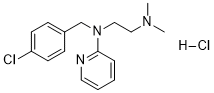
Chloropyramine hydrochloride (Alergosan, Allergan hydrochloride, Nilfan, Sinopen, Suprastin), the hydrochloride salt of Chloropyramine, is a potent antihistamine drug acting as a histamine receptor H1 antagonist. It has usefulness in the treatment of breast cancer.
Physicochemical Properties
| Molecular Formula | C₁₆H₂₁CL₂N₃ |
| Molecular Weight | 326.26 |
| Exact Mass | 325.111 |
| Elemental Analysis | C, 58.90; H, 6.49; Cl, 21.73; N, 12.88 |
| CAS # | 6170-42-9 |
| Related CAS # | Chloropyramine; 59-32-5 |
| PubChem CID | 25295 |
| Appearance | White to off-white solid powder |
| Boiling Point | 413.5ºC at 760 mmHg |
| Melting Point |
< 25 °C 60 °C |
| Flash Point | 203.9ºC |
| LogP | 4.105 |
| Hydrogen Bond Donor Count | 0 |
| Hydrogen Bond Acceptor Count | 3 |
| Rotatable Bond Count | 6 |
| Heavy Atom Count | 20 |
| Complexity | 264 |
| Defined Atom Stereocenter Count | 0 |
| SMILES | CN(C)CCN(CC1=CC=C(Cl)C=C1)C2=NC=CC=C2.[H]Cl |
| InChi Key | VEYWWAGBHABATA-UHFFFAOYSA-N |
| InChi Code | InChI=1S/C16H20ClN3.ClH/c1-19(2)11-12-20(16-5-3-4-10-18-16)13-14-6-8-15(17)9-7-14;/h3-10H,11-13H2,1-2H3;1H |
| Chemical Name | N'-[(4-chlorophenyl)methyl]-N,N-dimethyl-N'-pyridin-2-ylethane-1,2-diamine;hydrochloride |
| Synonyms | Chloropyribenzamine hydrochloride; Halopyramine hydrochloride; Alergosan; Allergan hydrochloride; Nilfan; Sinopen; Suprastin |
| HS Tariff Code | 2934.99.9001 |
| Storage |
Powder-20°C 3 years 4°C 2 years In solvent -80°C 6 months -20°C 1 month Note: Please store this product in a sealed and protected environment, avoid exposure to moisture. |
| Shipping Condition | Room temperature (This product is stable at ambient temperature for a few days during ordinary shipping and time spent in Customs) |
Biological Activity
| Targets | H1 Receptor; VEGFR-3 |
| ln Vitro | Chloropyramine hydrochloride (Compound 1) treatment highly sensitively affects BT474 cells, resulting in a 40% reduction in viability at 1 µM concentrations after 48 hours. The viability of control MCF7-pcDNA3 cells is found to be significantly higher than that of MCF7-VEGFR-3 cells at 1 µM concentrations of Chloropyramine hydrochloride (P<0.01), and this difference doubles at 10 µM concentration (P<0.001). Treatment with chloropyramine hydrochloride also causes a concentration-dependent reduction in cell proliferation in BT474 cells. Chloropyramine hydrochloride treatment causes the overexpressed VEGFR-3 breast cancer cells to undergo apoptosis after 48 hours. More than 60% of BT474 cells experience apoptosis when exposed to 10 µM chloropyramine hydrochloride, indicating a dose-dependent effect. Treatment with 10 µM Chloropyramine hydrochloride for 48 hours increases apoptotic cell death in the cell line that overexpresses VEGFR-3 by four times (18% versus 76%, respectively) in our model cell lines MCF7-pcDNA3 and MCF7-VEGFR-3[1]. |
| ln Vivo | Chloropyramine hydrochloride causes both model systems to experience a sharp decline in tumor growth, with treated groups' tumor sizes being about 20% smaller than those of the vehicle control groups. Tumor growth is reduced by about 60% when doxorubicin is given at a dose of 3 mg/kg; at 0 mg/kg, tumor growth is unaffected. However, chloropyramine hydrochloride by itself only has a negligible impact (a 50% decrease in tumor growth). A prolonged anti-tumor effect (85% reduction in tumor growth) is achieved by the low-dose combination of doxorubicin and chloropyramine hydrochloride, which is superior to either drug alone[1]. |
| Enzyme Assay | The cells are cultured with or without Chloropyramine Hydrochloride, and then stained with either anti-FAK antibody 4.47, paxillin, or VEGFR-3. Alexa Fluor 546 secondary antibody is used for detection, and a combination of Alexa Fluor 488 and Alexa Fluor 546 secondary antibody is used for dual staining[1]. |
| Cell Assay | The MTS assay measures the mitochondrial dehydrogenase activity of metabolically active cells in order to assess cell survival. In 96-well plates, 5.0×10³ (100 µL) cells are plated and left to attach for the entire night. Each well receives the addition of 100 microliters of fresh media, either with or without chloropyramine hydrochloride. Cells receive treatment for a predetermined period of time. As directed by the manufacturer, the MTS assay is carried out[1]. |
| Animal Protocol | Five mice per group, aged five to six weeks, receive subcutaneous injections of BT474 and MCF7-VEGFR-3 cells at a concentration of 2 to 5×10⁶ cells per 200 µL into their right flanks. The following day, following the intraperitoneal injection (IP) of cells once daily, treatment with chloropyramine hydrochloride is initiated. The volume of the tumor is computed using the formula length×width2×0.5, and the tumor size is measured three times per week. Once the tumor size reaches the protocol end point, or after 21 days of treatment, the animals are sacrificed. For the purpose of preparing proteins and RNA and doing cytochemistry, the tumor is removed, measured, and preserved[1]. |
| References |
[1]. Small molecule chloropyramine hydrochloride (C4) targets the binding site of focal adhesion kinase and vascular endothelial growth factor receptor 3 and suppresses breast cancer growth in vivo. J Med Chem. 2009 Aug 13;52(15):4716-24. |
| Additional Infomation |
N'-[(4-chlorophenyl)methyl]-N,N-dimethyl-N'-(2-pyridinyl)ethane-1,2-diamine is an aminopyridine. Chlorpyramine is a first generation antihistamine used in Eastern European countries to treat bronchial asthma as well as allergice rhinitis, allergic conjunctivitis, and other allergic reactions. It is also indicated for Quincke's edema, allergic reactions to insect bites, food and drug allergies, and anaphylactic shock. Drug Indication For the treatment of allergic conjunctivitis, allergic rhinitis, bronchial asthma, and other atopic (allergic) conditions. Mechanism of Action Chloropyramine binds to the histamine H1 receptor. This blocks the action of endogenous histamine, which subsequently leads to temporary relief of the negative symptoms brought on by histamine. Pharmacodynamics Chlorpyramine is a competitive reversible H1 receptor antagonist. This inhibits vasodilation, increases in vascular permeability, and tissue edema associated with histamine release. In addition, chloropyramine has some anticholinergic properties. These effects, along with its ability to pass through the blood-brain barrier lead to side effects such as drowsiness, weakness, vertigo, fatigue, dryness in the mouth, constipation, and rarely - visual disturbances and increase of intraocular pressure. |
Solubility Data
| Solubility (In Vitro) |
DMSO: 30~65 mg/mL (92~199.2 mM) H2O: ~100 mg/mL (~306.5 mM) |
| Solubility (In Vivo) |
Solubility in Formulation 1: ≥ 2.08 mg/mL (6.38 mM) (saturation unknown) in 10% DMSO + 40% PEG300 + 5% Tween80 + 45% Saline (add these co-solvents sequentially from left to right, and one by one), clear solution. For example, if 1 mL of working solution is to be prepared, you can add 100 μL of 20.8 mg/mL clear DMSO stock solution to 400 μL PEG300 and mix evenly; then add 50 μL Tween-80 to the above solution and mix evenly; then add 450 μL normal saline to adjust the volume to 1 mL. Preparation of saline: Dissolve 0.9 g of sodium chloride in 100 mL ddH₂ O to obtain a clear solution. Solubility in Formulation 2: ≥ 2.08 mg/mL (6.38 mM) (saturation unknown) in 10% DMSO + 90% (20% SBE-β-CD in Saline) (add these co-solvents sequentially from left to right, and one by one), clear solution. For example, if 1 mL of working solution is to be prepared, you can add 100 μL of 20.8 mg/mL clear DMSO stock solution to 900 μL of 20% SBE-β-CD physiological saline solution and mix evenly. Preparation of 20% SBE-β-CD in Saline (4°C,1 week): Dissolve 2 g SBE-β-CD in 10 mL saline to obtain a clear solution. Solubility in Formulation 3: ≥ 2.08 mg/mL (6.38 mM) (saturation unknown) in 10% DMSO + 90% Corn Oil (add these co-solvents sequentially from left to right, and one by one), clear solution. For example, if 1 mL of working solution is to be prepared, you can add 100 μL of 20.8 mg/mL clear DMSO stock solution to 900 μL of corn oil and mix evenly. Solubility in Formulation 4: 50 mg/mL (153.25 mM) in PBS (add these co-solvents sequentially from left to right, and one by one), clear solution; with ultrasonication. (Please use freshly prepared in vivo formulations for optimal results.) |
| Preparing Stock Solutions | 1 mg | 5 mg | 10 mg | |
| 1 mM | 3.0650 mL | 15.3252 mL | 30.6504 mL | |
| 5 mM | 0.6130 mL | 3.0650 mL | 6.1301 mL | |
| 10 mM | 0.3065 mL | 1.5325 mL | 3.0650 mL |