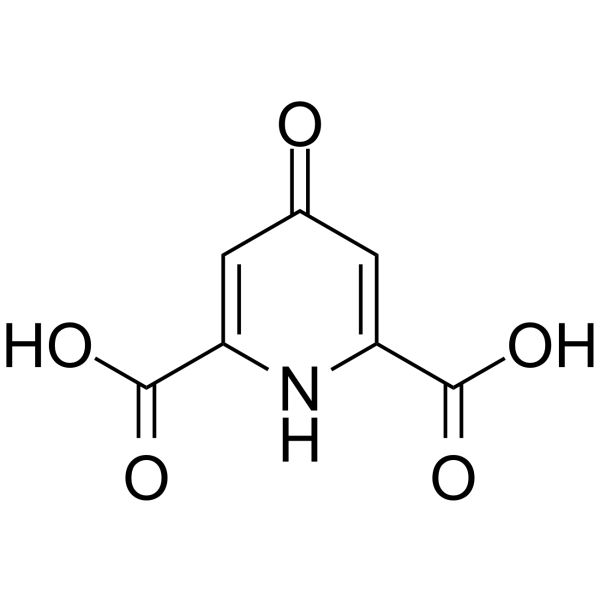
Physicochemical Properties
| Molecular Formula | C7H5NO5 |
| Molecular Weight | 183.1183 |
| Exact Mass | 183.016 |
| CAS # | 138-60-3 |
| PubChem CID | 8743 |
| Appearance | Yellow to brown solid powder |
| Density | 1.7±0.1 g/cm3 |
| Boiling Point | 428.3±45.0 °C at 760 mmHg |
| Melting Point | 267 °C (dec.)(lit.) |
| Flash Point | 212.8±28.7 °C |
| Vapour Pressure | 0.0±2.2 mmHg at 25°C |
| Index of Refraction | 1.635 |
| LogP | -1.43 |
| Hydrogen Bond Donor Count | 3 |
| Hydrogen Bond Acceptor Count | 6 |
| Rotatable Bond Count | 2 |
| Heavy Atom Count | 13 |
| Complexity | 320 |
| Defined Atom Stereocenter Count | 0 |
| InChi Key | XTLJJHGQACAZMS-UHFFFAOYSA-N |
| InChi Code | InChI=1S/C7H5NO5/c9-3-1-4(6(10)11)8-5(2-3)7(12)13/h1-2H,(H,8,9)(H,10,11)(H,12,13) |
| Chemical Name | 4-oxo-1H-pyridine-2,6-dicarboxylic acid |
| HS Tariff Code | 2934.99.9001 |
| Storage |
Powder-20°C 3 years 4°C 2 years In solvent -80°C 6 months -20°C 1 month |
| Shipping Condition | Room temperature (This product is stable at ambient temperature for a few days during ordinary shipping and time spent in Customs) |
Biological Activity
| Targets | Glutamate decarboxylase (GAD) from rat brain (competitive inhibitor, Ki = 33 μM)[3] |
| ln Vitro |
Chelidamic acid is a heterocyclic organic acid having a pyran structure [1]. Chelidonium acid exhibits strong coordination with noble metal ions [2]. Chelidamic Acid is a potent inhibitor of glutamic acid decarboxylase, with a Ki of 33 μM [3]. Chelidamic acid was identified as a potent inhibitor of rat brain glutamate decarboxylase (GAD). In an initial screening at 1 mM inhibitor concentration against 0.5 mM L-glutamate, Chelidamic acid inhibited GAD activity by 90% (Figure 2).[3] Kinetic analysis demonstrated that Chelidamic acid is a competitive inhibitor of GAD with respect to its substrate, L-glutamate. The inhibition constant (Ki) for Chelidamic acid was determined to be 33 μM. The apparent Km of the enzyme for glutamate under these conditions was 1.1 mM.[3] |
| Enzyme Assay |
Glutamate decarboxylase (GAD) activity was measured by trapping and counting 14CO2 released from purified D,L-[1-14C]glutamate. Assays were conducted at 37°C.[3] For the initial screening of inhibitors, the assay mixture contained approximately 0.5 mM L-glutamate (half the Km), 20 μM pyridoxal-P, 1 mM AET (2-aminoethylisothiouronium bromide), and 100 mM HEPES buffer (pH 7.0). Enzyme activity was determined in the presence or absence of 1 mM test inhibitor, and inhibition was expressed as a percentage of the control activity.[3] For detailed kinetic analysis of potent inhibitors like Chelidamic acid, assays were performed at varying glutamate concentrations (1 to 10 mM) in the presence of different inhibitor concentrations. Data were analyzed by fitting the competitive inhibition equation to determine the apparent Km and the inhibition constant (Ki).[3] |
| References |
[1]. Synthesis, DNA-cleaving properties and cytotoxicity of intercalating chelidamic acid derivatives. Anticancer Drug Des. 13(8):837-55. [2]. Mesogenic palladium complexes with pincer ligands derived from dipicolinic acid. Inorg Chem. 2000 Aug, 7;39(16):3645-51. [3]. Chelidonic acid and other conformationally restricted substrate analogues as inhibitors of rat brain glutamate decarboxylase. Biochem Pharmacol. 1985 Dec 1;34(23):4145-50. |
| Additional Infomation |
Chelidamic acid is a conformationally restricted analogue of glutamate, classified as a pyridine dicarboxylic acid (4-hydroxypyridine-2,6-dicarboxylic acid).[3] The study suggests that an intercarboxylate distance of about 0.75 nm (as found in isophthalic acid and Chelidamic acid) is optimal for competitive inhibition of GAD, indicating that glutamate likely binds to the enzyme's active site in an extended conformation.[3] The research aimed to find specific inhibitors of GAD as tools to study the regulation and role of γ-aminobutyric acid (GABA) synthesis in the nervous system. Chelidamic acid is a competitive inhibitor that blocks the entry of glutamate into the active site and does not promote the formation of inactive apoenzyme (unlike some other inhibitor classes).[3] |
Solubility Data
| Solubility (In Vitro) |
DMSO : ~10 mg/mL (~54.61 mM) H2O : ~1 mg/mL (~5.46 mM) |
| Solubility (In Vivo) |
Solubility in Formulation 1: ≥ 1 mg/mL (5.46 mM) (saturation unknown) in 10% DMSO + 40% PEG300 + 5% Tween80 + 45% Saline (add these co-solvents sequentially from left to right, and one by one), clear solution. For example, if 1 mL of working solution is to be prepared, you can add 100 μL of 10.0 mg/mL clear DMSO stock solution to 400 μL of PEG300 and mix evenly; then add 50 μL of Tween-80 to the above solution and mix evenly; then add 450 μL of normal saline to adjust the volume to 1 mL. Preparation of saline: Dissolve 0.9 g of sodium chloride in 100 mL ddH₂ O to obtain a clear solution. Solubility in Formulation 2: ≥ 1 mg/mL (5.46 mM) (saturation unknown) in 10% DMSO + 90% (20% SBE-β-CD in Saline) (add these co-solvents sequentially from left to right, and one by one), clear solution. For example, if 1 mL of working solution is to be prepared, you can add 100 μL of 10.0 mg/mL clear DMSO stock solution to 900 μL of 20% SBE-β-CD physiological saline solution and mix evenly. Preparation of 20% SBE-β-CD in Saline (4°C,1 week): Dissolve 2 g SBE-β-CD in 10 mL saline to obtain a clear solution. Solubility in Formulation 3: 1 mg/mL (5.46 mM) in PBS (add these co-solvents sequentially from left to right, and one by one), clear solution; with ultrasonication (<60°C). (Please use freshly prepared in vivo formulations for optimal results.) |
| Preparing Stock Solutions | 1 mg | 5 mg | 10 mg | |
| 1 mM | 5.4609 mL | 27.3045 mL | 54.6090 mL | |
| 5 mM | 1.0922 mL | 5.4609 mL | 10.9218 mL | |
| 10 mM | 0.5461 mL | 2.7304 mL | 5.4609 mL |