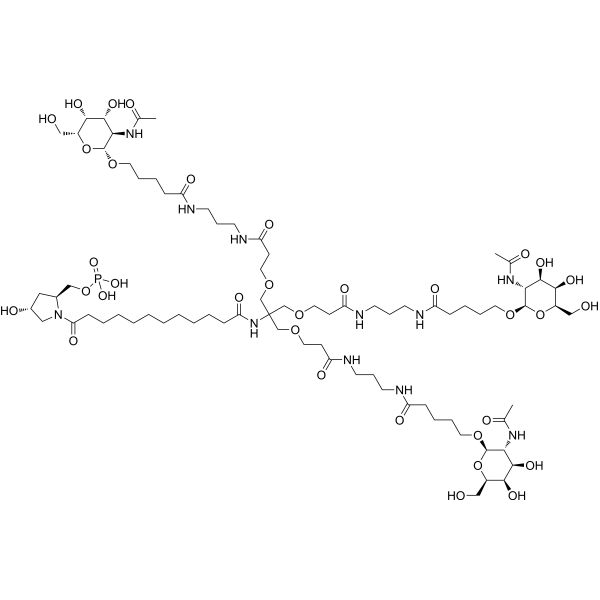
Cemdisiran, terminal sugar modification- is an N-acetylgalactosamine (GalNAc) conjugated siRNA (terminal sugar modified RNAi drug) used for complement-mediated diseases by suppressing liver production of complement 5 (C5) protein.
Physicochemical Properties
| Molecular Formula | C78H140N11O34P |
| Molecular Weight | 1806.97 |
| Exact Mass | 1805.93 |
| CAS # | 1436858-07-9 |
| PubChem CID | 126480325 |
| Appearance | Typically exists as solid at room temperature |
| LogP | -8 |
| Hydrogen Bond Donor Count | 22 |
| Hydrogen Bond Acceptor Count | 34 |
| Rotatable Bond Count | 66 |
| Heavy Atom Count | 124 |
| Complexity | 2950 |
| Defined Atom Stereocenter Count | 17 |
| SMILES | CC(=O)N[C@@H]1[C@H]([C@H]([C@H](O[C@H]1OCCCCC(=O)NCCCNC(=O)CCOCC(COCCC(=O)NCCCNC(=O)CCCCO[C@H]2[C@@H]([C@H]([C@H]([C@H](O2)CO)O)O)NC(=O)C)(COCCC(=O)NCCCNC(=O)CCCCO[C@H]3[C@@H]([C@H]([C@H]([C@H](O3)CO)O)O)NC(=O)C)NC(=O)CCCCCCCCCCC(=O)N4C[C@@H](C[C@H]4COP(=O)(O)O)O)CO)O)O |
| InChi Key | LQRNAUZEMLGYOX-LZVIIAQDSA-N |
| InChi Code | InChI=1S/C78H140N11O34P/c1-50(93)85-66-72(108)69(105)55(43-90)121-75(66)117-35-15-12-21-58(97)79-29-18-32-82-61(100)26-38-114-47-78(88-64(103)24-10-8-6-4-5-7-9-11-25-65(104)89-42-54(96)41-53(89)46-120-124(111,112)113,48-115-39-27-62(101)83-33-19-30-80-59(98)22-13-16-36-118-76-67(86-51(2)94)73(109)70(106)56(44-91)122-76)49-116-40-28-63(102)84-34-20-31-81-60(99)23-14-17-37-119-77-68(87-52(3)95)74(110)71(107)57(45-92)123-77/h53-57,66-77,90-92,96,105-110H,4-49H2,1-3H3,(H,79,97)(H,80,98)(H,81,99)(H,82,100)(H,83,101)(H,84,102)(H,85,93)(H,86,94)(H,87,95)(H,88,103)(H2,111,112,113)/t53-,54+,55+,56+,57+,66+,67+,68+,69-,70-,71-,72+,73+,74+,75+,76+,77+/m0/s1 |
| Chemical Name | [(2S,4R)-1-[12-[[1,3-bis[3-[3-[5-[(2R,3R,4R,5R,6R)-3-acetamido-4,5-dihydroxy-6-(hydroxymethyl)oxan-2-yl]oxypentanoylamino]propylamino]-3-oxopropoxy]-2-[[3-[3-[5-[(2R,3R,4R,5R,6R)-3-acetamido-4,5-dihydroxy-6-(hydroxymethyl)oxan-2-yl]oxypentanoylamino]propylamino]-3-oxopropoxy]methyl]propan-2-yl]amino]-12-oxododecanoyl]-4-hydroxypyrrolidin-2-yl]methyl dihydrogen phosphate |
| HS Tariff Code | 2934.99.9001 |
| Storage |
Powder-20°C 3 years 4°C 2 years In solvent -80°C 6 months -20°C 1 month |
| Shipping Condition | Room temperature (This product is stable at ambient temperature for a few days during ordinary shipping and time spent in Customs) |
Biological Activity
| Toxicity/Toxicokinetics |
Effects During Pregnancy and Lactation ◉ Summary of Use during Lactation No information is available on the clinical use of inclisiran during breastfeeding. Because inclisiran is a large oligonucleotide, the amount in milk is likely to be very low and absorption by the infant is probably minimal. If inclisiran is required by the mother, it is not a reason to discontinue breastfeeding. Until more data become available, inclisiran should be used with caution during breastfeeding, especially while nursing a newborn or preterm infant. ◉ Effects in Breastfed Infants Relevant published information was not found as of the revision date. ◉ Effects on Lactation and Breastmilk Relevant published information was not found as of the revision date. |
| Additional Infomation |
Cemdisiran is under investigation in clinical trial NCT03841448 (A Study of Cemdisiran in Adults With Immunoglobulin a Nephropathy (Igan)). Cemdisiran is a proprietary formulation composed of small-interfering RNAs (siRNAs) directed against terminal complement component 5 (C5) of the complement pathway conjugated to a N-acetylgalactosamine (GalNAc) ligand, which has potential use in the treatment of complement-mediated diseases, such as paroxysmal nocturnal hemoglobinuria (PNH). Upon subcutaneous administration of cemdisiran, the GalNAc ligand moiety specifically binds to and is taken up by the asialoglycoprotein receptor (ASGPR) expressed on hepatocytes. Inside the cell, the siRNAs bind to C5 mRNAs, which results in the inhibition of both the translation and expression of the C5 protein. This lowers plasma C5 levels, prevents C5 cleavage into pro-inflammatory components and blocks complement-mediated hemolysis. C5, a complement pathway protein, is expressed at high levels by the liver. See also: Inclisiran (annotation moved to). Drug Indication Leqvio is indicated in adults with primary hypercholesterolaemia (heterozygous familial and non-familial) or mixed dyslipidaemia, as an adjunct to diet: in combination with a statin or statin with other lipid-lowering therapies in patients unable to reach LDL-C goals with the maximum tolerated dose of a statin, oralone or in combination with other lipid-lowering therapies in patients who are statin-intolerant, or for whom a statin is contraindicated. |
Solubility Data
| Solubility (In Vitro) | May dissolve in DMSO (in most cases), if not, try other solvents such as H2O, Ethanol, or DMF with a minute amount of products to avoid loss of samples |
| Solubility (In Vivo) |
Note: Listed below are some common formulations that may be used to formulate products with low water solubility (e.g. < 1 mg/mL), you may test these formulations using a minute amount of products to avoid loss of samples. Injection Formulations (e.g. IP/IV/IM/SC) Injection Formulation 1: DMSO : Tween 80: Saline = 10 : 5 : 85 (i.e. 100 μL DMSO stock solution → 50 μL Tween 80 → 850 μL Saline) *Preparation of saline: Dissolve 0.9 g of sodium chloride in 100 mL ddH ₂ O to obtain a clear solution. Injection Formulation 2: DMSO : PEG300 :Tween 80 : Saline = 10 : 40 : 5 : 45 (i.e. 100 μL DMSO → 400 μLPEG300 → 50 μL Tween 80 → 450 μL Saline) Injection Formulation 3: DMSO : Corn oil = 10 : 90 (i.e. 100 μL DMSO → 900 μL Corn oil) Example: Take the Injection Formulation 3 (DMSO : Corn oil = 10 : 90) as an example, if 1 mL of 2.5 mg/mL working solution is to be prepared, you can take 100 μL 25 mg/mL DMSO stock solution and add to 900 μL corn oil, mix well to obtain a clear or suspension solution (2.5 mg/mL, ready for use in animals). Injection Formulation 4: DMSO : 20% SBE-β-CD in saline = 10 : 90 [i.e. 100 μL DMSO → 900 μL (20% SBE-β-CD in saline)] *Preparation of 20% SBE-β-CD in Saline (4°C,1 week): Dissolve 2 g SBE-β-CD in 10 mL saline to obtain a clear solution. Injection Formulation 5: 2-Hydroxypropyl-β-cyclodextrin : Saline = 50 : 50 (i.e. 500 μL 2-Hydroxypropyl-β-cyclodextrin → 500 μL Saline) Injection Formulation 6: DMSO : PEG300 : castor oil : Saline = 5 : 10 : 20 : 65 (i.e. 50 μL DMSO → 100 μLPEG300 → 200 μL castor oil → 650 μL Saline) Injection Formulation 7: Ethanol : Cremophor : Saline = 10: 10 : 80 (i.e. 100 μL Ethanol → 100 μL Cremophor → 800 μL Saline) Injection Formulation 8: Dissolve in Cremophor/Ethanol (50 : 50), then diluted by Saline Injection Formulation 9: EtOH : Corn oil = 10 : 90 (i.e. 100 μL EtOH → 900 μL Corn oil) Injection Formulation 10: EtOH : PEG300:Tween 80 : Saline = 10 : 40 : 5 : 45 (i.e. 100 μL EtOH → 400 μLPEG300 → 50 μL Tween 80 → 450 μL Saline) Oral Formulations Oral Formulation 1: Suspend in 0.5% CMC Na (carboxymethylcellulose sodium) Oral Formulation 2: Suspend in 0.5% Carboxymethyl cellulose Example: Take the Oral Formulation 1 (Suspend in 0.5% CMC Na) as an example, if 100 mL of 2.5 mg/mL working solution is to be prepared, you can first prepare 0.5% CMC Na solution by measuring 0.5 g CMC Na and dissolve it in 100 mL ddH2O to obtain a clear solution; then add 250 mg of the product to 100 mL 0.5% CMC Na solution, to make the suspension solution (2.5 mg/mL, ready for use in animals). Oral Formulation 3: Dissolved in PEG400 Oral Formulation 4: Suspend in 0.2% Carboxymethyl cellulose Oral Formulation 5: Dissolve in 0.25% Tween 80 and 0.5% Carboxymethyl cellulose Oral Formulation 6: Mixing with food powders Note: Please be aware that the above formulations are for reference only. InvivoChem strongly recommends customers to read literature methods/protocols carefully before determining which formulation you should use for in vivo studies, as different compounds have different solubility properties and have to be formulated differently. (Please use freshly prepared in vivo formulations for optimal results.) |
| Preparing Stock Solutions | 1 mg | 5 mg | 10 mg | |
| 1 mM | 0.5534 mL | 2.7671 mL | 5.5341 mL | |
| 5 mM | 0.1107 mL | 0.5534 mL | 1.1068 mL | |
| 10 mM | 0.0553 mL | 0.2767 mL | 0.5534 mL |