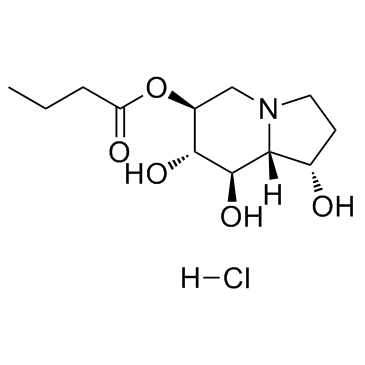
Celgosivir hydrochloride (MDL-28574A) is a novel and potent α-glucosidase I inhibitor that inhibits bovine viral diarrhoea virus (BVDV) with an IC50 of 1.27 μM in in vitro assay.
Physicochemical Properties
| Molecular Formula | C12H22CLNO5 |
| Molecular Weight | 295.7598 |
| Exact Mass | 295.119 |
| CAS # | 141117-12-6 |
| Related CAS # | Celgosivir;121104-96-9 |
| PubChem CID | 3033824 |
| Appearance | White to gray solid powder |
| Boiling Point | 422.9ºC at 760 mmHg |
| Flash Point | 209.6ºC |
| Vapour Pressure | 6.34E-09mmHg at 25°C |
| Hydrogen Bond Donor Count | 4 |
| Hydrogen Bond Acceptor Count | 6 |
| Rotatable Bond Count | 4 |
| Heavy Atom Count | 19 |
| Complexity | 311 |
| Defined Atom Stereocenter Count | 5 |
| SMILES | CCCC(=O)O[C@H]1CN2CC[C@@H]([C@@H]2[C@H]([C@@H]1O)O)O.Cl |
| InChi Key | KXNZMBFOWDNCRU-QVMZSJACSA-N |
| InChi Code | InChI=1S/C12H21NO5.ClH/c1-2-3-9(15)18-8-6-13-5-4-7(14)10(13)12(17)11(8)16;/h7-8,10-12,14,16-17H,2-6H2,1H3;1H/t7-,8-,10+,11+,12+;/m0./s1 |
| Chemical Name | [(1S,6S,7S,8R,8aR)-1,7,8-trihydroxy-1,2,3,5,6,7,8,8a-octahydroindolizin-6-yl] butanoate;hydrochloride |
| HS Tariff Code | 2934.99.9001 |
| Storage |
Powder-20°C 3 years 4°C 2 years In solvent -80°C 6 months -20°C 1 month Note: Please store this product in a sealed and protected environment, avoid exposure to moisture. |
| Shipping Condition | Room temperature (This product is stable at ambient temperature for a few days during ordinary shipping and time spent in Customs) |
Biological Activity
| ln Vitro | By inhibiting glycoprotein processing, cegosivir is more effective (IC50=20 μM) than the parent molecule (IC50=254 μM) at causing the buildup of glucosylated oligosaccharides in HIV-infected cells. With an IC50 of 2.0±2.3 μM, celibosivir demonstrates strong antiviral activity against HIV-1[1]. The hepatitis C virus (HCV) and the bovine viral diarrhea virus (BVDV) are closely related viruses. With IC50 values of 16 and 47 μM in the plaque assay and cytopathic effect assay, respectively, celgosivir suppresses BVDV[2]. With an EC50 of 0.2 μM, celgosivir suppresses the replication of DENV2. Less than 0.7 μM is the EC50 value against DENV1, 3, and 4[3]. | |
| ln Vivo | At a dose of 50 mg/kg twice daily (BID) for five days, cegosivir completely protects AG129 mice against a deadly infection with a mouse-adapted dengue virus. It remains efficacious even after a 48-hour treatment delay. Celgosivir's protective effects vary depending on the dose and schedule; a 50, 25 or 10 mg/kg twice-day regimen is more effective than a 100 mg/kg dose taken once daily. Celgosivir quickly metabolizes to castanospermine, according to pharmacokinetic tests conducted in mice[4]. When mice were first infected with the mouse-adapted DENV strain S221, their viremia increased on day 3, but by day 10, 80% of them had recovered, and by day 8, the virus had totally disappeared[3]. | |
| Enzyme Assay |
|
|
| Cell Assay |
|
|
| References |
[1]. Inhibition of alpha-glucosidase I of the glycoprotein-processing enzymes by 6-O-butanoylcastanospermine (MDL 28,574) and its consequences in human immunodeficiency virus-infected T cells. Antimicrob Agents Chemother. 1994 Aug;38(8):1780-7. [2]. Action of celgosivir (6 O-butanoyl castanospermine) against the pestivirus BVDV: implications for the treatment of hepatitis C. Antivir Chem Chemother. 2004 May;15(3):141-51. [3]. Dose- and schedule-dependent protective efficacy of celgosivir in a lethal mouse model for dengue virus infection informs dosing regimen for a proof of concept clinical trial. Antiviral Res. 2012 Oct;96(1):32-5. [4]. Celgosivir treatment misfolds dengue virus NS1 protein, induces cellular pro-survival genes andprotects against lethal challenge mouse model. Antiviral Res. 2011 Dec;92(3):453-60. |
Solubility Data
| Solubility (In Vitro) |
H2O : ≥ 100 mg/mL (~338.11 mM) DMSO : ~100 mg/mL (~338.11 mM) |
| Solubility (In Vivo) |
Solubility in Formulation 1: ≥ 2.5 mg/mL (8.45 mM) (saturation unknown) in 10% DMSO + 40% PEG300 + 5% Tween80 + 45% Saline (add these co-solvents sequentially from left to right, and one by one), clear solution. For example, if 1 mL of working solution is to be prepared, you can add 100 μL of 25.0 mg/mL clear DMSO stock solution to 400 μL PEG300 and mix evenly; then add 50 μL Tween-80 to the above solution and mix evenly; then add 450 μL normal saline to adjust the volume to 1 mL. Preparation of saline: Dissolve 0.9 g of sodium chloride in 100 mL ddH₂ O to obtain a clear solution. Solubility in Formulation 2: ≥ 2.5 mg/mL (8.45 mM) (saturation unknown) in 10% DMSO + 90% (20% SBE-β-CD in Saline) (add these co-solvents sequentially from left to right, and one by one), clear solution. For example, if 1 mL of working solution is to be prepared, you can add 100 μL of 25.0 mg/mL clear DMSO stock solution to 900 μL of 20% SBE-β-CD physiological saline solution and mix evenly. Preparation of 20% SBE-β-CD in Saline (4°C,1 week): Dissolve 2 g SBE-β-CD in 10 mL saline to obtain a clear solution. Solubility in Formulation 3: ≥ 2.5 mg/mL (8.45 mM) (saturation unknown) in 10% DMSO + 90% Corn Oil (add these co-solvents sequentially from left to right, and one by one), clear solution. For example, if 1 mL of working solution is to be prepared, you can add 100 μL of 25.0 mg/mL clear DMSO stock solution to 900 μL of corn oil and mix evenly. Solubility in Formulation 4: 100 mg/mL (338.11 mM) in PBS (add these co-solvents sequentially from left to right, and one by one), clear solution; with ultrasonication. (Please use freshly prepared in vivo formulations for optimal results.) |
| Preparing Stock Solutions | 1 mg | 5 mg | 10 mg | |
| 1 mM | 3.3811 mL | 16.9056 mL | 33.8112 mL | |
| 5 mM | 0.6762 mL | 3.3811 mL | 6.7622 mL | |
| 10 mM | 0.3381 mL | 1.6906 mL | 3.3811 mL |