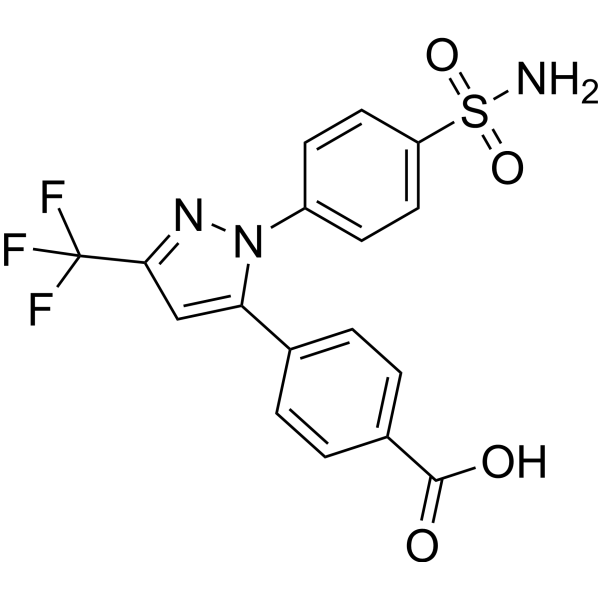
Physicochemical Properties
| Molecular Formula | C17H12F3N3O4S |
| Molecular Weight | 411.36 |
| Exact Mass | 411.05 |
| CAS # | 170571-01-4 |
| PubChem CID | 10047220 |
| Appearance | White to off-white solid powder |
| Density | 1.571g/cm3 |
| Boiling Point | 612.122ºC at 760 mmHg |
| Melting Point | 237-239ºC |
| Flash Point | 324ºC |
| Vapour Pressure | 0mmHg at 25°C |
| Index of Refraction | 1.635 |
| LogP | 4.684 |
| Hydrogen Bond Donor Count | 2 |
| Hydrogen Bond Acceptor Count | 9 |
| Rotatable Bond Count | 4 |
| Heavy Atom Count | 28 |
| Complexity | 666 |
| Defined Atom Stereocenter Count | 0 |
| SMILES | NS(C1C=CC(N2C(C3C=CC(C(O)=O)=CC=3)=CC(C(F)(F)F)=N2)=CC=1)(=O)=O |
| InChi Key | WTHNOVFEXONZMI-UHFFFAOYSA-N |
| InChi Code | InChI=1S/C17H12F3N3O4S/c18-17(19,20)15-9-14(10-1-3-11(4-2-10)16(24)25)23(22-15)12-5-7-13(8-6-12)28(21,26)27/h1-9H,(H,24,25)(H2,21,26,27) |
| Chemical Name | 4-[2-(4-sulfamoylphenyl)-5-(trifluoromethyl)pyrazol-3-yl]benzoic acid |
| Synonyms | Celecoxib Carboxylic Acid; 170571-01-4; Carboxylic acid celecoxib; Celecoxib metabolite M2; 4-(1-(4-(Aminosulfonyl)phenyl)-3-(trifluoromethyl)-1H-pyrazol-5-yl)benzoic acid; UNII-EQJ1364UKF; EQJ1364UKF; 4-[2-(4-sulfamoylphenyl)-5-(trifluoromethyl)pyrazol-3-yl]benzoic Acid; |
| HS Tariff Code | 2934.99.9001 |
| Storage |
Powder-20°C 3 years 4°C 2 years In solvent -80°C 6 months -20°C 1 month Note: Please store this product in a sealed and protected environment, avoid exposure to moisture. |
| Shipping Condition | Room temperature (This product is stable at ambient temperature for a few days during ordinary shipping and time spent in Customs) |
Biological Activity
| Targets | Celecoxib metabolite; COX-2 |
| ln Vivo | Celecoxib, a selective cyclooxygenase (COX)-2 inhibitor, is used for the treatment of rheumatoid arthritis and osteoarthritis. The predominant hepatic metabolism of celecoxib to celecoxib carboxylic acid (CCA) is mediated mainly by CYP2C9. We investigated the effects of the major CYP2C9 genetic variants in Asian populations, CYP2C9*3 and CYP2C9*13, on the pharmacokinetics of celecoxib and its carboxylic acid metabolite in healthy Korean subjects. A single 200-mg oral dose of celecoxib was given to 52 Korean subjects with different CYP2C9 genotypes: CYP2C9EM (n = 26; CYP2C9*1/*1), CYP2C9IM (n = 24; CYP2C9*1/*3 and *1/*13), and CYP2C9PM (n = 2; CYP2C9*3/*3). Celecoxib and CCA concentrations in plasma samples collected up to 48 or 96 h after drug intake were determined by HPLC-MS/MS. The mean area under the plasma concentration-time curve (AUC0-∞) of celecoxib was increased 1.63-fold (P < 0.001), and the apparent oral clearance (CL/F) of celecoxib was decreased by 39.6% in the CYP2C9IM genotype group compared with that of CYP2C9EM (P < 0.001). The overall pharmacokinetic parameters for celecoxib in CYP2C9*1/*13 subjects were similar to those in CYP2C9*1/*3 subjects. Two subjects with CYP2C9PM genotype both showed markedly higher AUC0-∞, prolonged half-life, and lower CL/F for celecoxib than did subjects with CYP2C9EM and IM genotypes. CYP2C9*3 and CYP2C9*13 variant alleles significantly affected the plasma concentration of celecoxib[1]. |
| Animal Protocol |
Pharmacokinetic analysis [1] The pharmacokinetic parameters of celecoxib and CCA were estimated with the BA calc 2007 analysis program (KFDA, Seoul, Korea). Actual blood sampling times were used, and observed values were used for the maximum plasma concentration (Cmax) and time to reach Cmax (tmax). The area under the plasma concentration–time curve (AUC) was calculated using the linear-log trapezoidal rule. The elimination rate constant (ke) was estimated from the least-squares regression slope of the terminal plasma concentration. The AUC from 0 to infinity (AUC0–∞) was calculated as AUC0–∞ = AUC + Ct/ke, where Ct is the most recently measured plasma concentration. The half-life (t1/2) was calculated as ln 2/ke, and the apparent oral clearance (CL/F) of celecoxib was calculated as CL/F = dose/AUC0–∞. |
| ADME/Pharmacokinetics |
Metabolism / Metabolites Carboxy celecoxib has known human metabolites that include (2S,3S,4S,5R)-3,4,5-Trihydroxy-6-[4-[2-(4-sulfamoylphenyl)-5-(trifluoromethyl)pyrazol-3-yl]benzoyl]oxyoxane-2-carboxylic acid. |
| References |
[1].Effects of CYP2C9 genetic polymorphisms on the pharmacokinetics of celecoxib and its carboxylic acid metabolite. Arch Pharm Res. 2017 Mar;40(3):382-390. |
| Additional Infomation | Carboxylic acid celecoxib is a member of pyrazoles. |
Solubility Data
| Solubility (In Vitro) | DMSO :~125 mg/mL (~303.87 mM; with sonication) |
| Solubility (In Vivo) |
Note: Listed below are some common formulations that may be used to formulate products with low water solubility (e.g. < 1 mg/mL), you may test these formulations using a minute amount of products to avoid loss of samples. Injection Formulations (e.g. IP/IV/IM/SC) Injection Formulation 1: DMSO : Tween 80: Saline = 10 : 5 : 85 (i.e. 100 μL DMSO stock solution → 50 μL Tween 80 → 850 μL Saline) *Preparation of saline: Dissolve 0.9 g of sodium chloride in 100 mL ddH ₂ O to obtain a clear solution. Injection Formulation 2: DMSO : PEG300 :Tween 80 : Saline = 10 : 40 : 5 : 45 (i.e. 100 μL DMSO → 400 μLPEG300 → 50 μL Tween 80 → 450 μL Saline) Injection Formulation 3: DMSO : Corn oil = 10 : 90 (i.e. 100 μL DMSO → 900 μL Corn oil) Example: Take the Injection Formulation 3 (DMSO : Corn oil = 10 : 90) as an example, if 1 mL of 2.5 mg/mL working solution is to be prepared, you can take 100 μL 25 mg/mL DMSO stock solution and add to 900 μL corn oil, mix well to obtain a clear or suspension solution (2.5 mg/mL, ready for use in animals). Injection Formulation 4: DMSO : 20% SBE-β-CD in saline = 10 : 90 [i.e. 100 μL DMSO → 900 μL (20% SBE-β-CD in saline)] *Preparation of 20% SBE-β-CD in Saline (4°C,1 week): Dissolve 2 g SBE-β-CD in 10 mL saline to obtain a clear solution. Injection Formulation 5: 2-Hydroxypropyl-β-cyclodextrin : Saline = 50 : 50 (i.e. 500 μL 2-Hydroxypropyl-β-cyclodextrin → 500 μL Saline) Injection Formulation 6: DMSO : PEG300 : castor oil : Saline = 5 : 10 : 20 : 65 (i.e. 50 μL DMSO → 100 μLPEG300 → 200 μL castor oil → 650 μL Saline) Injection Formulation 7: Ethanol : Cremophor : Saline = 10: 10 : 80 (i.e. 100 μL Ethanol → 100 μL Cremophor → 800 μL Saline) Injection Formulation 8: Dissolve in Cremophor/Ethanol (50 : 50), then diluted by Saline Injection Formulation 9: EtOH : Corn oil = 10 : 90 (i.e. 100 μL EtOH → 900 μL Corn oil) Injection Formulation 10: EtOH : PEG300:Tween 80 : Saline = 10 : 40 : 5 : 45 (i.e. 100 μL EtOH → 400 μLPEG300 → 50 μL Tween 80 → 450 μL Saline) Oral Formulations Oral Formulation 1: Suspend in 0.5% CMC Na (carboxymethylcellulose sodium) Oral Formulation 2: Suspend in 0.5% Carboxymethyl cellulose Example: Take the Oral Formulation 1 (Suspend in 0.5% CMC Na) as an example, if 100 mL of 2.5 mg/mL working solution is to be prepared, you can first prepare 0.5% CMC Na solution by measuring 0.5 g CMC Na and dissolve it in 100 mL ddH2O to obtain a clear solution; then add 250 mg of the product to 100 mL 0.5% CMC Na solution, to make the suspension solution (2.5 mg/mL, ready for use in animals). Oral Formulation 3: Dissolved in PEG400 Oral Formulation 4: Suspend in 0.2% Carboxymethyl cellulose Oral Formulation 5: Dissolve in 0.25% Tween 80 and 0.5% Carboxymethyl cellulose Oral Formulation 6: Mixing with food powders Note: Please be aware that the above formulations are for reference only. InvivoChem strongly recommends customers to read literature methods/protocols carefully before determining which formulation you should use for in vivo studies, as different compounds have different solubility properties and have to be formulated differently. (Please use freshly prepared in vivo formulations for optimal results.) |
| Preparing Stock Solutions | 1 mg | 5 mg | 10 mg | |
| 1 mM | 2.4310 mL | 12.1548 mL | 24.3096 mL | |
| 5 mM | 0.4862 mL | 2.4310 mL | 4.8619 mL | |
| 10 mM | 0.2431 mL | 1.2155 mL | 2.4310 mL |