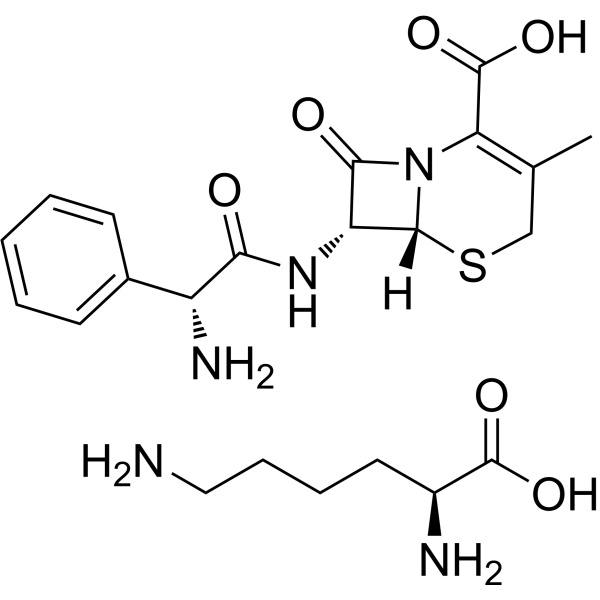
Physicochemical Properties
| Molecular Formula | C16H17N3O4S.C6H14N2O2 |
| Molecular Weight | 493.57644 |
| Exact Mass | 493.199 |
| CAS # | 53950-14-4 |
| Related CAS # | Cephalexin;15686-71-2;Cephalexin hydrochloride;59695-59-9;Cephalexin monohydrate;23325-78-2;Cephalexin hydrochloride monohydrate;105879-42-3 |
| PubChem CID | 92135907 |
| Appearance | Typically exists as solid at room temperature |
| Hydrogen Bond Donor Count | 6 |
| Hydrogen Bond Acceptor Count | 10 |
| Rotatable Bond Count | 9 |
| Heavy Atom Count | 34 |
| Complexity | 706 |
| Defined Atom Stereocenter Count | 4 |
| SMILES | CC1=C(N2[C@@H]([C@@H](C2=O)NC(=O)[C@@H](C3=CC=CC=C3)N)SC1)C(=O)O.C(CCN)C[C@@H](C(=O)O)N |
| InChi Key | CSXICSKZWGBACI-SSDGIDNNSA-N |
| InChi Code | InChI=1S/C16H17N3O4S.C6H14N2O2/c1-8-7-24-15-11(14(21)19(15)12(8)16(22)23)18-13(20)10(17)9-5-3-2-4-6-9;7-4-2-1-3-5(8)6(9)10/h2-6,10-11,15H,7,17H2,1H3,(H,18,20)(H,22,23);5H,1-4,7-8H2,(H,9,10)/t10-,11-,15-;5-/m10/s1 |
| Chemical Name | (6R,7R)-7-[[(2R)-2-amino-2-phenylacetyl]amino]-3-methyl-8-oxo-5-thia-1-azabicyclo[4.2.0]oct-2-ene-2-carboxylic acid;(2S)-2,6-diaminohexanoic acid |
| Synonyms | 53950-14-4; Cephalexin lysinate; (6R,7R)-7-[(2-amino-2-phenylacetyl)amino]-3-methyl-8-oxo-5-thia-1-azabicyclo[4.2.0]oct-2-ene-2-carboxylic acid;(2S)-2,6-diaminohexanoic acid; L-lysine compound with (6R,7R)-7-(2-amino-2-phenylacetamido)-3-methyl-8-oxo-5-thia-1-azabicyclo[4.2.0]oct-2-ene-2-carboxylic acid (1:1); L-lysine mono[[6R-[6alpha,7beta(R*)]]-7-[(aminophenylacetyl)amino]-3-methyl-8-oxo-5-thia-1-azabicyclo[4.2.0]oct-2-ene-2-carboxylate]; DTXSID30968760; CSXICSKZWGBACI-ZMZYGIGZSA-N; DB-230587; |
| HS Tariff Code | 2934.99.9001 |
| Storage |
Powder-20°C 3 years 4°C 2 years In solvent -80°C 6 months -20°C 1 month |
| Shipping Condition | Room temperature (This product is stable at ambient temperature for a few days during ordinary shipping and time spent in Customs) |
Biological Activity
| Targets | Cephalosporin antibiotic; bacterial cell wall synthesis; penicillin binding proteins (PBPs) |
| ln Vitro | Cephalexin lysine (10 μg/mL) inactivates an enzyme known as penicillin-binding protein (PBP), which disturbs the synthesis of the polymer peptidoglycan (PG) [1]. Numerous Gram-positive and Gram-negative bacteria are inhibited by cephalexin lysine. Bacillus anthracis, Vibrio cholerae, Edwardsiella spp., Pasteurella multocida, Edwardsiella lentus, and Alcaligenes have MIC values of 2. Proteus rettgeri and 2, 2, 2, 4, 4.4, and 5.7 μg/mL, respectively, were found in [2]. |
| ln Vivo | The antibacterial action of cephalexin lysine (0-50 mg/kg; oral; 3.5 hours) was seen against male Swiss-Webster mice infected with microorganisms [2]. |
| Enzyme Assay | Penicillin and related beta-lactams comprise one of our oldest and most widely used antibiotic therapies. These drugs have long been known to target enzymes called penicillin-binding proteins (PBPs) that build the bacterial cell wall. Investigating the downstream consequences of target inhibition and how they contribute to the lethal action of these important drugs, we demonstrate that beta-lactams do more than just inhibit the PBPs as is commonly believed. Rather, they induce a toxic malfunctioning of their target biosynthetic machinery involving a futile cycle of cell wall synthesis and degradation, thereby depleting cellular resources and bolstering their killing activity. Characterization of this mode of action additionally revealed a quality control function for enzymes that cleave bonds in the cell wall matrix. The results thus provide insight into the mechanism of cell wall assembly and suggest how best to interfere with the process for future antibiotic development.[1] |
| Animal Protocol |
Animal/Disease Models: Bacterially infected male Swiss-Webster mice [2] Doses: 0-50 mg/kg Route of Administration: po (po (oral gavage)) 3.5 hrs (hrs (hours)) Experimental Results: Against Streptococcus pyogenes, Streptococcus pneumoniae, Staphylococcus aureus and several Antimicrobial activity against Gram-negative bacteria in mice. |
| ADME/Pharmacokinetics |
Absorption Well absorbed from the upper gastrointestinal tract with nearly 100% oral bioavailability. Cephalexin is not absorbed in the stomach but is absorbed in the upper intestine. Patients taking 250mg of cephalexin reach a maximum plasma concentration of 7.7mcg/mL and patients taking 500mg reach 12.3mcg/mL. Route of Elimination Cephalexin is over 90% excreted in the urine after 6 hours by glomerular filtration and tubular secretion with a mean urinary recovery of 99.3%. Cephalexin is unchanged in the urine. Volume of Distribution 5.2-5.8L. Clearance Clearance from one subject was 376mL/min. LESS THAN 10 TO 15%...IS BOUND TO PLASMA PROTEIN, & PLASMA DRUG CONCN FALL RAPIDLY... MORE THAN 90%...IS EXCRETED UNALTERED IN URINE WITHIN 6 HR, PRIMARILY BY RENAL TUBULAR SECRETION. ...THERAPEUTICALLY EFFECTIVE CONCN ARE STILL ACHIEVED IN URINE OF PT WITH DECR RENAL FUNCTION. CEPHALEXIN...IS WELL ABSORBED FROM GI TRACT. PEAK PLASMA CONCN, REACHED @ ABOUT 1 HR AFTER INGESTION OF DRUG, ARE APPROX 9 & 18 UG/ML AFTER ORAL DOSES OF 250 & 500 MG, RESPECTIVELY. INGESTION OF FOOD MAY DELAY ABSORPTION. BOTH ABSORPTION & EXCRETION OF CEPHALEXIN ARE IMPAIRED IN NEW-BORN INFANTS, WHERe 24-HR URINARY RECOVERY OF ANTIBIOTIC ACCOUNTED FOR 5-66% OF DAILY ORAL DOSE. Metabolism / Metabolites Cephalexin is not metabolized in the body. Biological Half-Life The half life of cephalexin is 49.5 minutes in a fasted state and 76.5 minutes with food though these times were not significantly different in the study. The serum half-life of cephalexin is 0.5-1.2 hr in adults with normal renal function. The serum half-life of the drug is reported to be about 5 hr in neonates and 2.5 hr in children 3-12 mo of age. In one study, the serum half-life was 7.7 hr in adults with creatinine clearances of 9.2 ml/min and 13.9 hr in adults with creatinine clearances of 4 ml/min. Protein Binding Cephalexin is 10-15% bound to serum proteins including serum albumin. |
| Toxicity/Toxicokinetics |
Effects During Pregnancy and Lactation
◉ Summary of Use during Lactation Limited information indicates that maternal cephalexin produces low levels in milk that are usually not expected to cause adverse effects in breastfed infants. Cephalexin is an alternative for the treatment of mastitis. Occasionally disruption of the infant's gastrointestinal flora, resulting in diarrhea or thrush have been reported with cephalosporins, but these effects have not been adequately evaluated. A rare case of a severe allergic reaction occurred in an infant previously exposed to intravenous cefazolin whose mother began taking cephalexin while breastfeeding. Cephalexin is acceptable in nursing mothers. ◉ Effects in Breastfed Infants In a prospective follow-up study, 7 nursing mothers reported taking cephalexin (dosage not specified). Two mothers reported diarrhea in their infants. No rashes or candidiasis were reported among the exposed infants. A prospective, controlled study asked mothers who called an information service about adverse reactions experience by their breastfed infants. One of 11 cephalexin-exposed infants reportedly developed diarrhea during maternal cephalexin therapy. A woman received intravenous cephalothin 1 g every 6 hours for 3 days. Her breastfed infant had a green liquid stool, severe diarrhea, discomfort and crying. The mother's drug regimen was then changed to oral cephalexin 500 mg plus oral probenecid 500 mg 4 times daily for another 16 days. The infant continued to have diarrhea during this time. The authors rated the diarrhea as probably related to cephalexin in milk. A 4-month-old infant was treated with intravenous cefazolin for a urinary tract infection. Nine days after being discharged and cefazolin discontinuation, the infant developed a blistering rash over most of the body that was diagnosed as toxic epidermal necrolysis (TEN). The infant was being breastfed (extent unspecified) by his mother who had begun cephalexin 2 days prior to the onset of symptoms. A lymphocyte transformation test performed 4 weeks after treatment for TEN was completed found sensitization to both cefazolin and cephalexin. The infant's reaction was probably caused by cephalexin in breastmilk after initial sensitization and subsequent cross-reaction to cefazolin. ◉ Effects on Lactation and Breastmilk Relevant published information was not found as of the revision date. View More
◈ What is cephalexin?
|
| References |
[1]. Beta-lactam antibiotics induce a lethal malfunctioning of the bacterial cell wall synthesis machinery. Cell. 2014 Dec 4;159(6):1300-11. [2]. Cefadroxil, a new broad-spectrum cephalosporin. Antimicrob Agents Chemother. 1977 Feb;11(2):324-30. |
| Additional Infomation |
Cephalexin is a semisynthetic first-generation cephalosporin antibiotic having methyl and beta-(2R)-2-amino-2-phenylacetamido groups at the 3- and 7- of the cephem skeleton, respectively. It is effective against both Gram-negative and Gram-positive organisms, and is used for treatment of infections of the skin, respiratory tract and urinary tract. It has a role as an antibacterial drug. It is a cephalosporin, a semisynthetic derivative and a beta-lactam antibiotic allergen. It is a conjugate acid of a cephalexin(1-).
Cephalexin is the first of the first generation cephalosporins. This antibiotic contains a beta lactam and a dihydrothiazide. Cephalexin is used to treat a number of susceptible bacterial infections through inhibition of cell wall synthesis. Cephalexin was approved by the FDA on 4 January 1971. Cephalexin anhydrous is a Cephalosporin Antibacterial. Keflet has been reported in Streptomyces. Cephalexin is a beta-lactam, first-generation cephalosporin antibiotic with bactericidal activity. Cephalexin binds to and inactivates penicillin-binding proteins (PBP) located on the inner membrane of the bacterial cell wall. Inactivation of PBPs interferes with the cross-linking of peptidoglycan chains necessary for bacterial cell wall strength and rigidity. This results in the weakening of the bacterial cell wall and causes cell lysis. Compared to second and third generation cephalosporins, cephalexin is more active against gram-positive and less active against gram-negative organisms. Cephalexin Anhydrous is the anhydrous form of cephalexin, a semisynthetic first-generation cephalosporin with antibacterial activity. Cephalexin binds to and inactivates penicillin-binding proteins (PBPs) located on the inner membrane of the bacterial cell wall. PBPs are enzymes involved in the terminal stages of assembling the bacterial cell wall and in reshaping the cell wall during growth and division. Inactivation of PBPs interferes with the cross-linkage of peptidoglycan chains necessary for bacterial cell wall strength and rigidity. This results in the weakening of the bacterial cell wall and causes cell lysis. A semisynthetic cephalosporin antibiotic with antimicrobial activity similar to that of CEPHALORIDINE or CEPHALOTHIN, but somewhat less potent. It is effective against both gram-positive and gram-negative organisms. View More
Drug Indication
Pharmacodynamics Cephalexin (also called Cefalexin) is a first generation cephalosporin antibiotic. It is one of the most widely prescribed antibiotics, often used for the treatment of superficial infections that result as complications of minor wounds or lacerations. It is effective against most gram-positive bacteria through its inihibition of the cross linking reaction between N-acetyl muramicacid and N-acetylglucosamine in the cell wall, leading to cell lysis. Mechanism of Action Cephalexin is a first generation cephalosporin antibiotic. Cephalosporins contain a beta lactam and dihydrothiazide. Unlike penicillins, cephalosprins are more resistant to the action of beta lactamase. Cephalexin inhibits bacterial cell wall synthesis, leading breakdown and eventualy cell death. CEPHALOTHIN & ITS CONGENERS INHIBIT BACTERIAL CELL-WALL SYNTHESIS IN MANNER SIMILAR TO THAT OF PENICILLIN. /CEPHALOSPORINS/ The penicillins and their metabolites are potent immunogens because of their ability to combine with proteins and act as haptens for acute antibody-mediated reactions. The most frequent (about 95 percent) or "major" determinant of penicillin allergy is the penicilloyl determinant produced by opening the beta-lactam ring of the penicillin. This allows linkage of the penicillin to protein at the amide group. "Minor" determinants (less frequent) are the other metabolites formed, including native penicillin and penicilloic acids. /Penicillins/ Bactericidal; action depends on ability to reach and bind penicillin-binding proteins located in bacterial cytoplasmic membranes; cephalosporins inhibit bacterial septum and cell wall synthesis, probably by acylation of membrane-bound transpeptidase enzymes. This prevents cross-linkage of peptidoglycan chains, which is necessary for bacterial cell wall strength and rigidity. Also, cell division and growth are inhibited, and lysis and elongation of susceptible bacteria frequently occur. Rapidly dividing bacteria are those most susceptible to the action of cephalosporins. /Cephalosporins/ |
Solubility Data
| Solubility (In Vitro) | May dissolve in DMSO (in most cases), if not, try other solvents such as H2O, Ethanol, or DMF with a minute amount of products to avoid loss of samples |
| Solubility (In Vivo) |
Note: Listed below are some common formulations that may be used to formulate products with low water solubility (e.g. < 1 mg/mL), you may test these formulations using a minute amount of products to avoid loss of samples. Injection Formulations (e.g. IP/IV/IM/SC) Injection Formulation 1: DMSO : Tween 80: Saline = 10 : 5 : 85 (i.e. 100 μL DMSO stock solution → 50 μL Tween 80 → 850 μL Saline) *Preparation of saline: Dissolve 0.9 g of sodium chloride in 100 mL ddH ₂ O to obtain a clear solution. Injection Formulation 2: DMSO : PEG300 :Tween 80 : Saline = 10 : 40 : 5 : 45 (i.e. 100 μL DMSO → 400 μLPEG300 → 50 μL Tween 80 → 450 μL Saline) Injection Formulation 3: DMSO : Corn oil = 10 : 90 (i.e. 100 μL DMSO → 900 μL Corn oil) Example: Take the Injection Formulation 3 (DMSO : Corn oil = 10 : 90) as an example, if 1 mL of 2.5 mg/mL working solution is to be prepared, you can take 100 μL 25 mg/mL DMSO stock solution and add to 900 μL corn oil, mix well to obtain a clear or suspension solution (2.5 mg/mL, ready for use in animals). Injection Formulation 4: DMSO : 20% SBE-β-CD in saline = 10 : 90 [i.e. 100 μL DMSO → 900 μL (20% SBE-β-CD in saline)] *Preparation of 20% SBE-β-CD in Saline (4°C,1 week): Dissolve 2 g SBE-β-CD in 10 mL saline to obtain a clear solution. Injection Formulation 5: 2-Hydroxypropyl-β-cyclodextrin : Saline = 50 : 50 (i.e. 500 μL 2-Hydroxypropyl-β-cyclodextrin → 500 μL Saline) Injection Formulation 6: DMSO : PEG300 : castor oil : Saline = 5 : 10 : 20 : 65 (i.e. 50 μL DMSO → 100 μLPEG300 → 200 μL castor oil → 650 μL Saline) Injection Formulation 7: Ethanol : Cremophor : Saline = 10: 10 : 80 (i.e. 100 μL Ethanol → 100 μL Cremophor → 800 μL Saline) Injection Formulation 8: Dissolve in Cremophor/Ethanol (50 : 50), then diluted by Saline Injection Formulation 9: EtOH : Corn oil = 10 : 90 (i.e. 100 μL EtOH → 900 μL Corn oil) Injection Formulation 10: EtOH : PEG300:Tween 80 : Saline = 10 : 40 : 5 : 45 (i.e. 100 μL EtOH → 400 μLPEG300 → 50 μL Tween 80 → 450 μL Saline) Oral Formulations Oral Formulation 1: Suspend in 0.5% CMC Na (carboxymethylcellulose sodium) Oral Formulation 2: Suspend in 0.5% Carboxymethyl cellulose Example: Take the Oral Formulation 1 (Suspend in 0.5% CMC Na) as an example, if 100 mL of 2.5 mg/mL working solution is to be prepared, you can first prepare 0.5% CMC Na solution by measuring 0.5 g CMC Na and dissolve it in 100 mL ddH2O to obtain a clear solution; then add 250 mg of the product to 100 mL 0.5% CMC Na solution, to make the suspension solution (2.5 mg/mL, ready for use in animals). Oral Formulation 3: Dissolved in PEG400 Oral Formulation 4: Suspend in 0.2% Carboxymethyl cellulose Oral Formulation 5: Dissolve in 0.25% Tween 80 and 0.5% Carboxymethyl cellulose Oral Formulation 6: Mixing with food powders Note: Please be aware that the above formulations are for reference only. InvivoChem strongly recommends customers to read literature methods/protocols carefully before determining which formulation you should use for in vivo studies, as different compounds have different solubility properties and have to be formulated differently. (Please use freshly prepared in vivo formulations for optimal results.) |
| Preparing Stock Solutions | 1 mg | 5 mg | 10 mg | |
| 1 mM | 2.0260 mL | 10.1301 mL | 20.2601 mL | |
| 5 mM | 0.4052 mL | 2.0260 mL | 4.0520 mL | |
| 10 mM | 0.2026 mL | 1.0130 mL | 2.0260 mL |