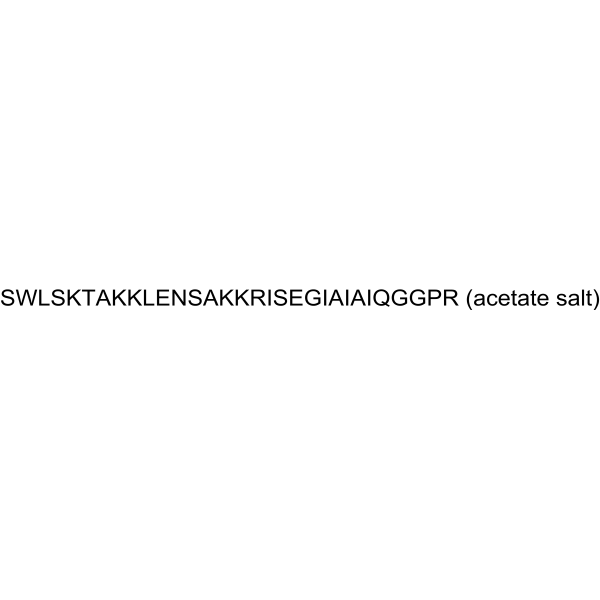
Physicochemical Properties
| Molecular Formula | C₁₄₉H₂₅₇N₄₅O₄₅ |
| Molecular Weight | 3398.91 |
| Related CAS # | Cecropin P1, porcine;125667-96-1 |
| Appearance | Typically exists as solid at room temperature |
| HS Tariff Code | 2934.99.9001 |
| Storage |
Powder-20°C 3 years 4°C 2 years In solvent -80°C 6 months -20°C 1 month |
| Shipping Condition | Room temperature (This product is stable at ambient temperature for a few days during ordinary shipping and time spent in Customs) |
Biological Activity
| ln Vitro | Cecropin P1, porcine (0-480 μg/mL, 36-96 h) significantly suppresses CH-1a infection and replication in Marc-145 cells [2]. In addition to exhibiting extracellular virucidal action against PRRSV (porcine reproductive and respiratory syndrome virus) at concentrations of 0-480 μg/mL for 36 hours, cecropin P1, porcine, also has a strong inhibitory impact when administered before to, concurrently with, or following viral inoculation[2]. In the latter stages of infection, cecropin P1, porcine (480 μg/mL, 0–72 h), inhibits the apoptosis caused by CH-1a[2]. Viral particle release is inhibited by cecropin P1, porcine (0-480 μg/mL, 0–4 h)[2]. |
| ln Vivo | In rats suffering from septic shock, cecropin P1 (1 mg/kg, IP, once) inhibits the growth of bacteria, endotoxemia, and mortality[3]. |
| Cell Assay |
Cell Viability Assay[2] Cell Types: Marc-145 cells Tested Concentrations: 160, 320, and 480 μg/mL Incubation Duration: 36, 48, 72, 96 h Experimental Results: Dramatically inhibited viral infection in a dose-dependent manner at 36 h postinfection. Inhibited CH -1a infection in Marc-145 cells with a 50% effective concentration(EC50) of 112 μg/mL. The 50% cytotoxic concentration(CC50) of Cecropin P1 for Marc-145 cells was estimated to be 719 μg/mL. Western Blot Analysis[2] Cell Types: Marc-145 cells Tested Concentrations: 160, 320, and 480 μg/mL Incubation Duration: 36 h Experimental Results: Dramatically decreased the expression of the viral N protein when administered with either the pre-, co-, or posttreatment method. |
| References |
[1]. Ascaris nematodes from pig and human make three antibacterial peptides: isolation of cecropin P1 and two ASABF peptides. Cell Mol Life Sci. 2003 Mar;60(3):599-606. [2]. Cecropin P1 inhibits porcine reproductive and respiratory syndrome virus by blocking attachment. BMC Microbiol. 2014 Nov 18;14:273. [3]. Effect of mono-dose intraperitoneal cecropins in experimental septic shock. Crit Care Med. 2001 Sep;29(9):1666-9. [4]. Expression of antimicrobial peptide Cecropin P1 in Saccharomyces cerevisiae and its antibacterial, antiviral activity in vitro. Electronic Journal of Biotechnology, 2020. |
Solubility Data
| Solubility (In Vitro) | May dissolve in DMSO (in most cases), if not, try other solvents such as H2O, Ethanol, or DMF with a minute amount of products to avoid loss of samples |
| Solubility (In Vivo) |
Note: Listed below are some common formulations that may be used to formulate products with low water solubility (e.g. < 1 mg/mL), you may test these formulations using a minute amount of products to avoid loss of samples. Injection Formulations (e.g. IP/IV/IM/SC) Injection Formulation 1: DMSO : Tween 80: Saline = 10 : 5 : 85 (i.e. 100 μL DMSO stock solution → 50 μL Tween 80 → 850 μL Saline) *Preparation of saline: Dissolve 0.9 g of sodium chloride in 100 mL ddH ₂ O to obtain a clear solution. Injection Formulation 2: DMSO : PEG300 :Tween 80 : Saline = 10 : 40 : 5 : 45 (i.e. 100 μL DMSO → 400 μLPEG300 → 50 μL Tween 80 → 450 μL Saline) Injection Formulation 3: DMSO : Corn oil = 10 : 90 (i.e. 100 μL DMSO → 900 μL Corn oil) Example: Take the Injection Formulation 3 (DMSO : Corn oil = 10 : 90) as an example, if 1 mL of 2.5 mg/mL working solution is to be prepared, you can take 100 μL 25 mg/mL DMSO stock solution and add to 900 μL corn oil, mix well to obtain a clear or suspension solution (2.5 mg/mL, ready for use in animals). Injection Formulation 4: DMSO : 20% SBE-β-CD in saline = 10 : 90 [i.e. 100 μL DMSO → 900 μL (20% SBE-β-CD in saline)] *Preparation of 20% SBE-β-CD in Saline (4°C,1 week): Dissolve 2 g SBE-β-CD in 10 mL saline to obtain a clear solution. Injection Formulation 5: 2-Hydroxypropyl-β-cyclodextrin : Saline = 50 : 50 (i.e. 500 μL 2-Hydroxypropyl-β-cyclodextrin → 500 μL Saline) Injection Formulation 6: DMSO : PEG300 : castor oil : Saline = 5 : 10 : 20 : 65 (i.e. 50 μL DMSO → 100 μLPEG300 → 200 μL castor oil → 650 μL Saline) Injection Formulation 7: Ethanol : Cremophor : Saline = 10: 10 : 80 (i.e. 100 μL Ethanol → 100 μL Cremophor → 800 μL Saline) Injection Formulation 8: Dissolve in Cremophor/Ethanol (50 : 50), then diluted by Saline Injection Formulation 9: EtOH : Corn oil = 10 : 90 (i.e. 100 μL EtOH → 900 μL Corn oil) Injection Formulation 10: EtOH : PEG300:Tween 80 : Saline = 10 : 40 : 5 : 45 (i.e. 100 μL EtOH → 400 μLPEG300 → 50 μL Tween 80 → 450 μL Saline) Oral Formulations Oral Formulation 1: Suspend in 0.5% CMC Na (carboxymethylcellulose sodium) Oral Formulation 2: Suspend in 0.5% Carboxymethyl cellulose Example: Take the Oral Formulation 1 (Suspend in 0.5% CMC Na) as an example, if 100 mL of 2.5 mg/mL working solution is to be prepared, you can first prepare 0.5% CMC Na solution by measuring 0.5 g CMC Na and dissolve it in 100 mL ddH2O to obtain a clear solution; then add 250 mg of the product to 100 mL 0.5% CMC Na solution, to make the suspension solution (2.5 mg/mL, ready for use in animals). Oral Formulation 3: Dissolved in PEG400 Oral Formulation 4: Suspend in 0.2% Carboxymethyl cellulose Oral Formulation 5: Dissolve in 0.25% Tween 80 and 0.5% Carboxymethyl cellulose Oral Formulation 6: Mixing with food powders Note: Please be aware that the above formulations are for reference only. InvivoChem strongly recommends customers to read literature methods/protocols carefully before determining which formulation you should use for in vivo studies, as different compounds have different solubility properties and have to be formulated differently. (Please use freshly prepared in vivo formulations for optimal results.) |
| Preparing Stock Solutions | 1 mg | 5 mg | 10 mg | |
| 1 mM | 0.2942 mL | 1.4711 mL | 2.9421 mL | |
| 5 mM | 0.0588 mL | 0.2942 mL | 0.5884 mL | |
| 10 mM | 0.0294 mL | 0.1471 mL | 0.2942 mL |