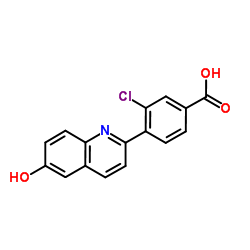
Cavosonstat (N-91115) is a novel, oral and potent inhibitor of S-nitrosoglutathione reductase (GSNOR) and a cystic fibrosis transmembrane conductance regulator (CFTR) stabilizer with the potential to be used for cystic fibrosis.
Physicochemical Properties
| Molecular Formula | C16H10CLNO3 |
| Molecular Weight | 299.71 |
| Exact Mass | 299.034 |
| CAS # | 1371587-51-7 |
| PubChem CID | 56960912 |
| Appearance | Light yellow to yellow solid powder |
| Density | 1.5±0.1 g/cm3 |
| Boiling Point | 527.5±50.0 °C at 760 mmHg |
| Flash Point | 272.8±30.1 °C |
| Vapour Pressure | 0.0±1.5 mmHg at 25°C |
| Index of Refraction | 1.715 |
| LogP | 4.28 |
| Hydrogen Bond Donor Count | 2 |
| Hydrogen Bond Acceptor Count | 4 |
| Rotatable Bond Count | 2 |
| Heavy Atom Count | 21 |
| Complexity | 392 |
| Defined Atom Stereocenter Count | 0 |
| InChi Key | BXSZILNGNMDGSL-UHFFFAOYSA-N |
| InChi Code | InChI=1S/C16H10ClNO3/c17-13-8-10(16(20)21)1-4-12(13)15-5-2-9-7-11(19)3-6-14(9)18-15/h1-8,19H,(H,20,21) |
| Chemical Name | 3-chloro-4-(6-hydroxyquinolin-2-yl)benzoic acid |
| Synonyms | N 91115 N-91115 Cavosonstat |
| HS Tariff Code | 2934.99.9001 |
| Storage |
Powder-20°C 3 years 4°C 2 years In solvent -80°C 6 months -20°C 1 month |
| Shipping Condition | Room temperature (This product is stable at ambient temperature for a few days during ordinary shipping and time spent in Customs) |
Biological Activity
| ln Vitro | The CFTR modulator Cavosonstat (N91115) works in tandem with CFTR correctors and enhancers to support the maturation of the cystic fibrosis transmembrane conductance regulator (CFTR) and the stability of the plasma membrane [1]. |
| References |
[1]. Pharmacokinetics and safety of cavosonstat (N91115) in healthy and cystic fibrosis adults homozygous for F508DEL-CFTR. J Cyst Fibros. 2017 May;16(3):371-379. |
| Additional Infomation | Cavosonstat is under investigation in clinical trial NCT02589236 (Study of Cavosonstat (N91115) in Patients With CF Homozygous for the F508del-CFTR Mutation). |
Solubility Data
| Solubility (In Vitro) | DMSO : ~50 mg/mL (~166.83 mM) |
| Solubility (In Vivo) |
Solubility in Formulation 1: ≥ 2.5 mg/mL (8.34 mM) (saturation unknown) in 10% DMSO + 40% PEG300 + 5% Tween80 + 45% Saline (add these co-solvents sequentially from left to right, and one by one), clear solution. For example, if 1 mL of working solution is to be prepared, you can add 100 μL of 25.0 mg/mL clear DMSO stock solution to 400 μL PEG300 and mix evenly; then add 50 μL Tween-80 to the above solution and mix evenly; then add 450 μL normal saline to adjust the volume to 1 mL. Preparation of saline: Dissolve 0.9 g of sodium chloride in 100 mL ddH₂ O to obtain a clear solution. Solubility in Formulation 2: ≥ 2.5 mg/mL (8.34 mM) (saturation unknown) in 10% DMSO + 90% (20% SBE-β-CD in Saline) (add these co-solvents sequentially from left to right, and one by one), clear solution. For example, if 1 mL of working solution is to be prepared, you can add 100 μL of 25.0 mg/mL clear DMSO stock solution to 900 μL of 20% SBE-β-CD physiological saline solution and mix evenly. Preparation of 20% SBE-β-CD in Saline (4°C,1 week): Dissolve 2 g SBE-β-CD in 10 mL saline to obtain a clear solution. (Please use freshly prepared in vivo formulations for optimal results.) |
| Preparing Stock Solutions | 1 mg | 5 mg | 10 mg | |
| 1 mM | 3.3366 mL | 16.6828 mL | 33.3656 mL | |
| 5 mM | 0.6673 mL | 3.3366 mL | 6.6731 mL | |
| 10 mM | 0.3337 mL | 1.6683 mL | 3.3366 mL |