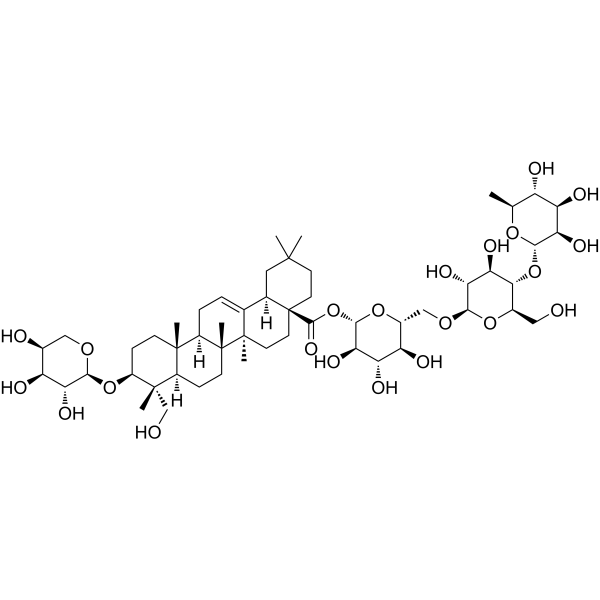
Physicochemical Properties
| Molecular Formula | C53H86O22 |
| Molecular Weight | 1075.2368 |
| Exact Mass | 1074.56 |
| CAS # | 12672-45-6 |
| PubChem CID | 71586956 |
| Appearance | White to off-white solid powder |
| LogP | -0.9 |
| Hydrogen Bond Donor Count | 13 |
| Hydrogen Bond Acceptor Count | 22 |
| Rotatable Bond Count | 12 |
| Heavy Atom Count | 75 |
| Complexity | 2060 |
| Defined Atom Stereocenter Count | 28 |
| SMILES | C[C@H]1[C@@H]([C@H]([C@H]([C@@H](O1)O[C@@H]2[C@H](O[C@H]([C@@H]([C@H]2O)O)OC[C@@H]3[C@H]([C@@H]([C@H]([C@@H](O3)OC(=O)[C@@]45CC[C@@]6(C(=CC[C@H]7[C@]6(CC[C@@H]8[C@@]7(CC[C@@H]([C@@]8(C)CO)O[C@H]9[C@@H]([C@H]([C@H](CO9)O)O)O)C)C)[C@H]4CC(CC5)(C)C)C)O)O)O)CO)O)O)O |
| InChi Key | UEHILKCNLIKLEV-QPMMERAHSA-N |
| InChi Code | InChI=1S/C53H86O22/c1-23-32(57)35(60)39(64)45(70-23)74-42-27(19-54)71-43(41(66)37(42)62)69-21-28-34(59)36(61)40(65)46(72-28)75-47(67)53-16-14-48(2,3)18-25(53)24-8-9-30-49(4)12-11-31(73-44-38(63)33(58)26(56)20-68-44)50(5,22-55)29(49)10-13-52(30,7)51(24,6)15-17-53/h8,23,25-46,54-66H,9-22H2,1-7H3/t23-,25+,26-,27+,28+,29+,30+,31-,32-,33-,34+,35+,36-,37+,38+,39+,40+,41+,42+,43+,44-,45-,46-,49-,50-,51+,52+,53-/m0/s1 |
| Chemical Name | [(2S,3R,4S,5S,6R)-6-[[(2R,3R,4R,5S,6R)-3,4-dihydroxy-6-(hydroxymethyl)-5-[(2S,3R,4R,5R,6S)-3,4,5-trihydroxy-6-methyloxan-2-yl]oxyoxan-2-yl]oxymethyl]-3,4,5-trihydroxyoxan-2-yl] (4aS,6aR,6aS,6bR,8aR,9R,10S,12aR,14bR)-9-(hydroxymethyl)-2,2,6a,6b,9,12a-hexamethyl-10-[(2S,3R,4S,5S)-3,4,5-trihydroxyoxan-2-yl]oxy-1,3,4,5,6,6a,7,8,8a,10,11,12,13,14b-tetradecahydropicene-4a-carboxylate |
| HS Tariff Code | 2934.99.9001 |
| Storage |
Powder-20°C 3 years 4°C 2 years In solvent -80°C 6 months -20°C 1 month Note: This product requires protection from light (avoid light exposure) during transportation and storage. |
| Shipping Condition | Room temperature (This product is stable at ambient temperature for a few days during ordinary shipping and time spent in Customs) |
Biological Activity
| Targets | Inhibition of inducible nitric oxide synthase (iNOS) and pro-inflammatory cytokine (TNF-α, IL-6) expression in activated microglia. [1] |
| ln Vitro |
Cauloside D (at high concentrations such as 50 μg/mL) significantly inhibited lipopolysaccharide (LPS)-induced nitric oxide (NO) generation in BV2 murine microglial cells in a dose-dependent manner. [1] Cauloside D (at low concentrations of 1-5 μg/mL) strongly suppressed LPS-induced iNOS protein expression in BV2 cells. [1] Cauloside D showed a relatively strong suppressing effect on the expression of the pro-inflammatory cytokines TNF-α and IL-6 in LPS-stimulated BV2 microglial cells. [1] In a preliminary cytotoxicity test, treatment with Cauloside D (1-50 μg/mL) for 24 hours did not modulate the viability of BV2 cells. [1] |
| Cell Assay |
Nitrite Assay (Griess Reaction): BV2 microglial cells were cultured in 24-well plates. Cells were co-treated with LPS (100 ng/mL) and various concentrations of Cauloside D for 24 hours. The accumulation of nitrite, a stable oxidation product of NO, in the culture supernatant was measured. Briefly, 50 μL of supernatant was mixed with an equal volume of Griess reagent (1% sulfanilamide and 0.1% N-1-naphthylethylenediamine dihydrochloride in 5% phosphoric acid), and the absorbance was measured at 540 nm. [1] Immunoblot Analysis (Western Blot): After treatment with LPS and Cauloside D for 24 hours, BV2 cells were washed and lysed. Protein concentrations were determined. Equal amounts of protein were separated by SDS-PAGE and transferred to a membrane. The membrane was blocked and then incubated with primary antibodies against iNOS, TNF-α, or IL-6, followed by incubation with horseradish peroxidase-conjugated secondary antibodies. Protein bands were visualized using an enhanced chemiluminescence detection kit. GAPDH was used as an internal loading control. [1] |
| References |
[1]. Anti-Inflammatory Effect of Triterpene Saponins Isolated from Blue Cohosh (Caulophyllum thalictroides). Evid Based Complement Alternat Med. 2012;2012:798192. |
| Additional Infomation |
Unii-4N5Z068gaz has been reported in Caulophyllum thalictroides, Pulsatilla campanella, and other organisms with data available. See also: Caulophyllum robustum Root (part of). Cauloside D is a triterpene saponin constituent isolated from the roots and rhizomes of blue cohosh (Caulophyllum thalictroides). [1] Cauloside D has three sugar moieties attached to a COO- group. The literature suggests that intracellular esterases might detach these sugars, potentially converting Cauloside D into Cauloside A within cells. [1] Among the tested Caulosides A-D, Cauloside D (along with Cauloside A) showed a relatively stronger suppressing effect on LPS-induced TNF-α expression in microglia. [1] |
Solubility Data
| Solubility (In Vitro) | DMSO : ~100 mg/mL (~89.50 mM) |
| Solubility (In Vivo) |
Solubility in Formulation 1: ≥ 2.5 mg/mL (2.24 mM) (saturation unknown) in 10% DMSO + 40% PEG300 + 5% Tween80 + 45% Saline (add these co-solvents sequentially from left to right, and one by one), clear solution. For example, if 1 mL of working solution is to be prepared, you can add 100 μL of 25.0 mg/mL clear DMSO stock solution to 400 μL PEG300 and mix evenly; then add 50 μL Tween-80 to the above solution and mix evenly; then add 450 μL normal saline to adjust the volume to 1 mL. Preparation of saline: Dissolve 0.9 g of sodium chloride in 100 mL ddH₂ O to obtain a clear solution. Solubility in Formulation 2: ≥ 2.5 mg/mL (2.24 mM) (saturation unknown) in 10% DMSO + 90% (20% SBE-β-CD in Saline) (add these co-solvents sequentially from left to right, and one by one), clear solution. For example, if 1 mL of working solution is to be prepared, you can add 100 μL of 25.0 mg/mL clear DMSO stock solution to 900 μL of 20% SBE-β-CD physiological saline solution and mix evenly. Preparation of 20% SBE-β-CD in Saline (4°C,1 week): Dissolve 2 g SBE-β-CD in 10 mL saline to obtain a clear solution. Solubility in Formulation 3: ≥ 2.5 mg/mL (2.24 mM) (saturation unknown) in 10% DMSO + 90% Corn Oil (add these co-solvents sequentially from left to right, and one by one), clear solution. For example, if 1 mL of working solution is to be prepared, you can add 100 μL of 25.0 mg/mL clear DMSO stock solution to 900 μL of corn oil and mix evenly. (Please use freshly prepared in vivo formulations for optimal results.) |
| Preparing Stock Solutions | 1 mg | 5 mg | 10 mg | |
| 1 mM | 0.9300 mL | 4.6501 mL | 9.3002 mL | |
| 5 mM | 0.1860 mL | 0.9300 mL | 1.8600 mL | |
| 10 mM | 0.0930 mL | 0.4650 mL | 0.9300 mL |