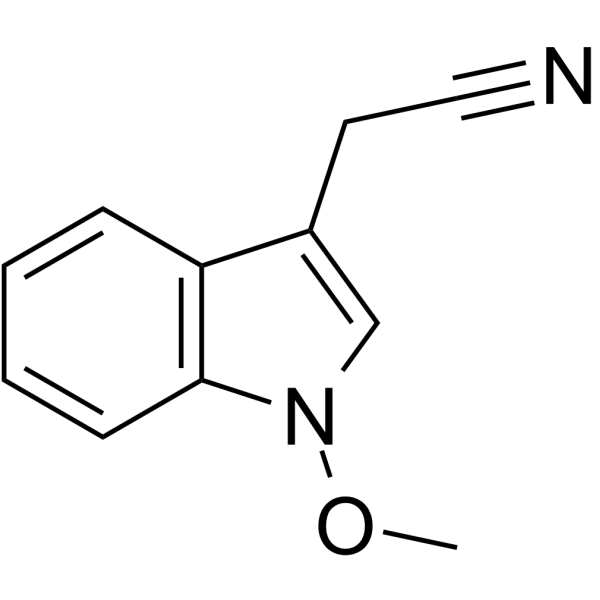
Physicochemical Properties
| Molecular Formula | C11H10N2O |
| Molecular Weight | 186.2099 |
| Exact Mass | 186.079 |
| CAS # | 30536-48-2 |
| PubChem CID | 11954881 |
| Appearance | Colorless to light yellow liquid |
| Density | 1.1±0.1 g/cm3 |
| Boiling Point | 350.7±34.0 °C at 760 mmHg |
| Flash Point | 165.9±25.7 °C |
| Vapour Pressure | 0.0±0.8 mmHg at 25°C |
| Index of Refraction | 1.580 |
| LogP | 2.25 |
| Hydrogen Bond Donor Count | 0 |
| Hydrogen Bond Acceptor Count | 2 |
| Rotatable Bond Count | 2 |
| Heavy Atom Count | 14 |
| Complexity | 245 |
| Defined Atom Stereocenter Count | 0 |
| SMILES | CON1C=C(C2=CC=CC=C21)CC#N |
| InChi Key | LIJIPBYXIXTNLE-UHFFFAOYSA-N |
| InChi Code | InChI=1S/C11H10N2O/c1-14-13-8-9(6-7-12)10-4-2-3-5-11(10)13/h2-5,8H,6H2,1H3 |
| Chemical Name | 2-(1-methoxyindol-3-yl)acetonitrile |
| HS Tariff Code | 2934.99.9001 |
| Storage |
Powder-20°C 3 years 4°C 2 years In solvent -80°C 6 months -20°C 1 month Note: Please store this product in a sealed and protected environment (e.g. under nitrogen), avoid exposure to moisture and light. |
| Shipping Condition | Room temperature (This product is stable at ambient temperature for a few days during ordinary shipping and time spent in Customs) |
Biological Activity
| ln Vitro | Caulilexin C appears to have a somewhat stronger antifungal effect than arvelexin, and it can totally suppress the growth of Rhizoctonia solani (0.5 mM). It also has a smaller effect on Leptosphaeria maculans (77% inhibition). |
| References |
[1]. The phytoalexins from cauliflower, caulilexins A, B and C: isolation, structure determination, syntheses and antifungal activity. Phytochemistry. 2006 Jul;67(14):1503-9. |
| Additional Infomation |
1-Methoxy-1H-indole-3-acetonitrile is a member of indoles. 1H-Indole-3-acetonitrile, 1-methoxy- has been reported in Eutrema halophilum, Arabidopsis thaliana, and other organisms with data available. |
Solubility Data
| Solubility (In Vitro) | DMSO : ~100 mg/mL (~537.03 mM) |
| Solubility (In Vivo) |
Solubility in Formulation 1: ≥ 2.5 mg/mL (13.43 mM) (saturation unknown) in 10% DMSO + 40% PEG300 + 5% Tween80 + 45% Saline (add these co-solvents sequentially from left to right, and one by one), clear solution. For example, if 1 mL of working solution is to be prepared, you can add 100 μL of 25.0 mg/mL clear DMSO stock solution to 400 μL PEG300 and mix evenly; then add 50 μL Tween-80 to the above solution and mix evenly; then add 450 μL normal saline to adjust the volume to 1 mL. Preparation of saline: Dissolve 0.9 g of sodium chloride in 100 mL ddH₂ O to obtain a clear solution. Solubility in Formulation 2: ≥ 2.5 mg/mL (13.43 mM) (saturation unknown) in 10% DMSO + 90% (20% SBE-β-CD in Saline) (add these co-solvents sequentially from left to right, and one by one), clear solution. For example, if 1 mL of working solution is to be prepared, you can add 100 μL of 25.0 mg/mL clear DMSO stock solution to 900 μL of 20% SBE-β-CD physiological saline solution and mix evenly. Preparation of 20% SBE-β-CD in Saline (4°C,1 week): Dissolve 2 g SBE-β-CD in 10 mL saline to obtain a clear solution. Solubility in Formulation 3: ≥ 2.5 mg/mL (13.43 mM) (saturation unknown) in 10% DMSO + 90% Corn Oil (add these co-solvents sequentially from left to right, and one by one), clear solution. For example, if 1 mL of working solution is to be prepared, you can add 100 μL of 25.0 mg/mL clear DMSO stock solution to 900 μL of corn oil and mix evenly. (Please use freshly prepared in vivo formulations for optimal results.) |
| Preparing Stock Solutions | 1 mg | 5 mg | 10 mg | |
| 1 mM | 5.3703 mL | 26.8514 mL | 53.7028 mL | |
| 5 mM | 1.0741 mL | 5.3703 mL | 10.7406 mL | |
| 10 mM | 0.5370 mL | 2.6851 mL | 5.3703 mL |