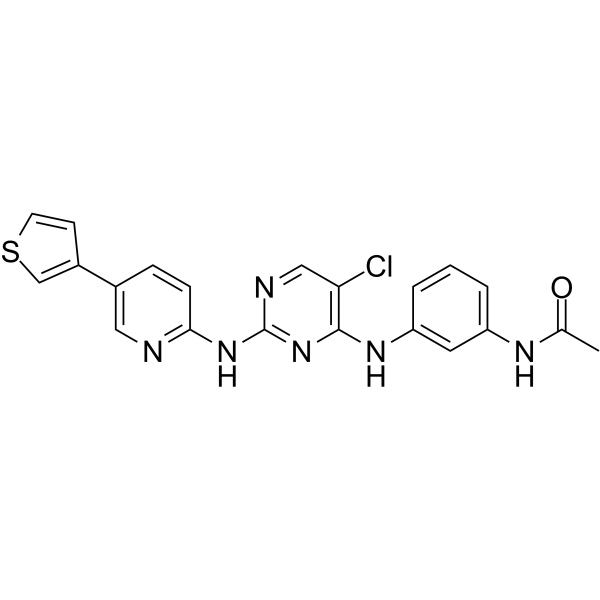
Physicochemical Properties
| Molecular Formula | C21H17CLN6OS |
| Molecular Weight | 436.917280912399 |
| Exact Mass | 436.087 |
| CAS # | 2825567-97-1 |
| PubChem CID | 163409160 |
| Appearance | White to off-white solid powder |
| LogP | 4.3 |
| Hydrogen Bond Donor Count | 3 |
| Hydrogen Bond Acceptor Count | 7 |
| Rotatable Bond Count | 6 |
| Heavy Atom Count | 30 |
| Complexity | 572 |
| Defined Atom Stereocenter Count | 0 |
| SMILES | C(NC1=CC=CC(NC2C(Cl)=CN=C(NC3=NC=C(C4C=CSC=4)C=C3)N=2)=C1)(=O)C |
| InChi Key | CVEIEBFUSJRUSP-UHFFFAOYSA-N |
| InChi Code | InChI=1S/C21H17ClN6OS/c1-13(29)25-16-3-2-4-17(9-16)26-20-18(22)11-24-21(28-20)27-19-6-5-14(10-23-19)15-7-8-30-12-15/h2-12H,1H3,(H,25,29)(H2,23,24,26,27,28) |
| Chemical Name | N-[3-[[5-chloro-2-[(5-thiophen-3-ylpyridin-2-yl)amino]pyrimidin-4-yl]amino]phenyl]acetamide |
| HS Tariff Code | 2934.99.9001 |
| Storage |
Powder-20°C 3 years 4°C 2 years In solvent -80°C 6 months -20°C 1 month Note: Please store this product in a sealed and protected environment (e.g. under nitrogen), avoid exposure to moisture and light. |
| Shipping Condition | Room temperature (This product is stable at ambient temperature for a few days during ordinary shipping and time spent in Customs) |
Biological Activity
| Targets | Cathepsin C |
| ln Vitro | With IC50s of 115.4 and 70.2 nM, respectively, cathepsin C-IN-5 (compound SF38) shows inhibitory effects in THP-1 and U937 cells [1]. |
| ln Vivo | In ICR mice, cathepsin C-IN-5 (1500 mg/kg) did not cause any appreciable weight loss or toxicity during 7 days of dosing[1]. The bioavailability of cathepsin C-IN-5 (oral 10 mg/kg; intravenous 2 mg/kg) is good (F=42.07%)[1]. In animal models of acute lung injury (ALI), cathepsin C-IN-5 (2, 10, 50 mg/kg; po) exhibits strong anti-inflammatory action and possible protective benefits[1]. |
| Animal Protocol |
Animal/Disease Models: C57BL/6 male mice (acute lung injury (ALI) mice model)[1] Doses: 2, 10, 50 mg/kg (one hour after administration, received LPS (20 mg/kg)) Route of Administration: Po Experimental Results: diminished the levels of proinflammatory cytokines (TNF-a, IL-6, and GM-CSF) and increased the concentration of the anti-inflammatory cytokine (IL-10) in a dose-dependent manner. |
| References |
[1]. Non-peptidyl non-covalent cathepsin C inhibitoEEr bearing a unique thiophene-substituted pyridine: Design, structure-activity relationship and anti-inflammatory activity in vivo. Eur J Med Chem. 2022 Jun 5;236:114368. |
Solubility Data
| Solubility (In Vitro) | DMSO: 20 mg/mL (45.77 mM) |
| Solubility (In Vivo) |
Solubility in Formulation 1: ≥ 2 mg/mL (4.58 mM) (saturation unknown) in 10% DMSO + 90% Corn Oil (add these co-solvents sequentially from left to right, and one by one), clear solution. For example, if 1 mL of working solution is to be prepared, you can add 100 μL of 20.0 mg/mL clear DMSO stock solution to 900 μL of corn oil and mix evenly. (Please use freshly prepared in vivo formulations for optimal results.) |
| Preparing Stock Solutions | 1 mg | 5 mg | 10 mg | |
| 1 mM | 2.2887 mL | 11.4437 mL | 22.8875 mL | |
| 5 mM | 0.4577 mL | 2.2887 mL | 4.5775 mL | |
| 10 mM | 0.2289 mL | 1.1444 mL | 2.2887 mL |