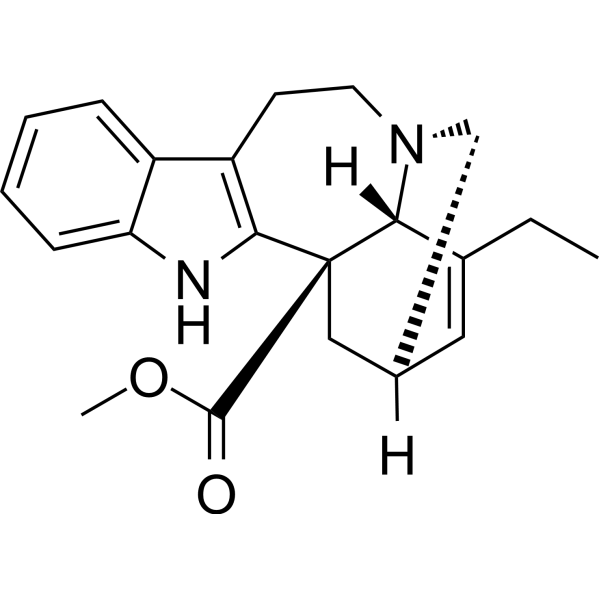
Physicochemical Properties
| Molecular Formula | C21H24N2O2 |
| Molecular Weight | 336.4275 |
| Exact Mass | 336.183 |
| CAS # | 2468-21-5 |
| Related CAS # | Catharanthine Tartrate;4168-17-6;Catharanthine Sulfate;153230-94-5 |
| PubChem CID | 5458190 |
| Appearance | White to off-white solid powder |
| Density | 1.3±0.1 g/cm3 |
| Boiling Point | 491.5±45.0 °C at 760 mmHg |
| Melting Point | 138-140ºC |
| Flash Point | 251.1±28.7 °C |
| Vapour Pressure | 0.0±1.2 mmHg at 25°C |
| Index of Refraction | 1.663 |
| LogP | 4.05 |
| Hydrogen Bond Donor Count | 1 |
| Hydrogen Bond Acceptor Count | 3 |
| Rotatable Bond Count | 3 |
| Heavy Atom Count | 25 |
| Complexity | 603 |
| Defined Atom Stereocenter Count | 3 |
| SMILES | CCC1=C[C@H]2C[C@]3([C@@H]1N(C2)CCC4=C3NC5=CC=CC=C45)C(=O)OC |
| InChi Key | CMKFQVZJOWHHDV-NQZBTDCJSA-N |
| InChi Code | InChI=1S/C21H24N2O2/c1-3-14-10-13-11-21(20(24)25-2)18-16(8-9-23(12-13)19(14)21)15-6-4-5-7-17(15)22-18/h4-7,10,13,19,22H,3,8-9,11-12H2,1-2H3/t13-,19+,21-/m0/s1 |
| Chemical Name | methyl (1R,15R,18R)-17-ethyl-3,13-diazapentacyclo[13.3.1.02,10.04,9.013,18]nonadeca-2(10),4,6,8,16-pentaene-1-carboxylate |
| HS Tariff Code | 2934.99.9001 |
| Storage |
Powder-20°C 3 years 4°C 2 years In solvent -80°C 6 months -20°C 1 month |
| Shipping Condition | Room temperature (This product is stable at ambient temperature for a few days during ordinary shipping and time spent in Customs) |
Biological Activity
| Targets |
Voltage-operated calcium channels (VOCCs) in vascular smooth muscle cells (IC50 = 3.2 μM) [1] Voltage-operated calcium channels (VOCCs) in cardiomyocytes (IC50 = 4.7 μM) [1] Serotonergic and norepinephrinergic neurotransmission pathways [2] |
| ln Vitro |
In isolated rat mesenteric arterial smooth muscle cells, Catharanthine (1-30 μM) dose-dependently inhibited voltage-operated calcium channel (VOCC)-mediated calcium influx. At 3.2 μM (IC50), calcium influx was reduced by 50%; at 30 μM, inhibition reached 82%. It also induced concentration-dependent relaxation of phenylephrine-precontracted mesenteric arteries, with 30 μM causing 78% relaxation [1] In isolated rat ventricular cardiomyocytes, Catharanthine (5-50 μM) decreased cardiac contractility and spontaneous beating rate. At 4.7 μM (IC50), peak shortening amplitude was reduced by 50%; at 50 μM, contractility was inhibited by 75% and beating rate decreased from 120 beats/min to 68 beats/min, without affecting cell viability (trypan blue exclusion: >95% viability) [1] |
| ln Vivo |
In anesthetized rats (250-300 g), intravenous administration of Catharanthine (1 mg/kg, 3 mg/kg, 10 mg/kg) dose-dependently decreased heart rate and mean arterial pressure. The 10 mg/kg dose reduced heart rate by 38% (from 360 beats/min to 223 beats/min) and mean arterial pressure by 25% (from 125 mmHg to 94 mmHg) without causing arrhythmia [1] In isolated rat mesenteric small arteries (diameter 100-200 μm) precontracted with phenylephrine (1 μM), Catharanthine (1-30 μM) induced endothelium-independent relaxation. At 30 μM, relaxation rate was 76%, which was abolished by preincubation with VOCC blocker nifedipine, confirming VOCC inhibition as the mechanism [1] In male Swiss mice (20-25 g), intraperitoneal administration of Catharanthine (5 mg/kg, 10 mg/kg, 20 mg/kg) exerted antidepressant-like activity. The 20 mg/kg dose reduced immobility time by 52% in the forced swim test and by 48% in the tail suspension test. It increased serotonin (5-HT) levels by 47% and norepinephrine (NE) levels by 39% in the prefrontal cortex, without affecting dopamine (DA) levels [2] |
| Enzyme Assay |
Vascular smooth muscle cell VOCC assay: Isolated rat mesenteric arterial smooth muscle cells were loaded with fluorescent calcium indicator for 30 minutes at 37°C. Catharanthine (1-30 μM) was added, and 10 minutes later, cells were depolarized with 60 mM KCl to activate VOCCs. Fluorescence intensity was measured at 488 nm/525 nm (excitation/emission) to quantify calcium influx. IC50 was calculated from concentration-response curves [1] Cardiomyocyte VOCC assay: Isolated rat ventricular cardiomyocytes were voltage-clamped at -80 mV using whole-cell patch-clamp technique. Catharanthine (5-50 μM) was preincubated for 5 minutes, then VOCC currents were elicited by depolarizing steps to +10 mV. Current amplitude was recorded, and IC50 was determined by fitting data to the Hill equation [1] |
| Cell Assay |
Rat mesenteric arterial smooth muscle cell culture: Smooth muscle cells were isolated from rat mesenteric arteries by enzymatic digestion, cultured in DMEM with fetal bovine serum. Cells were seeded in 96-well plates (1×10⁴ cells/well), loaded with calcium indicator, and treated with Catharanthine (1-30 μM) before KCl depolarization. Calcium influx was measured by microplate reader [1] Rat ventricular cardiomyocyte isolation and contractility assay: Ventricular cardiomyocytes were isolated from rat hearts by retrograde perfusion with collagenase. Cells were plated on laminin-coated coverslips, and spontaneous contractility (beating rate, peak shortening amplitude) was recorded under phase-contrast microscopy after treatment with Catharanthine (5-50 μM) for 30 minutes [1] |
| Animal Protocol |
Anesthetized rat hemodynamic assay: Male Wistar rats (250-300 g) were anesthetized, intubated, and instrumented with arterial catheter for blood pressure monitoring and venous catheter for drug administration. Catharanthine was dissolved in physiological saline (1 mg/mL, 3 mg/mL, 10 mg/mL) and administered intravenously at 1 mg/kg, 3 mg/kg, 10 mg/kg. Heart rate and mean arterial pressure were recorded continuously for 60 minutes [1] Mouse antidepressant model: Male Swiss mice (20-25 g, n=8 per group) were randomly divided into control and treatment groups. Catharanthine was dissolved in 0.9% saline (5 mg/mL, 10 mg/mL, 20 mg/mL) and administered intraperitoneally once daily for 7 days. Forced swim test and tail suspension test were performed 60 minutes after the last dose. Prefrontal cortex was collected to measure neurotransmitter levels by HPLC [2] |
| References |
[1]. Catharanthine dilates small mesenteric arteries and decreases heart rate and cardiac contractility by inhibition of voltage-operated calcium channels on vascular smooth muscle cells and cardiomyocytes. J Pharmacol Exp Ther. 2013 Jun;345(3):383-92. [2]. (+)-Catharanthine and (-)-18-methoxycoronaridine induce antidepressant-like activity in mice by differently recruiting serotonergic and norepinephrinergic neurotransmission. Eur J Pharmacol. 2023 Jan 15:939:175454. |
| Additional Infomation |
Catharanthine is an organic heteropentacyclic compound and monoterpenoid indole alkaloid produced by the medicinal plant Catharanthus roseus via strictosidine. It is a bridged compound, an organic heteropentacyclic compound, a methyl ester, a monoterpenoid indole alkaloid, a tertiary amino compound and an alkaloid ester. It is a conjugate base of a catharanthine(1+). Catharanthine has been reported in Tabernaemontana catharinensis, Catharanthus trichophyllus, and other organisms with data available. Catharanthine is a natural indole alkaloid isolated from the plant Catharanthus roseus (Madagascar periwinkle) [1][2] Its cardiovascular effects are mediated by selective inhibition of voltage-operated calcium channels (VOCCs) in vascular smooth muscle cells and cardiomyocytes, leading to vasodilation, reduced heart rate, and decreased cardiac contractility [1] Its antidepressant-like activity involves modulation of serotonergic and norepinephrinergic neurotransmission, increasing prefrontal cortex levels of 5-HT and NE without affecting DA [2] The compound exhibits endothelium-independent vasorelaxation and does not induce arrhythmia at therapeutic doses, supporting its potential for cardiovascular and psychiatric disorder research [1][2] |
Solubility Data
| Solubility (In Vitro) |
DMSO : ≥ 100 mg/mL (~297.24 mM) H2O : < 0.1 mg/mL |
| Solubility (In Vivo) |
Solubility in Formulation 1: ≥ 3.5 mg/mL (10.40 mM) (saturation unknown) in 10% DMSO + 40% PEG300 + 5% Tween80 + 45% Saline (add these co-solvents sequentially from left to right, and one by one), clear solution. For example, if 1 mL of working solution is to be prepared, you can add 100 μL of 35.0 mg/mL clear DMSO stock solution to 400 μL PEG300 and mix evenly; then add 50 μL Tween-80 to the above solution and mix evenly; then add 450 μL normal saline to adjust the volume to 1 mL. Preparation of saline: Dissolve 0.9 g of sodium chloride in 100 mL ddH₂ O to obtain a clear solution. Solubility in Formulation 2: ≥ 3.5 mg/mL (10.40 mM) (saturation unknown) in 10% DMSO + 90% Corn Oil (add these co-solvents sequentially from left to right, and one by one), clear solution. For example, if 1 mL of working solution is to be prepared, you can add 100 μL of 35.0 mg/mL clear DMSO stock solution to 900 μL of corn oil and mix evenly. (Please use freshly prepared in vivo formulations for optimal results.) |
| Preparing Stock Solutions | 1 mg | 5 mg | 10 mg | |
| 1 mM | 2.9724 mL | 14.8619 mL | 29.7239 mL | |
| 5 mM | 0.5945 mL | 2.9724 mL | 5.9448 mL | |
| 10 mM | 0.2972 mL | 1.4862 mL | 2.9724 mL |