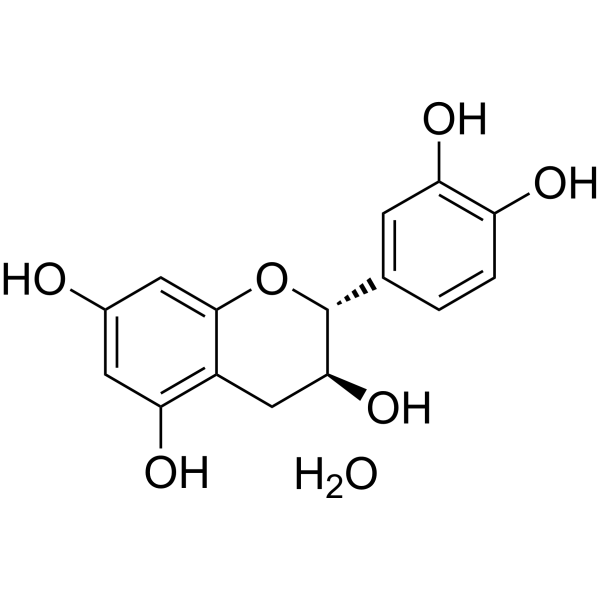
Physicochemical Properties
| Molecular Formula | C15H16O7 |
| Molecular Weight | 308.28 |
| CAS # | 88191-48-4 |
| Appearance | Typically exists as solids at room temperature |
| Boiling Point | 630.4ºC at 760 mmHg |
| Flash Point | 335ºC |
| LogP | 1.546 |
| SMILES | O[C@H]1CC2C(=CC(=CC=2O[C@@H]1C1C=CC(O)=C(O)C=1)O)O.O |
| Synonyms | Catechin hydrate; (+)-Catechin hydrate; Cianidanol hydrate; Catechuic acid hydrate |
| HS Tariff Code | 2934.99.9001 |
| Storage |
Powder-20°C 3 years 4°C 2 years In solvent -80°C 6 months -20°C 1 month |
| Shipping Condition | Room temperature (This product is stable at ambient temperature for a few days during ordinary shipping and time spent in Customs) |
Biological Activity
| Targets | COX-1 1.4 μM (IC50) |
| ln Vitro | Catechin exhibits >95% inhibitory activity at 70 μg/mL against cyclooxygenase-1 (COX-1) with an IC50 of 1.4 μM[1]. A dose-dependent reduction in color is observed after 24 hours of treatment with Catechin, and 54.76% of the cells are dead at the highest concentration of Catechin tested (160 μg/mL) whereas the IC50 of Catechin is achieved at 127.62 μg/mL Catechin. A dose- and time-dependent increase in the induction of apoptosis is observed when MCF-7 cells are treated with Catechin. When compare to the control cells at 24 hours, 40.7 and 41.16% of the cells treated with 150 μg/mL and 300 μg/mL Catechin, respectively, undergo apoptosis. The expression levels of Caspase-3, -8, and -9 and p53 in MCF-7 cells treated with 150 μg/mL Catechin for 24 h increase by 5.81, 1.42, 3.29, and 2.68 fold, respectively, as compare to the levels in untreated control cells[2]. |
| ln Vivo | Animals treated with Catechin at the lowest tested dose, i.e., 50 mg/kg, p.o. have spent comparatively more time in exploring the novel object in the choice trial, however, the difference is not statistically significant. Catechin prevents the time-induced episodic memory deficits in a dose-dependent manner, the most effective being 200 mg/kg, p.o.. Treatment with Catechin prevents the rise in MPO level compare to DOX alone treatment group (21.98±9.44 and 36.76±4.39% in the hippocampus and the frontal cortex respectively)[3]. |
| References |
[1]. Potential cancer-chemopreventive activities of wine stilbenoids and flavans extracted from grape (Vitis vinifera) cell cultures. Nutr Cancer. 2001;40(2):173-9. [2]. Alshatwi AA. Catechin hydrate suppresses MCF-7 proliferation through TP53/Caspase-mediated apoptosis. J Exp Clin Cancer Res. 2010 Dec 17;29:167. [3]. Catechin ameliorates doxorubicin-induced neuronal cytotoxicity in in vitro and episodic memory deficit in in vivo in Wistar rats. Cytotechnology. 2018 Feb;70(1):245-259. [4]. Potential cancer-chemopreventive activities of wine stilbenoids and flavans extracted from grape (Vitis vinifera) cell cultures. Nutr Cancer. 2001;40(2):173-9. [5]. Alshatwi AA. Catechin hydrate suppresses MCF-7 proliferation through TP53/Caspase-mediated apoptosis. J Exp Clin Cancer Res. 2010 Dec 17;29:167. [6]. Catechin ameliorates doxorubicin-induced neuronal cytotoxicity in in vitro and episodic memory deficit in in vivo in Wistar rats. Cytotechnology. 2018 Feb;70(1):245-259. |
Solubility Data
| Solubility (In Vitro) | May dissolve in DMSO (in most cases), if not, try other solvents such as H2O, Ethanol, or DMF with a minute amount of products to avoid loss of samples |
| Solubility (In Vivo) |
Note: Listed below are some common formulations that may be used to formulate products with low water solubility (e.g. < 1 mg/mL), you may test these formulations using a minute amount of products to avoid loss of samples. Injection Formulations (e.g. IP/IV/IM/SC) Injection Formulation 1: DMSO : Tween 80: Saline = 10 : 5 : 85 (i.e. 100 μL DMSO stock solution → 50 μL Tween 80 → 850 μL Saline) *Preparation of saline: Dissolve 0.9 g of sodium chloride in 100 mL ddH ₂ O to obtain a clear solution. Injection Formulation 2: DMSO : PEG300 :Tween 80 : Saline = 10 : 40 : 5 : 45 (i.e. 100 μL DMSO → 400 μLPEG300 → 50 μL Tween 80 → 450 μL Saline) Injection Formulation 3: DMSO : Corn oil = 10 : 90 (i.e. 100 μL DMSO → 900 μL Corn oil) Example: Take the Injection Formulation 3 (DMSO : Corn oil = 10 : 90) as an example, if 1 mL of 2.5 mg/mL working solution is to be prepared, you can take 100 μL 25 mg/mL DMSO stock solution and add to 900 μL corn oil, mix well to obtain a clear or suspension solution (2.5 mg/mL, ready for use in animals). Injection Formulation 4: DMSO : 20% SBE-β-CD in saline = 10 : 90 [i.e. 100 μL DMSO → 900 μL (20% SBE-β-CD in saline)] *Preparation of 20% SBE-β-CD in Saline (4°C,1 week): Dissolve 2 g SBE-β-CD in 10 mL saline to obtain a clear solution. Injection Formulation 5: 2-Hydroxypropyl-β-cyclodextrin : Saline = 50 : 50 (i.e. 500 μL 2-Hydroxypropyl-β-cyclodextrin → 500 μL Saline) Injection Formulation 6: DMSO : PEG300 : castor oil : Saline = 5 : 10 : 20 : 65 (i.e. 50 μL DMSO → 100 μLPEG300 → 200 μL castor oil → 650 μL Saline) Injection Formulation 7: Ethanol : Cremophor : Saline = 10: 10 : 80 (i.e. 100 μL Ethanol → 100 μL Cremophor → 800 μL Saline) Injection Formulation 8: Dissolve in Cremophor/Ethanol (50 : 50), then diluted by Saline Injection Formulation 9: EtOH : Corn oil = 10 : 90 (i.e. 100 μL EtOH → 900 μL Corn oil) Injection Formulation 10: EtOH : PEG300:Tween 80 : Saline = 10 : 40 : 5 : 45 (i.e. 100 μL EtOH → 400 μLPEG300 → 50 μL Tween 80 → 450 μL Saline) Oral Formulations Oral Formulation 1: Suspend in 0.5% CMC Na (carboxymethylcellulose sodium) Oral Formulation 2: Suspend in 0.5% Carboxymethyl cellulose Example: Take the Oral Formulation 1 (Suspend in 0.5% CMC Na) as an example, if 100 mL of 2.5 mg/mL working solution is to be prepared, you can first prepare 0.5% CMC Na solution by measuring 0.5 g CMC Na and dissolve it in 100 mL ddH2O to obtain a clear solution; then add 250 mg of the product to 100 mL 0.5% CMC Na solution, to make the suspension solution (2.5 mg/mL, ready for use in animals). Oral Formulation 3: Dissolved in PEG400 Oral Formulation 4: Suspend in 0.2% Carboxymethyl cellulose Oral Formulation 5: Dissolve in 0.25% Tween 80 and 0.5% Carboxymethyl cellulose Oral Formulation 6: Mixing with food powders Note: Please be aware that the above formulations are for reference only. InvivoChem strongly recommends customers to read literature methods/protocols carefully before determining which formulation you should use for in vivo studies, as different compounds have different solubility properties and have to be formulated differently. (Please use freshly prepared in vivo formulations for optimal results.) |
| Preparing Stock Solutions | 1 mg | 5 mg | 10 mg | |
| 1 mM | 3.2438 mL | 16.2190 mL | 32.4380 mL | |
| 5 mM | 0.6488 mL | 3.2438 mL | 6.4876 mL | |
| 10 mM | 0.3244 mL | 1.6219 mL | 3.2438 mL |