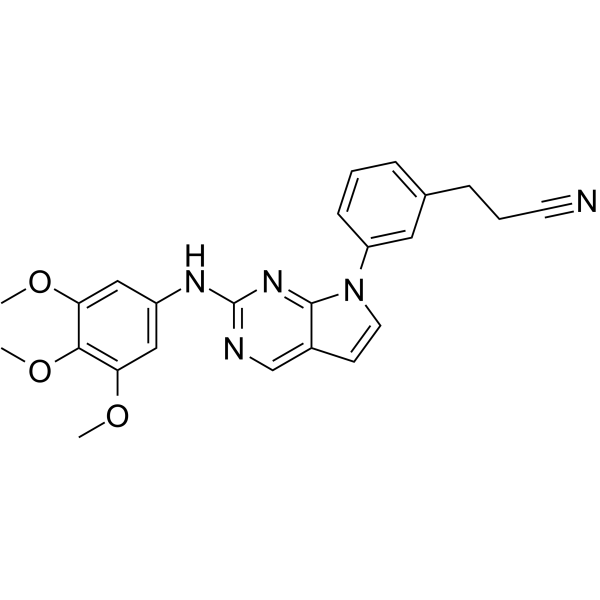
Physicochemical Properties
| Molecular Formula | C24H23N5O3 |
| Molecular Weight | 429.47112 |
| Exact Mass | 429.18 |
| CAS # | 863598-09-8 |
| Related CAS # | Casein Kinase II Inhibitor IV hydrochloride;2320347-54-2 |
| PubChem CID | 11453158 |
| Appearance | Light yellow to yellow solid powder |
| LogP | 4.719 |
| Hydrogen Bond Donor Count | 1 |
| Hydrogen Bond Acceptor Count | 7 |
| Rotatable Bond Count | 8 |
| Heavy Atom Count | 32 |
| Complexity | 628 |
| Defined Atom Stereocenter Count | 0 |
| InChi Key | KKVZKYOBQGDKIB-UHFFFAOYSA-N |
| InChi Code | InChI=1S/C24H23N5O3/c1-30-20-13-18(14-21(31-2)22(20)32-3)27-24-26-15-17-9-11-29(23(17)28-24)19-8-4-6-16(12-19)7-5-10-25/h4,6,8-9,11-15H,5,7H2,1-3H3,(H,26,27,28) |
| Chemical Name | 3-[3-[2-(3,4,5-trimethoxyanilino)pyrrolo[2,3-d]pyrimidin-7-yl]phenyl]propanenitrile |
| HS Tariff Code | 2934.99.9001 |
| Storage |
Powder-20°C 3 years 4°C 2 years In solvent -80°C 6 months -20°C 1 month |
| Shipping Condition | Room temperature (This product is stable at ambient temperature for a few days during ordinary shipping and time spent in Customs) |
Biological Activity
| ln Vitro | After 48 hours, the early differentiation markers keratin 1 and 10 were upregulated in human epidermal keratinocytes (NHEK) treated with casein kinase II inhibitor IV. Cells treated with IV casein kinase II inhibitor showed increased levels of IVL and TGM for 72 hours, and these levels continued for 96 hours. Additionally, at later times, treatment with casein kinase II inhibitor IV led to the production of loricrin, a hallmark of final differentiation. When NHEK was treated with casein kinase II inhibitor IV, messenger RNA (mRNA) expression study revealed similar outcomes. Treatment with casein kinase II inhibitor IV upregulated keratinocyte early differentiation marker genes, such as keratin 1 (5.4-fold) and keratin 10 (5.4-fold), at early time points (12 and 24 hours). At later times (36 and 48 hours), there was an upregulation of terminal differentiation marker genes, such as IVL (1.8-fold), TGM 1 (4.8-fold), loricrin (3.3-fold), and filaggrin (5.6-fold). These findings confirm that casein kinase II inhibitor IV can stimulate epidermal progenitor cells to develop into terminally differentiated keratinocytes [1]. |
| References |
[1]. Identification and characterization of small-molecule inducers of epidermal keratinocyte differentiation. ACS Chem Biol. 2007 Mar 20;2(3):171-5. |
Solubility Data
| Solubility (In Vitro) | DMSO : ~33.33 mg/mL (~77.61 mM) |
| Solubility (In Vivo) |
Solubility in Formulation 1: ≥ 2.5 mg/mL (5.82 mM) (saturation unknown) in 10% DMSO + 40% PEG300 +5% Tween-80 + 45% Saline (add these co-solvents sequentially from left to right, and one by one), clear solution. For example, if 1 mL of working solution is to be prepared, you can add 100 μL of 25.0 mg/mL clear DMSO stock solution to 400 μL PEG300 and mix evenly; then add 50 μL Tween-80 + to the above solution and mix evenly; then add 450 μL normal saline to adjust the volume to 1 mL. Preparation of saline: Dissolve 0.9 g of sodium chloride in 100 mL ddH₂ O to obtain a clear solution. (Please use freshly prepared in vivo formulations for optimal results.) |
| Preparing Stock Solutions | 1 mg | 5 mg | 10 mg | |
| 1 mM | 2.3285 mL | 11.6423 mL | 23.2845 mL | |
| 5 mM | 0.4657 mL | 2.3285 mL | 4.6569 mL | |
| 10 mM | 0.2328 mL | 1.1642 mL | 2.3285 mL |