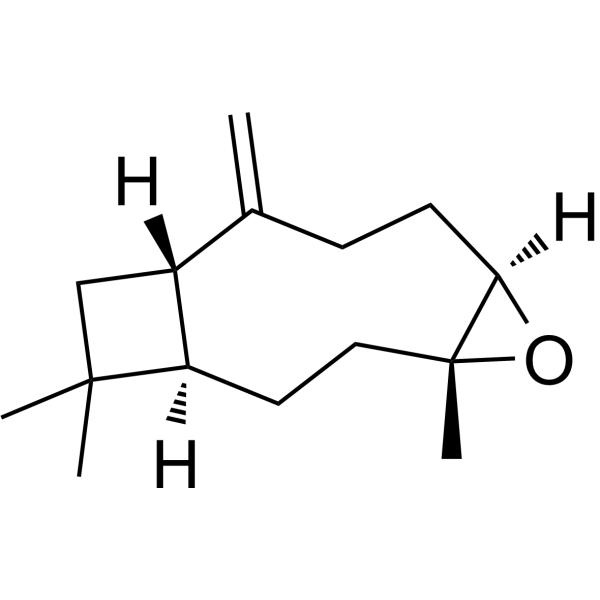
Physicochemical Properties
| Molecular Formula | C15H24O |
| Molecular Weight | 220.35000 |
| Exact Mass | 220.182 |
| CAS # | 1139-30-6 |
| PubChem CID | 1742210 |
| Appearance | White to off-white solid powder |
| Density | 1.0±0.1 g/cm3 |
| Boiling Point | 279.7±19.0 °C at 760 mmHg |
| Melting Point | 62-63ºC(lit.) |
| Flash Point | 119.7±19.5 °C |
| Vapour Pressure | 0.0±0.6 mmHg at 25°C |
| Index of Refraction | 1.507 |
| LogP | 4.57 |
| Hydrogen Bond Donor Count | 0 |
| Hydrogen Bond Acceptor Count | 1 |
| Rotatable Bond Count | 0 |
| Heavy Atom Count | 16 |
| Complexity | 330 |
| Defined Atom Stereocenter Count | 4 |
| SMILES | C[C@@]12CC[C@@H]3[C@H](CC3(C)C)C(=C)CC[C@H]1O2 |
| InChi Key | NVEQFIOZRFFVFW-RGCMKSIDSA-N |
| InChi Code | InChI=1S/C15H24O/c1-10-5-6-13-15(4,16-13)8-7-12-11(10)9-14(12,2)3/h11-13H,1,5-9H2,2-4H3/t11-,12-,13-,15-/m1/s1 |
| Chemical Name | (1R,4R,6R,10S)-4,12,12-trimethyl-9-methylidene-5-oxatricyclo[8.2.0.04,6]dodecane |
| HS Tariff Code | 2934.99.9001 |
| Storage |
Powder-20°C 3 years 4°C 2 years In solvent -80°C 6 months -20°C 1 month |
| Shipping Condition | Room temperature (This product is stable at ambient temperature for a few days during ordinary shipping and time spent in Customs) |
Biological Activity
| Targets |
The specific molecular target(s) of Caryophyllene oxide were not identified in this reference. Its analgesic and anti-inflammatory effects are suggested to potentially involve inhibition of central pain receptors and/or inhibition of cyclooxygenase and/or lipoxygenase (inflammatory mediators). [1] |
| ln Vivo |
Caryophyllene oxide administered intraperitoneally (i.p.) at doses of 12.5 and 25 mg/kg body weight showed significant, dose-dependent central analgesic activity in the Eddy's hot plate test in mice. The maximum increase in paw licking time (analgesia) was observed at 120 minutes post-treatment for the 25 mg/kg dose, and the effect was comparable to the standard drug pentazocin (50 mg/kg, i.p.).[1] Caryophyllene oxide administered i.p. at doses of 12.5 and 25 mg/kg body weight showed significant peripheral analgesic activity in the acetic acid-induced writhing test in mice. It reduced the number of writhes by 57.87% and 75.19%, respectively. The effect at 25 mg/kg was comparable to the standard drug aspirin (100 mg/kg, i.p.), which showed 74.41% inhibition.[1] Caryophyllene oxide administered orally (p.o.) at doses of 12.5 and 25 mg/kg body weight showed significant anti-inflammatory activity in the carrageenan-induced paw edema test in rats. It significantly inhibited paw edema volume at the 1-hour and 2-hour time points after carrageenan injection. The effect at 25 mg/kg was comparable to the standard drug aspirin (100 mg/kg, p.o.).[1] |
| Animal Protocol |
Eddy's Hot Plate Test (Central Analgesia): Male Swiss albino mice (20-25 g) were divided into groups. Caryophyllene oxide was dissolved in a vehicle of 1% dimethylformamide in water for injection. It was administered intraperitoneally (i.p.) at doses of 12.5 and 25 mg/kg body weight. The control group received the vehicle only. The standard drug pentazocin lactate (50 mg/kg, i.p.) was used. Mice were placed on a hot plate maintained at 55 ± 0.5°C. The reaction time (licking of paw or jumping) was recorded before treatment and at 30, 60, 90, 120, and 180 minutes post-treatment.[1] Acetic Acid-Induced Writhing Test (Peripheral Analgesia): Male Swiss albino mice (20-25 g) were divided into groups. Caryophyllene oxide was dissolved in a vehicle of 1% dimethylformamide in water for injection. It was administered intraperitoneally (i.p.) at doses of 12.5 and 25 mg/kg body weight, one hour prior to the i.p. injection of 0.6% v/v acetic acid. The control group received the vehicle only. The standard drug aspirin (100 mg/kg, i.p.) was used. Five minutes after acetic acid injection, the number of writhing movements was counted for a duration of 20 minutes.[1] Carrageenan-Induced Paw Edema Test (Anti-inflammatory): Wistar rats (150-200 g) of either sex were divided into groups. Caryophyllene oxide was dissolved in a vehicle of 1% dimethylformamide in water for injection. It was administered orally (p.o.) at doses of 12.5 and 25 mg/kg body weight, one hour prior to the subplantar injection of 0.1 ml of a 1% carrageenan suspension in the right hind paw. The control group received the vehicle only. The standard drug aspirin (100 mg/kg, p.o.) was used. Paw volume was measured plethysmometrically immediately before (0 hour) and at 1, 2, and 3 hours after carrageenan injection.[1] |
| ADME/Pharmacokinetics |
Metabolism / Metabolites 14-HYDROXYCARYOPHYLLENE OXIDE WAS ISOLATED FROM THE URINE OF RABBITS TREATED WITH (-)-CARYOPHYLLENE THE X-RAY CRYSTAL STRUCTURE OF 14-HYDROXYCARYOPHYLLENE (AS ACETATE DERIVATIVE) WAS REPORTED. THE METABOLISM WAS SHOWN TO PROGRESS THROUGH (-)-CARYOPHYLLENE OXIDE SINCE THE LATTER COMPOUND ALSO AFFORDED 14-HYDROXYCARYOPHYLLENE AS A METABOLITE. |
| References |
[1]. Analgesic and anti-inflammatory activity of Caryophyllene oxide from Annona squamosa L. bark. Phytomedicine. 2010 Feb;17(2):149-51. |
| Additional Infomation |
Caryophyllene oxide is an epoxide. It has a role as a metabolite. Caryophyllene oxide has been reported in Camellia sinensis, Artemisia thuscula, and other organisms with data available. See also: Cannabis sativa subsp. indica top (part of). Caryophyllene oxide was isolated as a white amorphous powder (32 mg) from the unsaponified petroleum ether extract of the bark of Annona squamosa L. Its structure was confirmed by matching its IR, 1H NMR, 13C NMR, and mass spectra with literature data.[1] The study suggests that the analgesic effect of Caryophyllene oxide may be mediated through both central (possibly via opioid-like mechanisms inferred from the hot plate test) and peripheral pathways (possibly via inhibition of inflammatory mediators like cyclooxygenase/lipoxygenase, inferred from the writhing and edema tests). Its anti-inflammatory effect against carrageenan-induced edema suggests it may inhibit both the early (histamine/serotonin) and late (prostaglandins) phases of inflammation.[1] |
Solubility Data
| Solubility (In Vitro) |
DMSO : ~100 mg/mL (~453.82 mM) H2O : ~1 mg/mL (~4.54 mM) |
| Solubility (In Vivo) |
Solubility in Formulation 1: ≥ 2.5 mg/mL (11.35 mM) (saturation unknown) in 10% DMSO + 40% PEG300 + 5% Tween80 + 45% Saline (add these co-solvents sequentially from left to right, and one by one), clear solution. For example, if 1 mL of working solution is to be prepared, you can add 100 μL of 25.0 mg/mL clear DMSO stock solution to 400 μL PEG300 and mix evenly; then add 50 μL Tween-80 to the above solution and mix evenly; then add 450 μL normal saline to adjust the volume to 1 mL. Preparation of saline: Dissolve 0.9 g of sodium chloride in 100 mL ddH₂ O to obtain a clear solution. Solubility in Formulation 2: ≥ 2.5 mg/mL (11.35 mM) (saturation unknown) in 10% DMSO + 90% (20% SBE-β-CD in Saline) (add these co-solvents sequentially from left to right, and one by one), clear solution. For example, if 1 mL of working solution is to be prepared, you can add 100 μL of 25.0 mg/mL clear DMSO stock solution to 900 μL of 20% SBE-β-CD physiological saline solution and mix evenly. Preparation of 20% SBE-β-CD in Saline (4°C,1 week): Dissolve 2 g SBE-β-CD in 10 mL saline to obtain a clear solution. Solubility in Formulation 3: ≥ 2.5 mg/mL (11.35 mM) (saturation unknown) in 10% DMSO + 90% Corn Oil (add these co-solvents sequentially from left to right, and one by one), clear solution. For example, if 1 mL of working solution is to be prepared, you can add 100 μL of 25.0 mg/mL clear DMSO stock solution to 900 μL of corn oil and mix evenly. (Please use freshly prepared in vivo formulations for optimal results.) |
| Preparing Stock Solutions | 1 mg | 5 mg | 10 mg | |
| 1 mM | 4.5382 mL | 22.6912 mL | 45.3823 mL | |
| 5 mM | 0.9076 mL | 4.5382 mL | 9.0765 mL | |
| 10 mM | 0.4538 mL | 2.2691 mL | 4.5382 mL |