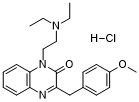
Physicochemical Properties
| Molecular Formula | C22H28CLN3O2 |
| Molecular Weight | 401.935 |
| Exact Mass | 401.187 |
| Elemental Analysis | C, 65.74; H, 7.02; Cl, 8.82; N, 10.45; O, 7.96 |
| CAS # | 55750-05-5 |
| Related CAS # | 23465-76-1;55750-05-5 (HCl); |
| PubChem CID | 3043582 |
| Appearance | White to off-white solid powder |
| Density | 1.11g/cm3 |
| Boiling Point | 521.2ºC at 760mmHg |
| Flash Point | 269ºC |
| LogP | 4.139 |
| Hydrogen Bond Donor Count | 1 |
| Hydrogen Bond Acceptor Count | 4 |
| Rotatable Bond Count | 8 |
| Heavy Atom Count | 28 |
| Complexity | 510 |
| Defined Atom Stereocenter Count | 0 |
| SMILES | CCN(CC)CCN1C2=CC=CC=C2N=C(C1=O)CC3=CC=C(C=C3)OC.Cl |
| InChi Key | JRNWTJUIMRLKBV-UHFFFAOYSA-N |
| InChi Code | InChI=1S/C22H27N3O2.ClH/c1-4-24(5-2)14-15-25-21-9-7-6-8-19(21)23-20(22(25)26)16-17-10-12-18(27-3)13-11-17;/h6-13H,4-5,14-16H2,1-3H3;1H |
| Chemical Name | 1-(2-(diethylamino)ethyl)-3-(4-methoxybenzyl)quinoxalin-2(1H)-one hydrochloride |
| Synonyms | P 201-1; P-201-1; P201-1; P 2011; P-2011; P2011; Caroverine HCl; Spadon; Tinnitin; Tinnex; |
| HS Tariff Code | 2934.99.9001 |
| Storage |
Powder-20°C 3 years 4°C 2 years In solvent -80°C 6 months -20°C 1 month Note: Please store this product in a sealed and protected environment, avoid exposure to moisture. |
| Shipping Condition | Room temperature (This product is stable at ambient temperature for a few days during ordinary shipping and time spent in Customs) |
Biological Activity
| ln Vitro | In rat hindquarter preparations, carvacrol (1 μM; 10 min pretreatment) decreases the pressor response to KCl (80 mM) and norepinephrine (1 μM). In isolated rat aortas, carvacine dramatically reduces the contraction caused by KCl (40 mM) [3]. |
| ln Vivo | Caroverine (1.44 mg/rat; subcutaneous injection; 1.0 mL/h for 72 hours) can reduce impulse noise-induced hearing loss in rats [4]. |
| Animal Protocol |
Animal/Disease Models: SD (SD (Sprague-Dawley)) rats (250-300 g) of either sex underwent pulsed noise exposure [4] Doses: 1.44 mg/rat Doses: 20 mg/mL; sc 1.0 mL/h for 72 hrs (hrs (hours)) Experimental Results: Significant protection of the cochlea from impulse noise damage. |
| References |
[1]. Pharmacokinetics of caroverine in the inner ear and its effects on cochlear function after systemic and local administrations in Guinea pigs. Audiol Neurootol. Jan-Feb 2003;8(1):49-56. [2]. Caroverine in tinnitus treatment. A placebo-controlled blind study. Acta Otolaryngol. 1997 Nov;117(6):825-30. [3]. Vasorelaxant action of caroverine fumarate (a quinoxaline derivative), a calcium-blocking agent. Br J Pharmacol. 1980;71(1):343-8. [4]. Low-dose, long-term caroverine administration attenuates impulse noise-induced hearing loss in the rat. Acta Otolaryngol. 2006 Dec;126(11):1140-7. |
Solubility Data
| Solubility (In Vitro) |
DMSO : ~100 mg/mL (~248.80 mM) H2O : ~20 mg/mL (~49.76 mM) |
| Solubility (In Vivo) |
Solubility in Formulation 1: ≥ 2.5 mg/mL (6.22 mM) (saturation unknown) in 10% DMSO + 40% PEG300 + 5% Tween80 + 45% Saline (add these co-solvents sequentially from left to right, and one by one), clear solution. For example, if 1 mL of working solution is to be prepared, you can add 100 μL of 25.0 mg/mL clear DMSO stock solution to 400 μL PEG300 and mix evenly; then add 50 μL Tween-80 to the above solution and mix evenly; then add 450 μL normal saline to adjust the volume to 1 mL. Preparation of saline: Dissolve 0.9 g of sodium chloride in 100 mL ddH₂ O to obtain a clear solution. Solubility in Formulation 2: ≥ 2.5 mg/mL (6.22 mM) (saturation unknown) in 10% DMSO + 90% (20% SBE-β-CD in Saline) (add these co-solvents sequentially from left to right, and one by one), clear solution. For example, if 1 mL of working solution is to be prepared, you can add 100 μL of 25.0 mg/mL clear DMSO stock solution to 900 μL of 20% SBE-β-CD physiological saline solution and mix evenly. Preparation of 20% SBE-β-CD in Saline (4°C,1 week): Dissolve 2 g SBE-β-CD in 10 mL saline to obtain a clear solution. Solubility in Formulation 3: ≥ 2.5 mg/mL (6.22 mM) (saturation unknown) in 10% DMSO + 90% Corn Oil (add these co-solvents sequentially from left to right, and one by one), clear solution. For example, if 1 mL of working solution is to be prepared, you can add 100 μL of 25.0 mg/mL clear DMSO stock solution to 900 μL of corn oil and mix evenly. (Please use freshly prepared in vivo formulations for optimal results.) |
| Preparing Stock Solutions | 1 mg | 5 mg | 10 mg | |
| 1 mM | 2.4879 mL | 12.4397 mL | 24.8793 mL | |
| 5 mM | 0.4976 mL | 2.4879 mL | 4.9759 mL | |
| 10 mM | 0.2488 mL | 1.2440 mL | 2.4879 mL |