Physicochemical Properties
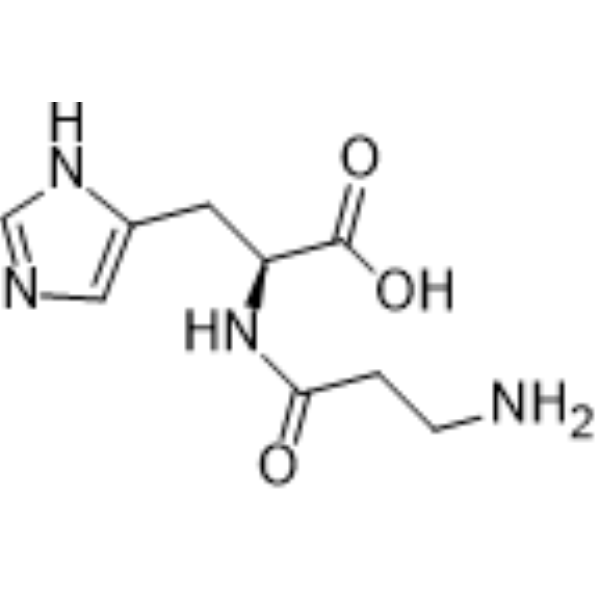
| Molecular Formula | C9H14N4O3 |
| Molecular Weight | 226.23 |
| Exact Mass | 226.106 |
| CAS # | 305-84-0 |
| Related CAS # | 305-84-0;5852-99-3 (HCl); |
| PubChem CID | 439224 |
| Appearance | White to off-white solid powder |
| Density | 1.4±0.1 g/cm3 |
| Boiling Point | 656.2±55.0 °C at 760 mmHg |
| Melting Point | 253 °C (dec.)(lit.) |
| Flash Point | 350.7±31.5 °C |
| Vapour Pressure | 0.0±2.1 mmHg at 25°C |
| Index of Refraction | 1.591 |
| LogP | -2.17 |
| Hydrogen Bond Donor Count | 4 |
| Hydrogen Bond Acceptor Count | 5 |
| Rotatable Bond Count | 6 |
| Heavy Atom Count | 16 |
| Complexity | 259 |
| Defined Atom Stereocenter Count | 1 |
| SMILES | C1=C(NC=N1)C[C@@H](C(=O)O)NC(=O)CCN |
| InChi Key | CQOVPNPJLQNMDC-ZETCQYMHSA-N |
| InChi Code | InChI=1S/C9H14N4O3/c10-2-1-8(14)13-7(9(15)16)3-6-4-11-5-12-6/h4-5,7H,1-3,10H2,(H,11,12)(H,13,14)(H,15,16)/t7-/m0/s1 |
| Chemical Name | (2S)-2-(3-aminopropanoylamino)-3-(1H-imidazol-5-yl)propanoic acid |
| HS Tariff Code | 2934.99.9001 |
| Storage |
Powder-20°C 3 years 4°C 2 years In solvent -80°C 6 months -20°C 1 month Note: Please store this product in a sealed and protected environment (e.g. under nitrogen), avoid exposure to moisture and light. |
| Shipping Condition | Room temperature (This product is stable at ambient temperature for a few days during ordinary shipping and time spent in Customs) |
Biological Activity
| ln Vitro | L-Carnosine is a dipeptide composed of the amino acids beta-alanine and histidine that has the ability to inhibit many of the metabolic changes associated with aging[1]. L-carnosine also has some antioxidant properties. L-Carnosine's antioxidant mechanism is attributed to its ability to chelate metal ions, have superoxide dismutase (SOD)-like activity, and scavenge ROS and free radicals[2]. |
| ADME/Pharmacokinetics |
Absorption, Distribution and Excretion Intestinal absorption of L-CAZ was studied in rats by Sano et al. using 14C- and 65Zn-labeled compounds. They suggested that L-CAZ dissociates to its components, L-carnosine and zinc, during intestinal absorption. Intestinal absorption of the drug was examined using 14C- and 65Zn-labeled compounds. Polaprezinc metabolizes into its components, L-carnosine and zinc, during intestinal absorption. It was found that the excretion rates after one administration using 14C-labeled L-CAZ to rats were 4.1% in urine, 13.3% in feces, and 38.8% in exhalation. The study using 65Zn-labeled Paleprozinc were 0.3% in urine and 85.0% in the feces. The absorption rate of zinc is estimated to be approximately 11%. Metabolism / Metabolites Excretion rates of polaprezinc after a single administration using 14C-labeled drug to rats are 4.1% in urine, 13.3% in feces, and 38.8% in exhalation, and those using 65Zn-labeled L-CAZ are 0.3% in urine and 85.0% in feces. The absorption rate of zinc is estimated to be about 11%. Biological Half-Life The half-life of polaprezinc has been studied in rats and found to be approximately 2 hours. |
| Toxicity/Toxicokinetics |
Protein Binding It has been observed that a diet heavy in proteins accelerates the absorption of zinc, implying that amino acids with low molecular weight may carry zinc into the circulatory system via complexation. |
| References |
[1]. Would carnosine or a carnivorous diet help suppress aging and associated pathologies? Ann N Y Acad Sci. 2006 May;1067:369-74. [2]. Carnosine may reduce lung injury caused by radiation therapy. Med Hypotheses. 2006;66(5):957-9. |
| Additional Infomation |
Carnosine is a dipeptide that is the N-(beta-alanyl) derivative of L-histidine. It has a role as an anticonvulsant, an antioxidant, an antineoplastic agent, a human metabolite, a Daphnia magna metabolite, a mouse metabolite, a neuroprotective agent and a geroprotector. It is a conjugate acid of a carnosinate. It is a tautomer of a carnosine zwitterion. Polaprezinc is a chelated form of zinc and L-carnosine. It is a zinc-related medicine approved for the first time in Japan, which has been clinically used to treat gastric ulcers. It was determined that polaprezinc may be effective in pressure ulcer treatment. A study in 2013 showed that CO-administration of polaprezinc may be effective against small intestine mucosal injury associated with long-term aspirin therapy. Carnosine has been investigated for the treatment of Gulf War Illness. Carnosine has been reported in Daphnia pulex, Glycine max, and other organisms with data available. Polaprezinc is an orally bioavailable chelate composed of zinc and L-carnosine, with potential gastroprotective, anti-oxidant, anti-ulcer and anti-inflammatory activities. Upon administration, polaprezinc increases the expression of various anti-oxidant enzymes, such as superoxide dismutase 1 (SOD-1), SOD-2, heme oxygenase-1 (HO-1), glutathione S-transferase (GST), glutathione peroxidase (GSH-px), peroxidredoxin-1 (PRDX1; PRXI) and PRXD5 (PRXV) in the gastric mucosa, which protect cells against reactive oxygen species (ROS). In addition, this agent inhibits the activity of the transcription factor nuclear factor-kappaB (NF-kappaB) and reduces the expression of several pro-inflammatory cytokines, such as interleukin (IL) 1beta, IL-6, IL-8, and tumor necrosis factor alpha (TNF-a). Polaprezinc also increases the expression of various growth factors, such as platelet-derived growth factor-B (PDGF-B), vascular endothelial growth factor (VEGF), and nerve growth factor (NGF), and various heat shock proteins (HSPs), including HSP90, HSP70, HSP60, HSP47, HSP27, and HSP10. This protects against damages to, and accelerates healing of the gastric mucosa. Carnosine is a dipeptide comprised of a beta-alanine and a 3-methyl-L-histidine, which is found in dietary red meat, with potential antioxidant, metal-chelating and anti-glycation activities. Carnosine scavenges both reactive oxygen species (ROS) and unsaturated aldehydes produced by cell membrane lipid peroxidation. Additionally, this dipeptide may reduce the rate of formation of advanced glycation end-products (AGE). Altogether, this may protect cells against oxidative damage. In addition, carnosine is able to chelate toxic metals. A naturally occurring dipeptide neuropeptide found in muscles. Drug Indication Peptic ulcer disease, dyspepsia. Mechanism of Action Polaprezinc increases the expression of various antioxidant enzymes, including superoxide dismutase 1 (SOD-1), SOD-2, heme oxygenase-1 (HO-1), glutathione S-transferase (GST), glutathione peroxidase (GSH-px), peroxidredoxin-1 (PRDX1; PRXI) and PRXD5 (PRXV). This process occurs in the gastric mucosa, defending mucosal cells against reactive oxygen species. This drug inhibits the activity of the transcription factor nuclear factor-kappaB (NF-kB) and decreases the expression of various inflammatory cytokines, including interleukin (IL) 1beta, IL-6, IL-8, and tumor necrosis factor alpha (TNF-a). Polaprezinc also promotes the expression of numerous growth factors, including as platelet-derived growth factor-B (PDGF-B), vascular endothelial growth factor (VEGF), and nerve growth factor (NGF), in addition to various heat shock proteins (HSPs), including HSP90, HSP70, HSP60, HSP47, HSP27, and HSP10. This process promotes tissue growth and protects against damage the gastric mucosa. Pharmacodynamics Used to treat/manage peptic ulcer disease or irritation of the gastrointestinal tract by promoting tissue healing by the elimination of free radicals. |
Solubility Data
| Solubility (In Vitro) | H2O : ~83.33 mg/mL (~368.34 mM) |
| Solubility (In Vivo) |
Solubility in Formulation 1: 100 mg/mL (442.03 mM) in PBS (add these co-solvents sequentially from left to right, and one by one), clear solution; with sonication. (Please use freshly prepared in vivo formulations for optimal results.) |
| Preparing Stock Solutions | 1 mg | 5 mg | 10 mg | |
| 1 mM | 4.4203 mL | 22.1014 mL | 44.2028 mL | |
| 5 mM | 0.8841 mL | 4.4203 mL | 8.8406 mL | |
| 10 mM | 0.4420 mL | 2.2101 mL | 4.4203 mL |