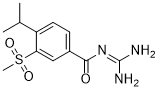
Physicochemical Properties
| Molecular Formula | C12H17N3O3S |
| Molecular Weight | 283.34 |
| Exact Mass | 283.099 |
| CAS # | 159138-80-4 |
| Related CAS # | Cariporide (mesilate);159138-81-5 |
| PubChem CID | 151172 |
| Appearance | White to off-white solid powder |
| Density | 1.3±0.1 g/cm3 |
| Boiling Point | 542.8±60.0 °C at 760 mmHg |
| Flash Point | 282.1±32.9 °C |
| Vapour Pressure | 0.0±1.4 mmHg at 25°C |
| Index of Refraction | 1.602 |
| LogP | 0.4 |
| Hydrogen Bond Donor Count | 2 |
| Hydrogen Bond Acceptor Count | 3 |
| Rotatable Bond Count | 3 |
| Heavy Atom Count | 19 |
| Complexity | 461 |
| Defined Atom Stereocenter Count | 0 |
| InChi Key | IWXNYAIICFKCTM-UHFFFAOYSA-N |
| InChi Code | InChI=1S/C12H17N3O3S/c1-7(2)9-5-4-8(11(16)15-12(13)14)6-10(9)19(3,17)18/h4-7H,1-3H3,(H4,13,14,15,16) |
| Chemical Name | N-(Diaminomethylidene)-3-methylsulfonyl-4-propan-2-ylbenzamide |
| Synonyms | Cariporide HOE642 HOE-642 HOE 642 |
| HS Tariff Code | 2934.99.9001 |
| Storage |
Powder-20°C 3 years 4°C 2 years In solvent -80°C 6 months -20°C 1 month |
| Shipping Condition | Room temperature (This product is stable at ambient temperature for a few days during ordinary shipping and time spent in Customs) |
Biological Activity
| ln Vitro | At 8 or 16 hours, ciprofloxacin dramatically reduced cell death indicators such TUNEL positivity and caspase-3 cleavage. The buildup of Na+ and Ca2+ in the cytoplasm is strongly inhibited by carboride. Cariporide inhibits H2+O2+-induced decrease of mitochondrial membrane potential [1]. By blocking Na+/H+ exchange, ciporide (HOE-642) lowers cytosolic Ca2+ in cardiomyocytes, reducing cardiac ischemia/reperfusion injury [2]. Human platelet degranulation, platelet leukocyte aggregation formation, and GPIIb/IIIa receptor (PAC-1) activation are all inhibited by carbariporide (HOE-642) [3]. |
| ln Vivo | Caripoli injection intravenously dramatically lowers cerebral edema, brain swelling, and infarct volume in addition to brain Na+ uptake [4]. |
| References |
[1]. Cariporide (HOE642), a selective Na+-H+ exchange inhibitor, inhibits the mitochondrial death pathway. Circulation. 2003 Nov 4;108(18):2275-81. [2]. Na(+)/H(+) exchanger in the regulation of platelet activation and paradoxical effects of cariporide. Exp Neurol. 2015 Oct;272:11-6. [3]. Intravenous HOE-642 reduces brain edema and Na uptake in the rat permanent middle cerebral artery occlusion model of stroke: evidence for participation of the blood-brain barrier Na/H exchanger. J Cereb Blood Flow Metab. 2013 Feb;33(2):225-34. |
| Additional Infomation |
See also: Cariporide Mesylate (annotation moved to). Drug Indication Investigated for use/treatment in cardiac surgery. Mechanism of Action Cariporide is a selective sodium-hydrogen antiporter inhibitor. The sodium-hydrogen exchanger is an importatn player in the pathophysiology of myocardial ischemia-referfusion injury. The accumulation of hydrogen ions in the myocyte cytoso; during ischemia creates a proton gradiant that promote the efflux of hydrogen ions in exchange for the influx of sodium ions. This sodium buildup can secondary activates the sodium-calcium exchanger to operate in the reverse mode, resulting in a net calcium accumulation in myocyte cytosol, which leads to dysfunction and cell death. By inhibiting sodium-hydrogen exchange, Cariporide can prevent the accumulation of calcium in cytosol, therefore reduce the infarct size. |
Solubility Data
| Solubility (In Vitro) | DMSO : ≥ 100 mg/mL (~352.92 mM) |
| Solubility (In Vivo) |
Solubility in Formulation 1: ≥ 2.5 mg/mL (8.82 mM) (saturation unknown) in 10% DMSO + 40% PEG300 + 5% Tween80 + 45% Saline (add these co-solvents sequentially from left to right, and one by one), clear solution. For example, if 1 mL of working solution is to be prepared, you can add 100 μL of 25.0 mg/mL clear DMSO stock solution to 400 μL PEG300 and mix evenly; then add 50 μL Tween-80 to the above solution and mix evenly; then add 450 μL normal saline to adjust the volume to 1 mL. Preparation of saline: Dissolve 0.9 g of sodium chloride in 100 mL ddH₂ O to obtain a clear solution. Solubility in Formulation 2: ≥ 2.5 mg/mL (8.82 mM) (saturation unknown) in 10% DMSO + 90% (20% SBE-β-CD in Saline) (add these co-solvents sequentially from left to right, and one by one), clear solution. For example, if 1 mL of working solution is to be prepared, you can add 100 μL of 25.0 mg/mL clear DMSO stock solution to 900 μL of 20% SBE-β-CD physiological saline solution and mix evenly. Preparation of 20% SBE-β-CD in Saline (4°C,1 week): Dissolve 2 g SBE-β-CD in 10 mL saline to obtain a clear solution. Solubility in Formulation 3: ≥ 2.5 mg/mL (8.82 mM) (saturation unknown) in 10% DMSO + 90% Corn Oil (add these co-solvents sequentially from left to right, and one by one), clear solution. For example, if 1 mL of working solution is to be prepared, you can add 100 μL of 25.0 mg/mL clear DMSO stock solution to 900 μL of corn oil and mix evenly. (Please use freshly prepared in vivo formulations for optimal results.) |
| Preparing Stock Solutions | 1 mg | 5 mg | 10 mg | |
| 1 mM | 3.5293 mL | 17.6466 mL | 35.2933 mL | |
| 5 mM | 0.7059 mL | 3.5293 mL | 7.0587 mL | |
| 10 mM | 0.3529 mL | 1.7647 mL | 3.5293 mL |