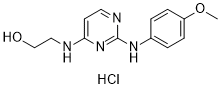
Cardiogenol C is a diaminopyrimidine compound that induces the differentiation of MHC- (myosin heavy chain) positive cardiomyocytes from embryonic stem cells with an EC50 of 0.1 µM. Cardiogenol C upregulates cardiac markers and induces cardiac functional properties in lineage-committed progenitor cells. Cardiogenol C can induce Mouse Hair Bulge Progenitor Cells to Transdifferentiate into Cardiomyocyte-like Cells.
Physicochemical Properties
| Molecular Formula | C13H17CLN4O2 |
| Molecular Weight | 296.755 |
| Exact Mass | 296.104 |
| Elemental Analysis | C, 52.62; H, 5.77; Cl, 11.95; N, 18.88; O, 10.78 |
| CAS # | 1049741-55-0 |
| Related CAS # | Cardiogenol C;671225-39-1 |
| PubChem CID | 16078958 |
| Appearance | White to off-white solid powder |
| LogP | 1.929 |
| Hydrogen Bond Donor Count | 4 |
| Hydrogen Bond Acceptor Count | 6 |
| Rotatable Bond Count | 6 |
| Heavy Atom Count | 20 |
| Complexity | 247 |
| Defined Atom Stereocenter Count | 0 |
| SMILES | Cl[H].O(C([H])([H])[H])C1C([H])=C([H])C(=C([H])C=1[H])N([H])C1=NC([H])=C([H])C(=N1)N([H])C([H])([H])C([H])([H])O[H] |
| InChi Key | 2-((2-((4-methoxyphenyl)amino)pyrimidin-4-yl)amino)ethan-1-ol hydrochloride |
| InChi Code | QQAHYSZVJLHCNA-UHFFFAOYSA-N |
| Chemical Name | Cardiogenol C Cardiogenol C HCl Cardiogenol C hydrochloride. |
| Synonyms | Cardiogenol C; Cardiogenol C HCl; Cardiogenol C hydrochloride. |
| HS Tariff Code | 2934.99.9001 |
| Storage |
Powder-20°C 3 years 4°C 2 years In solvent -80°C 6 months -20°C 1 month Note: Please store this product in a sealed and protected environment, avoid exposure to moisture. |
| Shipping Condition | Room temperature (This product is stable at ambient temperature for a few days during ordinary shipping and time spent in Customs) |
Biological Activity
| ln Vitro | When compared to untreated control cells, P19 cells treated with 1 μM of cardiogenol C hydrochloride for 7 days exhibit cardiogenic effects and considerably higher levels of atrial natriuretic factor (ANF, nppa) [1]. Heartogenol C hydrochloride (0.01–100 μM; 7 days) markedly elevated the expression of ANF. Additionally, this little chemical dramatically enhanced the expression of another widely used cardiac marker gene (NKX2-5) in C2C12 cells [2]. In C2C12 cells, cardiac Nav1.5 sodium channel protein expression is upregulated in a dose-dependent manner by cardiogenol C hydrochloride (0.001-100 μM; 7 days) [2]. The addition of 1 μM of cardiogenol C hydrochloride for 35 days, beginning on day 0, resulted in a considerable increase in the CB percentage of beating cardiomyocytes and in myocardial differentiation. This tiny chemical encourages the heart's developing beating cardiomyocytes, which are produced from cardiovascular progenitor cells [2]. Even at 10 μM, cardiogenol C hydrochloride (0.01-100 μM; 7 days) has no effect on cell proliferation. Moreover, Cardiogenol C dissolved in DMSO or water can have comparable results. On C2C12 cells, the maximum dosage of 100 μM exhibits notable cytotoxicity [2]. |
| Cell Assay |
RT-PCR[2] Cell Types: C2C12 Cell Tested Concentrations: 0.01 μM; 0.1μM; 1μM; 3μM; 10μM; 30μM; 100 μM Incubation Duration: 7 days Experimental Results: ANF and NKX2.5 mRNA levels increased in a dose-dependent manner. Western Blot Analysis[2] Cell Types: C2C12 Cell Tested Concentrations: 0.001 μM; 0.01μM; 0.1μM; 1μM; 10 μM Incubation Duration: 7 days Experimental Results: Increased cardiac Nav1.5 sodium channel protein levels. Cell proliferation experiment [2] Cell Types: C2C12 cell Tested Concentrations: 0.01 μM; 0.1 μM; 1 μM Incubation Duration: 7 days Experimental Results: 0.01-10 μM treatment had no toxic effect on C2C12 cells. |
| References |
[1]. Small molecules that induce cardiomyogenesis in embryonic stem cells.J Am Chem Soc. 2004 Feb 18;126(6):1590-1. [2]. Small molecule cardiogenol C upregulates cardiac markers and induces cardiac functional properties in lineage-committed progenitor cells. Cell Physiol Biochem. 2014;33(1):205-21. |
Solubility Data
| Solubility (In Vitro) |
DMSO : ≥ 59 mg/mL (~198.82 mM) H2O : ~2 mg/mL (~6.74 mM) |
| Solubility (In Vivo) |
Solubility in Formulation 1: 2.5 mg/mL (8.42 mM) in 10% DMSO + 40% PEG300 + 5% Tween80 + 45% Saline (add these co-solvents sequentially from left to right, and one by one), clear solution; with sonication. For example, if 1 mL of working solution is to be prepared, you can add 100 μL of 25.0 mg/mL clear DMSO stock solution to 400 μL PEG300 and mix evenly; then add 50 μL Tween-80 to the above solution and mix evenly; then add 450 μL normal saline to adjust the volume to 1 mL. Preparation of saline: Dissolve 0.9 g of sodium chloride in 100 mL ddH₂ O to obtain a clear solution. Solubility in Formulation 2: ≥ 2.5 mg/mL (8.42 mM) (saturation unknown) in 10% DMSO + 90% (20% SBE-β-CD in Saline) (add these co-solvents sequentially from left to right, and one by one), clear solution. For example, if 1 mL of working solution is to be prepared, you can add 100 μL of 25.0 mg/mL clear DMSO stock solution to 900 μL of 20% SBE-β-CD physiological saline solution and mix evenly. Preparation of 20% SBE-β-CD in Saline (4°C,1 week): Dissolve 2 g SBE-β-CD in 10 mL saline to obtain a clear solution. Solubility in Formulation 3: ≥ 2.5 mg/mL (8.42 mM) (saturation unknown) in 10% DMSO + 90% Corn Oil (add these co-solvents sequentially from left to right, and one by one), clear solution. For example, if 1 mL of working solution is to be prepared, you can add 100 μL of 25.0 mg/mL clear DMSO stock solution to 900 μL of corn oil and mix evenly. Solubility in Formulation 4: 3.33 mg/mL (11.22 mM) in PBS (add these co-solvents sequentially from left to right, and one by one), clear solution; with ultrasonication. (Please use freshly prepared in vivo formulations for optimal results.) |
| Preparing Stock Solutions | 1 mg | 5 mg | 10 mg | |
| 1 mM | 3.3697 mL | 16.8486 mL | 33.6973 mL | |
| 5 mM | 0.6739 mL | 3.3697 mL | 6.7395 mL | |
| 10 mM | 0.3370 mL | 1.6849 mL | 3.3697 mL |