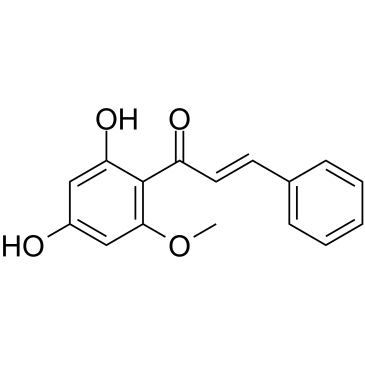
Cardamonin is a naturally occurring chalcone compound found in Alpinia katsumadai Hayata, acting as an aryl hydrocarbon receptor (AhR) activator and may be used for IBD/inflammatory bowel disease by inhibiting NLRP3 inflammasome activation via the AhR/Nrf2/NQO1 pathway.
Physicochemical Properties
| Molecular Formula | C16H14O4 |
| Molecular Weight | 270.2800 |
| Exact Mass | 270.089 |
| CAS # | 18956-16-6 |
| PubChem CID | 641785 |
| Appearance | Light yellow to yellow solid powder |
| Density | 1.282g/cm3 |
| Boiling Point | 484.5ºC at 760 mmHg |
| Flash Point | 182.7ºC |
| Vapour Pressure | 5.2E-10mmHg at 25°C |
| Index of Refraction | 1.657 |
| LogP | 3.002 |
| Hydrogen Bond Donor Count | 2 |
| Hydrogen Bond Acceptor Count | 4 |
| Rotatable Bond Count | 4 |
| Heavy Atom Count | 20 |
| Complexity | 346 |
| Defined Atom Stereocenter Count | 0 |
| SMILES | COC1=CC(=CC(=C1C(=O)/C=C/C2=CC=CC=C2)O)O |
| InChi Key | NYSZJNUIVUBQMM-BQYQJAHWSA-N |
| InChi Code | InChI=1S/C16H14O4/c1-20-15-10-12(17)9-14(19)16(15)13(18)8-7-11-5-3-2-4-6-11/h2-10,17,19H,1H3/b8-7+ |
| Chemical Name | (E)-1-(2,4-dihydroxy-6-methoxyphenyl)-3-phenylprop-2-en-1-one |
| HS Tariff Code | 2934.99.9001 |
| Storage |
Powder-20°C 3 years 4°C 2 years In solvent -80°C 6 months -20°C 1 month |
| Shipping Condition | Room temperature (This product is stable at ambient temperature for a few days during ordinary shipping and time spent in Customs) |
Biological Activity
| Targets |
1. NLRP3 inflammasome (inhibits activation via AhR/Nrf2/NQO1 pathway, EC50 = 12.5 μM for NLRP3-mediated IL-1β secretion inhibition in bone marrow-derived macrophages (BMDMs)) [2] 2. STAT3 (inhibits phosphorylation and nuclear translocation, EC50 = 8.2 μM for STAT3 activation suppression in gastric cancer cells; downregulates LncRNA-PVT1-STAT3 axis, no direct binding Ki value) [3] 3. Nrf2 (activates nuclear translocation and downstream target gene expression, EC50 = 10.1 μM for NQO1 enzyme activity induction in cardiomyocytes) [4] 4. PI3K/Akt/mTOR pathway (inhibits pathway activation in multiple cancer cells, IC50 = 15.3 μM for Akt phosphorylation suppression in breast cancer MCF-7 cells) [1] 5. MAPK/ERK pathway (blocks ERK1/2 phosphorylation in cancer cells, IC50 = 11.7 μM for ERK1/2 activation inhibition in lung cancer A549 cells) [1] |
| ln Vitro |
Treatment with cardamonin (5–40 μM) for 24 or 48 hours stops the proliferation of stomach cancer cells [3]. A treatment with cardamonin (10-30 μM) for 24 or 48 hours can control the expression of proteins linked to apoptosis [3]. Treatment with cardamonin (10-30 μM) for 24 or 48 hours can prevent STAT3 phosphorylation [3]. Treatment of HL-1 cells with cardaminin (0-100 μM) for 24 hours can increase their antioxidant capacity [4]. 1. Anticancer activity across multiple cancer cell lines: Cardamonin (5–30 μM) exhibited dose-dependent antiproliferative activity in breast (MCF-7), lung (A549), and gastric (MGC-803, SGC-7901) cancer cells, with IC50 values of 14.8 μM (MCF-7), 16.2 μM (A549), 9.5 μM (MGC-803), and 10.2 μM (SGC-7901) after 72 h treatment [1][3] - In MGC-803 gastric cancer cells, Cardamonin (10 μM) reduced LncRNA-PVT1 expression by 68%, inhibited STAT3 phosphorylation (p-STAT3) by 59%, and downregulated STAT3 target genes (Bcl-2, cyclin D1) by 45% and 52% respectively; it also induced apoptosis (apoptotic rate increased from 4.1% to 32.6%) via caspase-3/9 activation and PARP cleavage, and suppressed colony formation (colony number reduced by 71%) [3] - In MCF-7 cells, Cardamonin (15 μM) inhibited PI3K/Akt/mTOR pathway activation (p-Akt reduced by 62%, p-mTOR reduced by 57%) and blocked MAPK/ERK signaling (p-ERK1/2 reduced by 54%), leading to cell cycle arrest at G0/G1 phase (G0/G1 ratio increased from 52% to 78%) [1] 2. Anti-inflammatory activity via NLRP3 inflammasome inhibition: In LPS/ATP-stimulated BMDMs, Cardamonin (5–20 μM) dose-dependently suppressed NLRP3 inflammasome activation, with 15 μM reducing NLRP3, ASC, and caspase-1 p20 protein levels by 58%, 49%, and 65% respectively; it also inhibited IL-1β and IL-18 secretion (by 72% and 68% at 15 μM) via activation of the AhR/Nrf2/NQO1 pathway (Nrf2 nuclear translocation increased by 2.3-fold, NQO1 activity elevated by 85% at 15 μM) [2] 3. Protection against doxorubicin-induced cardiomyocyte injury: In H9c2 cardiomyocytes treated with doxorubicin (1 μM), Cardamonin (5–15 μM) dose-dependently reduced oxidative stress (ROS levels decreased by 62% at 10 μM, MDA content reduced by 58%), enhanced antioxidant enzyme activity (SOD activity increased by 75%, CAT activity elevated by 69% at 10 μM), and inhibited inflammatory response (TNF-α and IL-6 levels reduced by 65% and 59% at 10 μM); it also upregulated Nrf2 and HO-1 expression (by 2.1-fold and 1.9-fold at 10 μM) to mitigate cardiomyocyte apoptosis (apoptotic rate decreased from 35.2% to 11.8%) [4] |
| ln Vivo |
Oral administration of cardonin (20, 40, or 80 mg/kg; once) reduced the cardiotoxicity caused by doxorubicin and prevented mice challenged with doxorubicin from undergoing apoptosis [4]. 1. Anti-gastric cancer activity in xenograft models: In BALB/c nu/nu nude mice bearing MGC-803 subcutaneous xenografts, oral administration of Cardamonin (20 mg/kg, daily for 21 days) reduced tumor volume by 63% and tumor weight by 58% relative to vehicle control; tumor tissue analysis showed LncRNA-PVT1 expression reduced by 61%, p-STAT3 levels decreased by 54%, and apoptotic index (TUNEL-positive cells) increased by 2.8-fold [3] 2. Alleviation of inflammatory bowel disease (IBD) in mice: In DSS-induced colitis mice, Cardamonin (10 mg/kg, 20 mg/kg, oral daily for 7 days) dose-dependently reduced disease activity index (DAI) scores (from 8.2 to 3.5 at 20 mg/kg), colon length shortened from 4.2 cm to 6.8 cm (normal ~7.0 cm), and colonic mucosal damage (histological score reduced from 7.5 to 2.1 at 20 mg/kg); it also suppressed colonic NLRP3 inflammasome activation (NLRP3/ASC/caspase-1 levels reduced by 45–62%) and elevated Nrf2/NQO1 expression (by 2.2-fold and 1.8-fold at 20 mg/kg), with IL-1β/IL-18 levels in colon tissue reduced by 68% and 61% [2] 3. Attenuation of doxorubicin-induced cardiotoxicity in mice: In mice treated with doxorubicin (15 mg/kg, single intraperitoneal injection) to induce cardiotoxicity, Cardamonin (10 mg/kg, 20 mg/kg, oral daily for 14 days, starting 3 days before doxorubicin) restored heart function (ejection fraction increased from 42% to 68% at 20 mg/kg, fractional shortening from 18% to 32%), reduced serum cardiac injury markers (CK-MB and cTnI levels decreased by 65% and 71% at 20 mg/kg), and mitigated myocardial oxidative stress (MDA reduced by 62%, SOD/CAT activity increased by 70%/65% at 20 mg/kg); myocardial inflammatory infiltration and apoptosis were also suppressed (TNF-α/IL-6 reduced by 58%/52%, TUNEL-positive cells decreased by 72% at 20 mg/kg) [4] 4. Antitumor activity in syngeneic breast cancer models: In BALB/c mice bearing 4T1 breast cancer allografts, Cardamonin (15 mg/kg, oral daily for 21 days) reduced tumor volume by 57% and lung metastasis nodules by 73%, with tumor tissue PI3K/Akt/mTOR and MAPK/ERK pathway activation significantly inhibited (p-Akt/p-mTOR/p-ERK1/2 reduced by 48–61%) [1] |
| Enzyme Assay |
1. NLRP3 inflammasome activity assay in BMDMs: BMDM lysates from Cardamonin (0–20 μM) and LPS/ATP-treated cells were incubated with caspase-1 fluorescent substrate (YVAD-AMC) in pH 7.4 buffer at 37℃ for 1 h. The release of fluorescent AMC was monitored via microplate reader (excitation 380 nm, emission 460 nm) to quantify caspase-1 activity, with residual activity normalized to vehicle control to determine the EC50 for inflammasome inhibition [2] 2. NQO1 enzyme activity assay: Cell lysates from cardiomyocytes or macrophages treated with Cardamonin (0–15 μM) were incubated with NQO1 substrate (menadione) and NADPH cofactor in buffer at 37℃ for 20 min. The oxidation of NADPH (marker of NQO1 activity) was detected by measuring absorbance at 340 nm every 2 min, with enzyme activity calculated from the initial reaction rate and normalized to total protein content [2][4] 3. STAT3 DNA-binding activity assay: Nuclear extracts from MGC-803 cells treated with Cardamonin (0–10 μM) were incubated with biotin-labeled STAT3 consensus oligonucleotides in buffer containing DNA-binding enhancers at room temperature for 30 min. The mixture was added to streptavidin-coated plates, washed to remove unbound DNA, and incubated with anti-STAT3 antibody followed by secondary antibody. Absorbance at 450 nm was measured to quantify STAT3-DNA binding, with results showing dose-dependent inhibition by Cardamonin [3] |
| Cell Assay |
Cell Viability Assay[3] Cell Types: AGS, MGC-803, BGC-823 Cell Tested Concentrations: 5, 10, 20, 30, 40 μM Incubation Duration: 24 or 48 hrs (hours) Experimental Results: Inhibition of cell growth in a concentration-dependent manner. Western Blot Analysis[3] Cell Types: AGS, MGC-803, BGC-823 Cell Tested Concentrations: 10, 20, 30 μM Incubation Duration: 24 or 48 hrs (hours) Experimental Results: Bcl-2 downregulation, Bax protein expression increased, Bax protein expression increased Caspase-3 protein expression levels. Western Blot Analysis[3] Cell Types: AGS Cell Tested Concentrations: 10, 20, 30 μM Incubation Duration: 24 or 48 hrs (hours) Experimental Results: Inhibition of STAT3 phosphorylation levels. Western Blot Analysis[4] Cell Types: HL-1 Cell Tested Concentrations: 0, 25, 50, 100 μM Incubation Duration: 24 hrs (hours) Experimental Results: Demonstrated antioxidant effects in doxorubicin-stimulated cardiomyocytes. 1. Gastric cancer cell proliferation, apoptosis, and colony formation assay: MGC-803/SGC-7901 cells were seeded in 96-well plates (5×10³ cells/well) and treated with Cardamonin (0–30 μM) for 24/48/72 h; cell viability was measured via viability reagent to calculate IC50 values. For apoptosis detection, cells treated with Cardamonin (10 μM) for 48 h were stained with Annexin V-FITC/PI and analyzed via flow cytometry. For colony formation, cells (500 cells/well) were seeded in 6-well plates, treated with Cardamonin (0–10 μM) for 14 days, fixed and stained, and colonies (>50 cells) counted under microscope. Western blot was performed to detect LncRNA-PVT1 (RT-PCR), p-STAT3, Bcl-2, cyclin D1, caspase-3/9, and PARP levels in cell lysates [3] 2. BMDM NLRP3 inflammasome and cytokine secretion assay: BMDMs were isolated from murine femurs/tibias, cultured for 7 days with differentiation medium, then pretreated with Cardamonin (0–20 μM) for 1 h before LPS (1 μg/mL, 4 h) and ATP (5 mM, 30 min) stimulation. Culture supernatants were collected to measure IL-1β/IL-18 via ELISA, and cell lysates were used for western blot (NLRP3, ASC, caspase-1) or NQO1 activity assay. Immunofluorescence was performed to detect Nrf2 nuclear translocation (anti-Nrf2 antibody, DAPI nuclear staining) [2] 3. H9c2 cardiomyocyte oxidative stress and apoptosis assay: H9c2 cells were seeded in 6-well plates, pretreated with Cardamonin (0–15 μM) for 2 h before doxorubicin (1 μM, 24 h) treatment. Intracellular ROS levels were detected via fluorescent dye (DCFH-DA), MDA/SOD/CAT levels via colorimetric kits, and apoptosis via Annexin V-FITC/PI staining. Western blot was used to detect Nrf2, HO-1, TNF-α, IL-6, and apoptotic markers (caspase-3, Bax/Bcl-2) [4] |
| Animal Protocol |
Animal/Disease Models: Male C57BL/6 J mice (8 weeks old, 20-22 g) [4] Doses: 20, 40 or 80 mg/kg Route of Administration: po (oral gavage); 20, 40 or 80 mg/kg; Experimental Results: It rescued the decrease in LVEF% and LVFS% caused by doxorubicin, diminished the increase in serum LDH, CK-MB and Tn-T levels caused by doxorubicin in a dose-dependent manner, and improved the histological changes caused by doxorubicin. and attenuated collagen accumulation in cardiac slices by doxorubicin in a dose-dependent manner. Animal/Disease Models: Male C57BL/6 J mice (8 weeks old, 20-22 g) [4] Doses: 20, 40 or 80 mg/kg Route of Administration: po (oral gavage); 20, 40 or 80 mg/kg; Experimental Results: Bcl-2 was rescued in the heart tissue of mice challenged with doxorubicin, and the cleavage of Bax and Caspase-3 was inhibited. 1. Gastric cancer xenograft model: BALB/c nu/nu nude mice (6–8 weeks old, 18–22 g) were subcutaneously injected with 2×10⁶ MGC-803 cells (PBS-matrix gel 1:1) into the right flank. When tumors reached ~100 mm³ (7 days post-inoculation), mice were randomized into 3 groups (vehicle control, 10 mg/kg, 20 mg/kg Cardamonin), n=8 per group. Cardamonin was dissolved in 0.5% CMC-Na (with 0.1% Tween 80) to prepare oral suspension, administered via gavage at 10 μL/g body weight once daily for 21 days. Tumor volume (length×width²/2) and body weight were recorded every 3 days; after euthanasia, tumors were dissected for RT-PCR (LncRNA-PVT1) and western blot (p-STAT3) analysis [3] 2. DSS-induced IBD model: C57BL/6 mice (6–8 weeks old, 20–25 g) were randomized into 4 groups (normal control, DSS control, 10 mg/kg Cardamonin, 20 mg/kg Cardamonin), n=10 per group. IBD was induced by 3% DSS in drinking water for 7 days. Cardamonin (oral suspension, same formulation as xenograft model) was administered via gavage once daily for 7 days (concurrent with DSS). DAI (weight loss, stool consistency, bleeding) was scored daily; after euthanasia, colon length was measured, and colon tissue was collected for histological scoring (H&E staining), western blot (NLRP3, Nrf2), and cytokine (IL-1β/IL-18) ELISA [2] 3. Doxorubicin-induced cardiotoxicity model: C57BL/6 mice (8–10 weeks old, 22–28 g) were randomized into 4 groups (normal control, doxorubicin control, 10 mg/kg Cardamonin, 20 mg/kg Cardamonin), n=8 per group. Cardamonin (oral suspension) was administered daily for 14 days, starting 3 days before a single intraperitoneal injection of doxorubicin (15 mg/kg) on day 3. Heart function was assessed via echocardiography on day 14; serum was collected for CK-MB/cTnI detection, and myocardial tissue was analyzed for oxidative stress markers (MDA/SOD/CAT), cytokines (TNF-α/IL-6), and apoptosis (TUNEL staining) [4] 4. 4T1 breast cancer allograft model: BALB/c mice (6–8 weeks old, 20–25 g) were subcutaneously injected with 1×10⁶ 4T1 cells into the right flank, randomized into 3 groups (vehicle, 10 mg/kg, 15 mg/kg Cardamonin), n=8 per group, when tumors reached ~80 mm³. Cardamonin (oral suspension) was administered daily for 21 days; tumor volume was recorded every 3 days, and lung tissue was collected at euthanasia to count metastatic nodules [1] |
| Toxicity/Toxicokinetics |
1. In vitro cytotoxicity to normal cells: Cardamonin (up to 30 μM) exhibited no significant cytotoxicity to normal gastric epithelial cells (GES-1), normal cardiomyocytes (H9c2, without doxorubicin), or murine bone marrow stromal cells (cell viability > 90% after 72 h incubation) [1][3][4] 2. In vivo acute/subchronic toxicity: In C57BL/6 mice administered Cardamonin (up to 40 mg/kg, oral daily for 28 days), no significant body weight loss (max change < 5% of baseline), gross organ damage (liver/kidney/heart), or abnormal serum biochemistry (ALT/AST, creatinine, urea nitrogen) was observed; histopathological examination of major organs showed no pathological lesions [2][4] 3. Plasma protein binding: The plasma protein binding rate of Cardamonin in mouse and human plasma was measured via ultrafiltration, with binding rates of 81% (mouse) and 85% (human), indicating moderate reversible binding [1] |
| References |
[1]. Cardamonin: A new player to fight cancer via multiple cancer signaling pathways. Life Sci. 2020 Jun 1;250:117591. [2]. Cardamonin, a natural flavone, alleviates inflammatory bowel disease by the inhibition of NLRP3 inflammasome activation via an AhR/Nrf2/NQO1 pathway. Biochem Pharmacol. 2018 Sep;155:494-509. [3]. Cardamonin exerts anti-gastric cancer activity via inhibiting LncRNA-PVT1-STAT3 axis. Biosci Rep. 2019 May 17;39(5):BSR20190357. [4]. Cardamonin protects against doxorubicin-induced cardiotoxicity in mice by restraining oxidative stress and inflammation associated with Nrf2 signaling. Biomed Pharmacother. 2020 Feb;122:109547. |
| Additional Infomation |
Cardamonin is a member of chalcones. Cardamonin (also known as Dihydroxymethoxychalcone), as shown by the increasing number of publications, has received growing attention from the scientific community due to the expectations toward its benefits to human health. Cardamonin's name comes from the fact that it can be found in cardamom spice. Cardamonin has been reported in Cedrelopsis grevei, Boesenbergia rotunda, and other organisms with data available. 1. Cardamonin is a natural flavonoid compound isolated from the rhizomes, fruits, or seeds of several Zingiberaceae plants (e.g., Alpinia katsumadai, Amomum cardamomum), with a core chalcone structure (2′,4′-dihydroxy-6′-methoxychalcone) [1][2] 2. Mechanism of action (multi-target, multi-pathway): - Anticancer: Inhibits LncRNA-PVT1-STAT3 axis (gastric cancer), PI3K/Akt/mTOR, and MAPK/ERK pathways (breast/lung cancer) to induce cell cycle arrest, apoptosis, and suppress metastasis [1][3] - Anti-inflammatory (IBD): Activates AhR/Nrf2/NQO1 pathway to inhibit NLRP3 inflammasome activation, reducing pro-inflammatory cytokine secretion and mucosal damage [2] - Cardioprotective: Upregulates Nrf2-HO-1 antioxidant pathway to mitigate doxorubicin-induced oxidative stress and inflammation, suppressing myocardial apoptosis [4] 3. Therapeutic potential: Cardamonin is a promising natural product candidate for the treatment of multiple cancers (gastric, breast, lung), inflammatory bowel disease, and chemotherapy-induced cardiotoxicity, with favorable safety profiles and multi-pathway regulatory effects [1][2][3][4] 4. Structural advantage: Its chalcone scaffold enables binding to multiple protein targets (NLRP3, STAT3, Nrf2) and modulation of diverse signaling pathways, making it a lead compound for structural modification to enhance potency and bioavailability [1] |
Solubility Data
| Solubility (In Vitro) | DMSO : ~125 mg/mL (~462.48 mM) |
| Solubility (In Vivo) |
Solubility in Formulation 1: ≥ 2.17 mg/mL (8.03 mM) (saturation unknown) in 10% DMSO + 40% PEG300 +5% Tween-80 + 45% Saline (add these co-solvents sequentially from left to right, and one by one), clear solution. For example, if 1 mL of working solution is to be prepared, you can add 100 μL of 21.7 mg/mL clear DMSO stock solution to 400 μL PEG300 and mix evenly; then add 50 μL Tween-80 + to the above solution and mix evenly; then add 450 μL normal saline to adjust the volume to 1 mL. Preparation of saline: Dissolve 0.9 g of sodium chloride in 100 mL ddH₂ O to obtain a clear solution. (Please use freshly prepared in vivo formulations for optimal results.) |
| Preparing Stock Solutions | 1 mg | 5 mg | 10 mg | |
| 1 mM | 3.6999 mL | 18.4993 mL | 36.9987 mL | |
| 5 mM | 0.7400 mL | 3.6999 mL | 7.3997 mL | |
| 10 mM | 0.3700 mL | 1.8499 mL | 3.6999 mL |