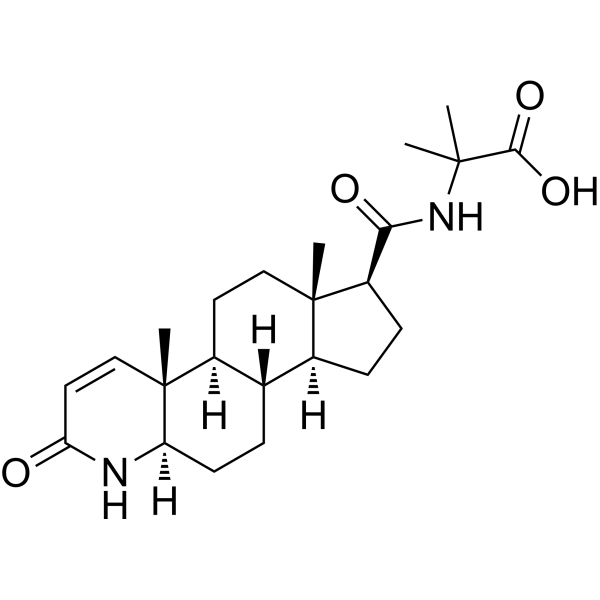
Physicochemical Properties
| Molecular Formula | C23H34N2O4 |
| Molecular Weight | 402.53 |
| Exact Mass | 402.252 |
| CAS # | 116285-37-1 |
| PubChem CID | 18632991 |
| Appearance | Typically exists as solid at room temperature |
| Density | 1.169g/cm3 |
| Boiling Point | 658.3ºC at 760 mmHg |
| Flash Point | 351.9ºC |
| Vapour Pressure | 4.94E-19mmHg at 25°C |
| Index of Refraction | 1.542 |
| LogP | 3.598 |
| Hydrogen Bond Donor Count | 3 |
| Hydrogen Bond Acceptor Count | 4 |
| Rotatable Bond Count | 3 |
| Heavy Atom Count | 29 |
| Complexity | 775 |
| Defined Atom Stereocenter Count | 7 |
| SMILES | C[C@]12CC[C@H]3[C@H]([C@@H]1CC[C@@H]2C(=O)NC(C)(C)C(=O)O)CC[C@@H]4[C@@]3(C=CC(=O)N4)C |
| InChi Key | OFTBMAPJHKDDJV-MKMSXTRJSA-N |
| InChi Code | InChI=1S/C23H34N2O4/c1-21(2,20(28)29)25-19(27)16-7-6-14-13-5-8-17-23(4,12-10-18(26)24-17)15(13)9-11-22(14,16)3/h10,12-17H,5-9,11H2,1-4H3,(H,24,26)(H,25,27)(H,28,29)/t13-,14-,15-,16+,17+,22-,23+/m0/s1 |
| Chemical Name | 2-[[(1S,3aS,3bS,5aR,9aR,9bS,11aS)-9a,11a-dimethyl-7-oxo-1,2,3,3a,3b,4,5,5a,6,9b,10,11-dodecahydroindeno[5,4-f]quinoline-1-carbonyl]amino]-2-methylpropanoic acid |
| Synonyms | Finasteride Carboxylic Acid; 116285-37-1; Carboxy finasteride; UNII-K71S04GO1T; K71S04GO1T; 2-[[(1S,3aS,3bS,5aR,9aR,9bS,11aS)-9a,11a-dimethyl-7-oxo-1,2,3,3a,3b,4,5,5a,6,9b,10,11-dodecahydroindeno[5,4-f]quinoline-1-carbonyl]amino]-2-methylpropanoic acid; Alanine, 2-methyl-N-(((4aR,4bS,6aS,7S,9aS,9bS,11aR)-2,4a,4b,5,6,6a,7,8,9,9a,9b,10,11,11a-tetradecahydro-4a,6a-dimethyl-2-oxo-1H-indeno(5,4-f)quinolin-7-yl)carbonyl)-; Alanine, 2-methyl-N-[[(4aR,4bS,6aS,7S,9aS,9bS,11aR)-2,4a,4b,5,6,6a,7,8,9,9a,9b,10,11,11a-tetradecahydro-4a,6a-dimethyl-2-oxo-1H-indeno[5,4-f]quinolin-7-yl]carbonyl]-; Finasteride carboxylic acid |
| HS Tariff Code | 2934.99.9001 |
| Storage |
Powder-20°C 3 years 4°C 2 years In solvent -80°C 6 months -20°C 1 month |
| Shipping Condition | Room temperature (This product is stable at ambient temperature for a few days during ordinary shipping and time spent in Customs) |
Biological Activity
| Targets | Finasteride metabolite; 5α-reductase |
| ln Vivo | The aim of this study was to investigate what the consequences of induced drug metabolism, caused by St. John's wort (SJW, Hypericum perforatum) treatment, would have on the plasma, biliary and urinary pharmacokinetics of finasteride and its two previously identified phase I metabolites (hydroxy-finasteride and Carboxy finasteride). Twelve healthy men were administered 5mg finasteride directly to the intestine via a catheter with a multi-channel tubing system, Loc-I-Gut, before and after 14 days SJW (300mg b.i.d, hyperforin 4%) treatment. Bile samples were withdrawn via the Loc-I-Gut device from the proximal jejunum. LC-ESI-MS/MS was used to analyze finasteride and its metabolites in plasma, bile and urine. HPLC-UV was used to analyze hyperforin in plasma. The herbal treatment significantly reduced the peak plasma concentration (C(max)), the area under the plasma concentration-time curve (AUC(0-24h)) and the elimination half-life (t(1/2)) of finasteride. The geometric mean ratios (90% CI) were 0.42 (0.36-0.49), 0.66 (0.56-0.79) and 0.54 (0.48-0.61), respectively. Finasteride was excreted unchanged to a minor extent into bile and urine. Hydroxy-finasteride was not detected in plasma, bile or urine. Carboxy-finasteride was quantified in all three compartments and its plasma pharmacokinetics was significantly affected by SJW treatment. Hyperforin concentration in plasma was 21+/-7ng/ml approximately 12h after the last dose of the 14 days SJW treatment. In conclusion, SJW treatment for 2 weeks induced the metabolism of finasteride and caused a reduced plasma exposure of the drug. New knowledge was gained about the biliary and urinary excretion or the drug and its metabolites. [1] |
| ADME/Pharmacokinetics |
The overall aim of this detailed investigation of the pharmacokinetics (PK) and metabolism of finasteride in pigs was to improve understanding of in vivo PK for this drug and its metabolites such as Carboxy finasteride. Specific aims were to examine the effects of ketoconazole coadministration on the PK in three plasma compartments (the portal, hepatic, and femoral veins), bile, and urine and to use these data to study in detail the intestinal absorption and the liver extraction ratio and apply a semiphysiological based PK model to the data. The pigs received an intrajejunal dose of finasteride (0.8 mg/kg) either alone (n = 5) or together with ketoconazole (10 mg/kg) (n = 5) or an intravenous dose (0.2 mg/kg) (n = 3). Plasma, bile, and urine (collected from 0 to 6 h) were analyzed with ultraperformance liquid chromatography-tandem mass spectrometry. Ketoconazole increased the bioavailability of finasteride from 0.36 ± 0.23 to 0.91 ± 0.1 (p < 0.05) and the terminal half-life from 1.6 ± 0.4 to 4.0 ± 1.1 h (p < 0.05). From deconvolution, it was found that the absorption rate from the intestine to the portal vein was rapid, and the product of the fraction absorbed and the fraction that escaped gut wall metabolism was high (f(a) · F(G) ∼ 1). Interestingly, the apparent absorption rate constant (k(a)) to the femoral vein was lower than that to the portal vein, probably because of binding and distribution within the liver. The liver extraction ratio was time-dependent and varied with the two routes of administration. After intrajejunal administration, from 1 to 6 h, the liver extraction ratio was significantly (p < 0.05) reduced by ketoconazole treatment from intermediate (0.41 ± 0.21) to low (0.21 ± 0.10).[2] Reference: Drug Metab Dispos. 2011 May;39(5):847-57. |
| References |
[1]. The effect of St. John’s wort on the pharmacokinetics, metabolism and biliary excretion of finasteride and its metabolites in healthy men. Eur J Pharm Sci. 2009 Mar 2;36(4-5):433-43. [2]. In vivo investigation in pigs of intestinal absorption, hepatobiliary disposition, and metabolism of the 5α-reductase inhibitor finasteride and the effects of coadministered ketoconazole. Drug Metab Dispos . 2011 May;39(5):847-57. |
| Additional Infomation | Finasteride Carboxylic Acid is a 3-hydroxy steroid. It has a role as an androgen. |
Solubility Data
| Solubility (In Vitro) | May dissolve in DMSO (in most cases), if not, try other solvents such as H2O, Ethanol, or DMF with a minute amount of products to avoid loss of samples |
| Solubility (In Vivo) |
Note: Listed below are some common formulations that may be used to formulate products with low water solubility (e.g. < 1 mg/mL), you may test these formulations using a minute amount of products to avoid loss of samples. Injection Formulations (e.g. IP/IV/IM/SC) Injection Formulation 1: DMSO : Tween 80: Saline = 10 : 5 : 85 (i.e. 100 μL DMSO stock solution → 50 μL Tween 80 → 850 μL Saline) *Preparation of saline: Dissolve 0.9 g of sodium chloride in 100 mL ddH ₂ O to obtain a clear solution. Injection Formulation 2: DMSO : PEG300 :Tween 80 : Saline = 10 : 40 : 5 : 45 (i.e. 100 μL DMSO → 400 μLPEG300 → 50 μL Tween 80 → 450 μL Saline) Injection Formulation 3: DMSO : Corn oil = 10 : 90 (i.e. 100 μL DMSO → 900 μL Corn oil) Example: Take the Injection Formulation 3 (DMSO : Corn oil = 10 : 90) as an example, if 1 mL of 2.5 mg/mL working solution is to be prepared, you can take 100 μL 25 mg/mL DMSO stock solution and add to 900 μL corn oil, mix well to obtain a clear or suspension solution (2.5 mg/mL, ready for use in animals). Injection Formulation 4: DMSO : 20% SBE-β-CD in saline = 10 : 90 [i.e. 100 μL DMSO → 900 μL (20% SBE-β-CD in saline)] *Preparation of 20% SBE-β-CD in Saline (4°C,1 week): Dissolve 2 g SBE-β-CD in 10 mL saline to obtain a clear solution. Injection Formulation 5: 2-Hydroxypropyl-β-cyclodextrin : Saline = 50 : 50 (i.e. 500 μL 2-Hydroxypropyl-β-cyclodextrin → 500 μL Saline) Injection Formulation 6: DMSO : PEG300 : castor oil : Saline = 5 : 10 : 20 : 65 (i.e. 50 μL DMSO → 100 μLPEG300 → 200 μL castor oil → 650 μL Saline) Injection Formulation 7: Ethanol : Cremophor : Saline = 10: 10 : 80 (i.e. 100 μL Ethanol → 100 μL Cremophor → 800 μL Saline) Injection Formulation 8: Dissolve in Cremophor/Ethanol (50 : 50), then diluted by Saline Injection Formulation 9: EtOH : Corn oil = 10 : 90 (i.e. 100 μL EtOH → 900 μL Corn oil) Injection Formulation 10: EtOH : PEG300:Tween 80 : Saline = 10 : 40 : 5 : 45 (i.e. 100 μL EtOH → 400 μLPEG300 → 50 μL Tween 80 → 450 μL Saline) Oral Formulations Oral Formulation 1: Suspend in 0.5% CMC Na (carboxymethylcellulose sodium) Oral Formulation 2: Suspend in 0.5% Carboxymethyl cellulose Example: Take the Oral Formulation 1 (Suspend in 0.5% CMC Na) as an example, if 100 mL of 2.5 mg/mL working solution is to be prepared, you can first prepare 0.5% CMC Na solution by measuring 0.5 g CMC Na and dissolve it in 100 mL ddH2O to obtain a clear solution; then add 250 mg of the product to 100 mL 0.5% CMC Na solution, to make the suspension solution (2.5 mg/mL, ready for use in animals). Oral Formulation 3: Dissolved in PEG400 Oral Formulation 4: Suspend in 0.2% Carboxymethyl cellulose Oral Formulation 5: Dissolve in 0.25% Tween 80 and 0.5% Carboxymethyl cellulose Oral Formulation 6: Mixing with food powders Note: Please be aware that the above formulations are for reference only. InvivoChem strongly recommends customers to read literature methods/protocols carefully before determining which formulation you should use for in vivo studies, as different compounds have different solubility properties and have to be formulated differently. (Please use freshly prepared in vivo formulations for optimal results.) |
| Preparing Stock Solutions | 1 mg | 5 mg | 10 mg | |
| 1 mM | 2.4843 mL | 12.4214 mL | 24.8429 mL | |
| 5 mM | 0.4969 mL | 2.4843 mL | 4.9686 mL | |
| 10 mM | 0.2484 mL | 1.2421 mL | 2.4843 mL |