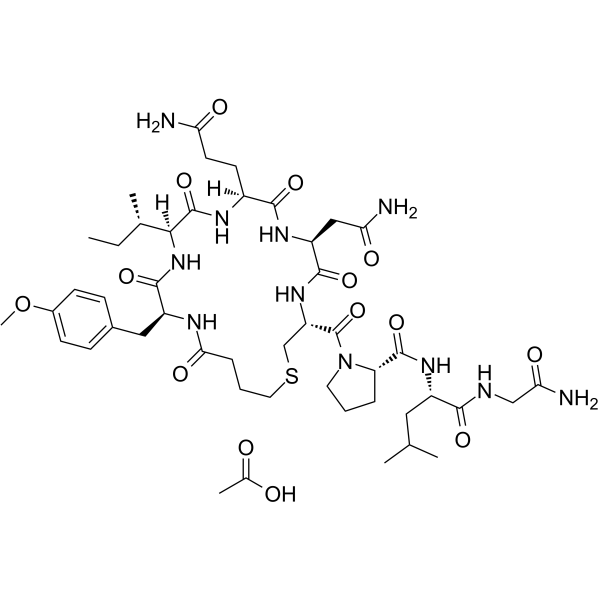
Physicochemical Properties
| Molecular Formula | C47H73N11O14S |
| Molecular Weight | 1048.21 |
| Exact Mass | 1047.505 |
| CAS # | 1631754-28-3 |
| Related CAS # | Carbetocin;37025-55-1 |
| PubChem CID | 129319308 |
| Appearance | White to off-white solid powder |
| Hydrogen Bond Donor Count | 11 |
| Hydrogen Bond Acceptor Count | 15 |
| Rotatable Bond Count | 18 |
| Heavy Atom Count | 73 |
| Complexity | 1880 |
| Defined Atom Stereocenter Count | 8 |
| SMILES | CC[C@H](C)[C@H]1C(=O)N[C@H](C(=O)N[C@H](C(=O)N[C@@H](CSCCCC(=O)N[C@H](C(=O)N1)CC2=CC=C(C=C2)OC)C(=O)N3CCC[C@H]3C(=O)N[C@@H](CC(C)C)C(=O)NCC(=O)N)CC(=O)N)CCC(=O)N.CC(=O)O |
| InChi Key | AWSBRHKQUFVWPU-AJDWMHSWSA-N |
| InChi Code | InChI=1S/C45H69N11O12S.C2H4O2/c1-6-25(4)38-44(66)51-28(15-16-34(46)57)40(62)52-31(21-35(47)58)41(63)54-32(23-69-18-8-10-37(60)50-30(42(64)55-38)20-26-11-13-27(68-5)14-12-26)45(67)56-17-7-9-33(56)43(65)53-29(19-24(2)3)39(61)49-22-36(48)59;1-2(3)4/h11-14,24-25,28-33,38H,6-10,15-23H2,1-5H3,(H2,46,57)(H2,47,58)(H2,48,59)(H,49,61)(H,50,60)(H,51,66)(H,52,62)(H,53,65)(H,54,63)(H,55,64);1H3,(H,3,4)/t25-,28-,29-,30-,31-,32-,33-,38-;/m0./s1 |
| Chemical Name | acetic acid;(2S)-N-[(2S)-1-[(2-amino-2-oxoethyl)amino]-4-methyl-1-oxopentan-2-yl]-1-[(3R,6S,9S,12S,15S)-6-(2-amino-2-oxoethyl)-9-(3-amino-3-oxopropyl)-12-[(2S)-butan-2-yl]-15-[(4-methoxyphenyl)methyl]-5,8,11,14,17-pentaoxo-1-thia-4,7,10,13,16-pentazacycloicosane-3-carbonyl]pyrrolidine-2-carboxamide |
| HS Tariff Code | 2934.99.9001 |
| Storage |
Powder-20°C 3 years 4°C 2 years In solvent -80°C 6 months -20°C 1 month Note: Please store this product in a sealed and protected environment (e.g. under nitrogen), avoid exposure to moisture and light. |
| Shipping Condition | Room temperature (This product is stable at ambient temperature for a few days during ordinary shipping and time spent in Customs) |
Biological Activity
| ln Vitro | An agonist with a ten-fold decrease in affinity for the oxytocin receptor, carbetocin acetate exhibits a notable increase in stability and a prolonged duration of activity. Higher affinity for chimeric E1 receptors is exhibited by carbetocin acetate, particularly when it comes to E1 binding to additional extracellular domains, such as chimeric receptors E13 (Ki=13 nM), E123 (Ki=56 nM), and E1234 (Ki=37 nM)[2]. |
| ln Vivo | Treatment effects of carbetocin acetate (2–20 mg/kg; i.p.) on climbing, swimming, and percentage of immobility are noteworthy[1]. After acute 100 μg/rat dosing, there is a dose-dependent increase in % swimming time observed with carbetocin acetate (1, 10, 100 μg/rat, icv)[1]. |
| Animal Protocol |
Animal/Disease Models: Male SD (Sprague-Dawley) rats weighing between 300 and 500 g[1] Doses: 2, 6.4, 20 mg/kg Route of Administration: IP; single dose Experimental Results: Increased climbing with 6.4 mg/kg and resulted in a Dramatically greater proportion of time spent swimming with 20 mg/kg. |
| References |
[1]. Assessing the antidepressant-like effects of carbetocin, an oxytocin agonist, using a modification of the forced swimming test. Psychopharmacology (Berl). 2010 May;210(1):35-43. [2]. Binding domains of the oxytocin receptor for the selective oxytocin receptor antagonist barusiban in comparison to the agonists oxytocin and carbetocin. Eur J Pharmacol. 2005 Mar 7;510(1-2):9-16. [3]. The effects of oxytocin and its analog, carbetocin, on genetic deficits in sensorimotor gating. Eur Neuropsychopharmacol. 2012 May;22(5):374-8. |
Solubility Data
| Solubility (In Vitro) |
DMSO: 125 mg/mL (119.25 mM) H2O: 10 mg/mL (9.54 mM) |
| Solubility (In Vivo) |
Solubility in Formulation 1: ≥ 2.08 mg/mL (1.98 mM) (saturation unknown) in 10% DMSO + 40% PEG300 + 5% Tween80 + 45% Saline (add these co-solvents sequentially from left to right, and one by one), clear solution. For example, if 1 mL of working solution is to be prepared, you can add 100 μL of 20.8 mg/mL clear DMSO stock solution to 400 μL PEG300 and mix evenly; then add 50 μL Tween-80 to the above solution and mix evenly; then add 450 μL normal saline to adjust the volume to 1 mL. Preparation of saline: Dissolve 0.9 g of sodium chloride in 100 mL ddH₂ O to obtain a clear solution. Solubility in Formulation 2: ≥ 2.08 mg/mL (1.98 mM) (saturation unknown) in 10% DMSO + 90% (20% SBE-β-CD in Saline) (add these co-solvents sequentially from left to right, and one by one), clear solution. For example, if 1 mL of working solution is to be prepared, you can add 100 μL of 20.8 mg/mL clear DMSO stock solution to 900 μL of 20% SBE-β-CD physiological saline solution and mix evenly. Preparation of 20% SBE-β-CD in Saline (4°C,1 week): Dissolve 2 g SBE-β-CD in 10 mL saline to obtain a clear solution. Solubility in Formulation 3: ≥ 2.08 mg/mL (1.98 mM) (saturation unknown) in 10% DMSO + 90% Corn Oil (add these co-solvents sequentially from left to right, and one by one), clear solution. For example, if 1 mL of working solution is to be prepared, you can add 100 μL of 20.8 mg/mL clear DMSO stock solution to 900 μL of corn oil and mix evenly. (Please use freshly prepared in vivo formulations for optimal results.) |
| Preparing Stock Solutions | 1 mg | 5 mg | 10 mg | |
| 1 mM | 0.9540 mL | 4.7700 mL | 9.5401 mL | |
| 5 mM | 0.1908 mL | 0.9540 mL | 1.9080 mL | |
| 10 mM | 0.0954 mL | 0.4770 mL | 0.9540 mL |