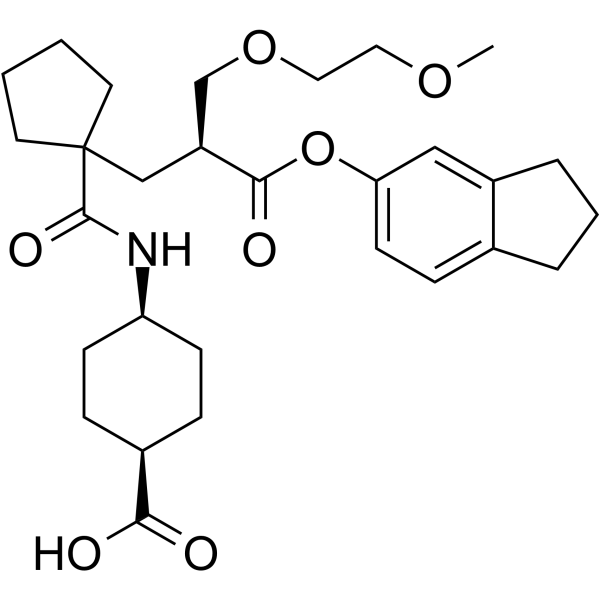
Physicochemical Properties
| Molecular Formula | C29H41NO7 |
| Molecular Weight | 515.63834 |
| Exact Mass | 515.288 |
| CAS # | 123122-55-4 |
| PubChem CID | 5362417 |
| Appearance | White to off-white solid powder |
| Density | 1.21g/cm3 |
| Boiling Point | 718.4ºC at 760mmHg |
| Flash Point | 388.3ºC |
| LogP | 4.91 |
| Hydrogen Bond Donor Count | 2 |
| Hydrogen Bond Acceptor Count | 7 |
| Rotatable Bond Count | 13 |
| Heavy Atom Count | 37 |
| Complexity | 772 |
| Defined Atom Stereocenter Count | 1 |
| SMILES | COCCOC[C@H](CC1(CCCC1)C(=O)NC2CCC(CC2)C(=O)O)C(=O)OC3=CC4=C(CCC4)C=C3 |
| InChi Key | ZTWZVMIYIIVABD-RZMWZJFBSA-N |
| InChi Code | InChI=1S/C29H41NO7/c1-35-15-16-36-19-23(27(33)37-25-12-9-20-5-4-6-22(20)17-25)18-29(13-2-3-14-29)28(34)30-24-10-7-21(8-11-24)26(31)32/h9,12,17,21,23-24H,2-8,10-11,13-16,18-19H2,1H3,(H,30,34)(H,31,32)/t21?,23-,24?/m0/s1 |
| Chemical Name | 4-[[1-[(2S)-3-(2,3-dihydro-1H-inden-5-yloxy)-2-(2-methoxyethoxymethyl)-3-oxopropyl]cyclopentanecarbonyl]amino]cyclohexane-1-carboxylic acid |
| HS Tariff Code | 2934.99.9001 |
| Storage |
Powder-20°C 3 years 4°C 2 years In solvent -80°C 6 months -20°C 1 month |
| Shipping Condition | Room temperature (This product is stable at ambient temperature for a few days during ordinary shipping and time spent in Customs) |
Biological Activity
| Targets |
Candoxatril is a neutral endopeptidase (NEP) inhibitor. [2] |
| ln Vivo |
NEP inhibitors raise urinary cGMP levels and have an anti-inflammatory effect on hematopoiesis, but they have no discernible effect on body weight, food and water intake, mean blood pressure, or creatinine levels. Additionally, there was an inverse correlation between the deposition of a-SMA in the renal cortex and the rise of cGMP, indicating an antifibrotic action dependent on NEP. Each treatment group's high-quality mRNA profiles were produced using a minimum of 8 separate samples. Information supports the potential therapeutic use of this neutral endopeptidase inhibitor and corroborates the cGMP-dependent antifibrotic actions of Sol-1 [2]. In a mouse unilateral ureteral obstruction (UUO) model of kidney fibrosis, treatment with candoxatril for 1 week increased urinary cGMP levels and reduced collagen deposition (from 1.8% ± 1.4% to 0.8% ± 0.3%, P < 0.05) and α-SMA content (from 8.3% ± 3.8% to 4.9% ± 1.9%, P < 0.05) in the kidney cortex, indicating antifibrotic effects. [2] |
| Animal Protocol |
Mice were subjected to unilateral ureteral obstruction (UUO) and treated for 1 week with candoxatril (as a reference NEP inhibitor), compared to sham-operated animals and other treatment groups (solvent, SOL-1, losartan). [2] |
| Toxicity/Toxicokinetics |
In the UUO mouse model, candoxatril did not significantly affect body weight, food and water intake, mean blood pressure, or creatinine levels. [2] |
| References |
[1]. Candoxatril, a neutral endopeptidase inhibitor: efficacy and tolerability in essential hypertension. J Hypertens. 1992 Jul;10(7):607-13. [2]. Neutral endopeptidase inhibitors SOL-1 and candoxatril counteract kidney fibrosis by reducing myofibroblast formation in mouse UUO model. Bmc Pharmacology & Toxicology , 2013 , 14 (1) :1-2. |
| Additional Infomation |
Candoxatril is the 2,3-dihydro-1H-inden-5-yl ester of the active enantiomer of candoxatrilat. Candoxatril is an orally active prodrug of candoxatrilat, a potent neutral endopeptidase (NEP, neprilysin) inhibitor used in the treatment of chronic heart failure. It has a role as an EC 3.4.24. (metalloendopeptidase) inhibitor. It is a monocarboxylic acid, a dicarboxylic acid monoester and a monocarboxylic acid amide. It is functionally related to an indan-5-ol and a candoxatrilat. Candoxatril is the orally-active prodrug of candoxatrilat (UK-73967), a potent neutral endopeptidase (NEP) inhibitor. Mechanism of Action Neutral endopeptidase inhibitors such as Candoxatril have a dual mechanism of action. They inhibit two metalloprotease enzymes, neutral endopeptidase and ACE, resulting in an increased availability of natriuretic peptides that exhibit vasodilatory effects and, possibly, tissue protective effects. Candoxatril is used as a reference neutral endopeptidase inhibitor in this study. It is suggested that NEP inhibitors may exert antifibrotic effects by increasing cGMP levels, potentially through preventing degradation of endothelial-derived C-type natriuretic peptide (CNP), which has cGMP-dependent antifibrotic properties. [2] |
Solubility Data
| Solubility (In Vitro) | May dissolve in DMSO (in most cases), if not, try other solvents such as H2O, Ethanol, or DMF with a minute amount of products to avoid loss of samples |
| Solubility (In Vivo) |
Note: Listed below are some common formulations that may be used to formulate products with low water solubility (e.g. < 1 mg/mL), you may test these formulations using a minute amount of products to avoid loss of samples. Injection Formulations (e.g. IP/IV/IM/SC) Injection Formulation 1: DMSO : Tween 80: Saline = 10 : 5 : 85 (i.e. 100 μL DMSO stock solution → 50 μL Tween 80 → 850 μL Saline) *Preparation of saline: Dissolve 0.9 g of sodium chloride in 100 mL ddH ₂ O to obtain a clear solution. Injection Formulation 2: DMSO : PEG300 :Tween 80 : Saline = 10 : 40 : 5 : 45 (i.e. 100 μL DMSO → 400 μLPEG300 → 50 μL Tween 80 → 450 μL Saline) Injection Formulation 3: DMSO : Corn oil = 10 : 90 (i.e. 100 μL DMSO → 900 μL Corn oil) Example: Take the Injection Formulation 3 (DMSO : Corn oil = 10 : 90) as an example, if 1 mL of 2.5 mg/mL working solution is to be prepared, you can take 100 μL 25 mg/mL DMSO stock solution and add to 900 μL corn oil, mix well to obtain a clear or suspension solution (2.5 mg/mL, ready for use in animals). Injection Formulation 4: DMSO : 20% SBE-β-CD in saline = 10 : 90 [i.e. 100 μL DMSO → 900 μL (20% SBE-β-CD in saline)] *Preparation of 20% SBE-β-CD in Saline (4°C,1 week): Dissolve 2 g SBE-β-CD in 10 mL saline to obtain a clear solution. Injection Formulation 5: 2-Hydroxypropyl-β-cyclodextrin : Saline = 50 : 50 (i.e. 500 μL 2-Hydroxypropyl-β-cyclodextrin → 500 μL Saline) Injection Formulation 6: DMSO : PEG300 : castor oil : Saline = 5 : 10 : 20 : 65 (i.e. 50 μL DMSO → 100 μLPEG300 → 200 μL castor oil → 650 μL Saline) Injection Formulation 7: Ethanol : Cremophor : Saline = 10: 10 : 80 (i.e. 100 μL Ethanol → 100 μL Cremophor → 800 μL Saline) Injection Formulation 8: Dissolve in Cremophor/Ethanol (50 : 50), then diluted by Saline Injection Formulation 9: EtOH : Corn oil = 10 : 90 (i.e. 100 μL EtOH → 900 μL Corn oil) Injection Formulation 10: EtOH : PEG300:Tween 80 : Saline = 10 : 40 : 5 : 45 (i.e. 100 μL EtOH → 400 μLPEG300 → 50 μL Tween 80 → 450 μL Saline) Oral Formulations Oral Formulation 1: Suspend in 0.5% CMC Na (carboxymethylcellulose sodium) Oral Formulation 2: Suspend in 0.5% Carboxymethyl cellulose Example: Take the Oral Formulation 1 (Suspend in 0.5% CMC Na) as an example, if 100 mL of 2.5 mg/mL working solution is to be prepared, you can first prepare 0.5% CMC Na solution by measuring 0.5 g CMC Na and dissolve it in 100 mL ddH2O to obtain a clear solution; then add 250 mg of the product to 100 mL 0.5% CMC Na solution, to make the suspension solution (2.5 mg/mL, ready for use in animals). Oral Formulation 3: Dissolved in PEG400 Oral Formulation 4: Suspend in 0.2% Carboxymethyl cellulose Oral Formulation 5: Dissolve in 0.25% Tween 80 and 0.5% Carboxymethyl cellulose Oral Formulation 6: Mixing with food powders Note: Please be aware that the above formulations are for reference only. InvivoChem strongly recommends customers to read literature methods/protocols carefully before determining which formulation you should use for in vivo studies, as different compounds have different solubility properties and have to be formulated differently. (Please use freshly prepared in vivo formulations for optimal results.) |
| Preparing Stock Solutions | 1 mg | 5 mg | 10 mg | |
| 1 mM | 1.9393 mL | 9.6967 mL | 19.3934 mL | |
| 5 mM | 0.3879 mL | 1.9393 mL | 3.8787 mL | |
| 10 mM | 0.1939 mL | 0.9697 mL | 1.9393 mL |