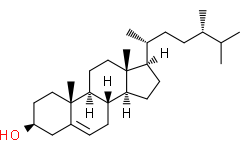
Physicochemical Properties
| Molecular Formula | C₂₈H₄₈O |
| Molecular Weight | 400.68 |
| Exact Mass | 400.37 |
| CAS # | 474-62-4 |
| PubChem CID | 173183 |
| Appearance | White to off-white solid powder |
| Density | 1.0±0.1 g/cm3 |
| Boiling Point | 489.5±14.0 °C at 760 mmHg |
| Melting Point | 156-160ºC |
| Flash Point | 214.3±12.4 °C |
| Vapour Pressure | 0.0±2.8 mmHg at 25°C |
| Index of Refraction | 1.522 |
| LogP | 10.2 |
| Hydrogen Bond Donor Count | 1 |
| Hydrogen Bond Acceptor Count | 1 |
| Rotatable Bond Count | 5 |
| Heavy Atom Count | 29 |
| Complexity | 620 |
| Defined Atom Stereocenter Count | 9 |
| SMILES | O([H])[C@@]1([H])C([H])([H])C([H])([H])[C@@]2(C([H])([H])[H])C(C1([H])[H])=C([H])C([H])([H])[C@]1([H])[C@@]2([H])C([H])([H])C([H])([H])[C@]2(C([H])([H])[H])[C@@]([H])([C@]([H])(C([H])([H])[H])C([H])([H])C([H])([H])[C@]([H])(C([H])([H])[H])C([H])(C([H])([H])[H])C([H])([H])[H])C([H])([H])C([H])([H])[C@]21[H] |
| InChi Key | SGNBVLSWZMBQTH-PODYLUTMSA-N |
| InChi Code | InChI=1S/C28H48O/c1-18(2)19(3)7-8-20(4)24-11-12-25-23-10-9-21-17-22(29)13-15-27(21,5)26(23)14-16-28(24,25)6/h9,18-20,22-26,29H,7-8,10-17H2,1-6H3/t19-,20-,22+,23+,24-,25+,26+,27+,28-/m1/s1 |
| Chemical Name | (3S,8S,9S,10R,13R,14S,17R)-17-[(2R,5R)-5,6-dimethylheptan-2-yl]-10,13-dimethyl-2,3,4,7,8,9,11,12,14,15,16,17-dodecahydro-1H-cyclopenta[a]phenanthren-3-ol |
| Synonyms | (24R-5-Ergosten-3β-olCampesterol |
| HS Tariff Code | 2934.99.9001 |
| Storage |
Powder-20°C 3 years 4°C 2 years In solvent -80°C 6 months -20°C 1 month |
| Shipping Condition | Room temperature (This product is stable at ambient temperature for a few days during ordinary shipping and time spent in Customs) |
Biological Activity
| Targets |
- `Campesterol` exhibits antiangiogenic activity, with effects on vascular endothelial cell function[1] |
| ln Vitro |
In non-proliferating human umbilical vein endothelial cells (HUVEC), cholesterol exhibits mild cytotoxicity. While having no effect on HUVEC motility, campesterol dramatically suppressed bFGF-induced HUVEC proliferation and tube lumen development within the non-cytotoxic dose range. Cell viability was lowered by 56% (IC50 above 50 μg/mL) at 50 μg/mL of cholesterol [1]. - In human umbilical vein endothelial cells (HUVECs), treatment with `Campesterol` (10-80 μM) for 48 hours inhibited cell proliferation dose-dependently: 10 μM caused 12% proliferation reduction, 40 μM caused 45% reduction, and 80 μM caused 78% reduction (MTT assay) [1] - In HUVEC migration assay (transwell method), `Campesterol` (20-80 μM) for 24 hours reduced migration rate: 20 μM decreased migration by 28%, 40 μM by 53%, and 80 μM by 81% compared to the control group [1] - In HUVEC tube formation assay (Matrigel-coated plates), `Campesterol` (20-80 μM) for 12 hours inhibited tube formation: 20 μM reduced tube length by 32%, 40 μM by 61%, and 80 μM by 92%; no complete tube structures were observed at 80 μM [1] |
| ln Vivo |
The neovascularization of chicken chorioallantoic membrane (CAM) caused by bFGF is efficiently disrupted in vivo by cholesterol [1]. - In the chick embryo chorioallantoic membrane (CAM) assay (day 7 chick embryos, n=10 per group), topical application of `Campesterol` (5-20 μg/egg) for 48 hours inhibited angiogenesis: 5 μg/egg reduced blood vessel density by 25%, 10 μg/egg by 48%, and 20 μg/egg by 73% vs. the vehicle group. No obvious embryo toxicity (e.g., embryo death) was observed [1] |
| Cell Assay |
- HUVEC proliferation assay: HUVECs were seeded in 96-well plates (3×10³ cells/well) and cultured overnight. `Campesterol` (0-80 μM) was added, and cells were incubated for 48 hours at 37°C (5% CO₂). MTT solution (5 mg/mL) was added, incubated for 4 hours, then DMSO was added to dissolve formazan. Absorbance was measured at 570 nm, and proliferation inhibition rate was calculated [1] - HUVEC migration assay (transwell): HUVECs (1×10⁵ cells/mL) were suspended in serum-free medium containing `Campesterol` (0-80 μM) and added to the upper chamber of transwell inserts (8 μm pore size). The lower chamber was filled with medium containing 10% FBS. After 24 hours of incubation, non-migrated cells on the upper surface were removed, and migrated cells on the lower surface were fixed, stained, and counted under a light microscope [1] - HUVEC tube formation assay: Matrigel was coated onto 24-well plates and polymerized at 37°C for 30 minutes. HUVECs (2×10⁴ cells/well) suspended in medium containing `Campesterol` (0-80 μM) were seeded onto the Matrigel. After 12 hours of incubation, tube structures were observed under a microscope, and tube length was quantified using image analysis software [1] |
| Animal Protocol |
- Fertilized chicken eggs were incubated at 37°C with 60% humidity for 7 days. A small window was opened on the eggshell to expose the CAM. `Campesterol` was dissolved in DMSO and diluted with PBS (final DMSO concentration <0.1%), then 50 μL of the solution (containing 5-20 μg `Campesterol`) was dropped onto the CAM. The vehicle group received 50 μL of DMSO/PBS (0.1% DMSO). Eggs were incubated for another 48 hours, then the CAM was fixed with 4% paraformaldehyde. Blood vessel density was observed under a stereomicroscope and quantified by counting the number of vessel branches in a 1 mm² area [1] |
| Toxicity/Toxicokinetics |
- In HUVECs, `Campesterol` showed low cytotoxicity: the 50% cytotoxic concentration (CC50) was >100 μM (after 48 hours of treatment), and cell viability was >90% at concentrations ≤80 μM (MTT assay) [1] - In the chick embryo CAM assay, `Campesterol` up to 20 μg/egg caused no embryo death or abnormal development (e.g., growth retardation) [1] |
| References | [1]. Choi JM, et al. Identification of campesterol from Chrysanthemum coronarium L. and its antiangiogenic activities. Phytother Res. 2007 Oct;21(10):954-9 |
| Additional Infomation |
Campesterol is a member of phytosterols, a 3beta-sterol, a 3beta-hydroxy-Delta(5)-steroid and a C28-steroid. It has a role as a mouse metabolite. It derives from a hydride of a campestane. Campesterol has been reported in Acanthus ilicifolius, Amaranthus hybridus, and other organisms with data available. Campesterol is a steroid derivative that is the simplest sterol, characterized by the hydroxyl group in position C-3 of the steroid skeleton, and saturated bonds throughout the sterol structure, with the exception of the 5-6 double bond in the B ring. See also: Calendula Officinalis Flower (part of); Saw Palmetto (part of). - `Campesterol` was isolated from the aerial parts of ` Chrysanthemum coronarium ` L. (crown daisy) via chromatographic methods: silica gel column chromatography (eluted with chloroform-methanol gradient) followed by preparative thin-layer chromatography (TLC) [1] - The antiangiogenic mechanism of `Campesterol` is proposed to be associated with the inhibition of vascular endothelial cell proliferation, migration, and tube formation—key steps in angiogenesis—but no specific signaling pathways (e.g., VEGF, PI3K/Akt) were verified [1] |
Solubility Data
| Solubility (In Vitro) |
Ethanol : ~9.09 mg/mL (~22.69 mM) H2O : ~1 mg/mL (~2.50 mM) DMSO : ~0.67 mg/mL (~1.67 mM) |
| Solubility (In Vivo) |
Solubility in Formulation 1: 0.91 mg/mL (2.27 mM) in 10% EtOH + 40% PEG300 + 5% Tween80 + 45% Saline (add these co-solvents sequentially from left to right, and one by one), suspension solution; with sonication. For example, if 1 mL of working solution is to be prepared, you can add 100 μL of 9.1 mg/mL clear EtOH stock solution to 400 μL PEG300 and mix evenly; then add 50 μL Tween-80 to the above solution and mix evenly; then add 450 μL normal saline to adjust the volume to 1 mL. Preparation of saline: Dissolve 0.9 g of sodium chloride in 100 mL ddH₂ O to obtain a clear solution. Solubility in Formulation 2: ≥ 0.91 mg/mL (2.27 mM) (saturation unknown) in 10% EtOH + 90% Corn Oil (add these co-solvents sequentially from left to right, and one by one), clear solution. For example, if 1 mL of working solution is to be prepared, you can add 100 μL of 9.1 mg/mL clear EtOH stock solution to 900 μL of corn oil and mix well. (Please use freshly prepared in vivo formulations for optimal results.) |
| Preparing Stock Solutions | 1 mg | 5 mg | 10 mg | |
| 1 mM | 2.4958 mL | 12.4788 mL | 24.9576 mL | |
| 5 mM | 0.4992 mL | 2.4958 mL | 4.9915 mL | |
| 10 mM | 0.2496 mL | 1.2479 mL | 2.4958 mL |