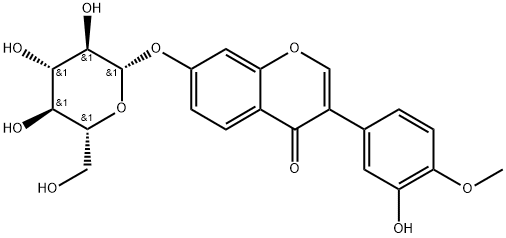
Physicochemical Properties
| Molecular Formula | C22H22O10 |
| Molecular Weight | 446.4041 |
| Exact Mass | 446.121 |
| CAS # | 20633-67-4 |
| PubChem CID | 5318267 |
| Appearance | White to off-white solid powder |
| Density | 1.5±0.1 g/cm3 |
| Boiling Point | 745.2±60.0 °C at 760 mmHg |
| Flash Point | 262.0±26.4 °C |
| Vapour Pressure | 0.0±2.6 mmHg at 25°C |
| Index of Refraction | 1.675 |
| LogP | 0.09 |
| Hydrogen Bond Donor Count | 5 |
| Hydrogen Bond Acceptor Count | 10 |
| Rotatable Bond Count | 5 |
| Heavy Atom Count | 32 |
| Complexity | 698 |
| Defined Atom Stereocenter Count | 5 |
| SMILES | COC1=C(C=C(C=C1)C2=COC3=C(C2=O)C=CC(=C3)O[C@H]4[C@@H]([C@H]([C@@H]([C@H](O4)CO)O)O)O)O |
| InChi Key | WACBUPFEGWUGPB-MIUGBVLSSA-N |
| InChi Code | InChI=1S/C22H22O10/c1-29-15-5-2-10(6-14(15)24)13-9-30-16-7-11(3-4-12(16)18(13)25)31-22-21(28)20(27)19(26)17(8-23)32-22/h2-7,9,17,19-24,26-28H,8H2,1H3/t17-,19-,20+,21-,22-/m1/s1 |
| Chemical Name | 3-(3-hydroxy-4-methoxyphenyl)-7-[(2S,3R,4S,5S,6R)-3,4,5-trihydroxy-6-(hydroxymethyl)oxan-2-yl]oxychromen-4-one |
| HS Tariff Code | 2934.99.9001 |
| Storage |
Powder-20°C 3 years 4°C 2 years In solvent -80°C 6 months -20°C 1 month |
| Shipping Condition | Room temperature (This product is stable at ambient temperature for a few days during ordinary shipping and time spent in Customs) |
Biological Activity
| ln Vitro | In microvessels isolated from ischemic rat brain, calycosin-7-O-β-D-glucoside (2 μM; 6 h) strongly suppresses MMPs' expression and activity while ensuring the expression of tight junction proteins and cav-1 [1]. |
| ln Vivo | In an in vivo MCAO ischemia-reperfusion rat model of barrier permeability, verbascoside-7-O-β-D-glucoside (ip; 26.8 mg/kg; 14 days) dramatically lowers infarct volume, histological damage, and blood brain [1]. |
| Animal Protocol |
Animal/Disease Models: Middle cerebral artery occlusion (MCAO) male adult Sprague-Daweley rat [1] Doses: 26.8 mg/kg Route of Administration: intraperitoneal (ip) injection; 26.8 mg/kg; 14 days Experimental Results: Neuroprotective effect on rats . |
| References |
[1]. Calycosin-7-O-β-D-glucoside regulates nitric oxide /caveolin-1/matrix metalloproteinases pathway and protects blood-brain barrier integrity in experimental cerebral ischemia-reperfusion injury. J Ethnopharmacol. 2014 Aug 8;155(1):692-701. [2]. Calycosin-7- O- β- D-glucoside Attenuates OGD/R-Induced Damage by Preventing Oxidative Stress and Neuronal Apoptosis via the SIRT1/FOXO1/PGC-1 α Pathway in HT22 Cells. Neural Plast. 2019 Dec 1;2019:8798069. |
| Additional Infomation |
Calycosin-7-O-beta-D-glucoside is a glycosyloxyisoflavone that is calycosin substituted by a beta-D-glucopyranosyl residue at position at 7 via a glycosidic linkage. It is a hydroxyisoflavone, a monosaccharide derivative, a member of 4'-methoxyisoflavones and a 7-hydroxyisoflavones 7-O-beta-D-glucoside. It is functionally related to a calycosin. Calycosin 7-O-glucoside has been reported in Glycyrrhiza pallidiflora, Maackia amurensis, and other organisms with data available. See also: Astragalus propinquus root (part of). |
Solubility Data
| Solubility (In Vitro) | DMSO : ≥ 100 mg/mL (~224.01 mM) |
| Solubility (In Vivo) |
Solubility in Formulation 1: ≥ 2.5 mg/mL (5.60 mM) (saturation unknown) in 10% DMSO + 40% PEG300 + 5% Tween80 + 45% Saline (add these co-solvents sequentially from left to right, and one by one), clear solution. For example, if 1 mL of working solution is to be prepared, you can add 100 μL of 25.0 mg/mL clear DMSO stock solution to 400 μL PEG300 and mix evenly; then add 50 μL Tween-80 to the above solution and mix evenly; then add 450 μL normal saline to adjust the volume to 1 mL. Preparation of saline: Dissolve 0.9 g of sodium chloride in 100 mL ddH₂ O to obtain a clear solution. Solubility in Formulation 2: ≥ 2.5 mg/mL (5.60 mM) (saturation unknown) in 10% DMSO + 90% (20% SBE-β-CD in Saline) (add these co-solvents sequentially from left to right, and one by one), clear solution. For example, if 1 mL of working solution is to be prepared, you can add 100 μL of 25.0 mg/mL clear DMSO stock solution to 900 μL of 20% SBE-β-CD physiological saline solution and mix evenly. Preparation of 20% SBE-β-CD in Saline (4°C,1 week): Dissolve 2 g SBE-β-CD in 10 mL saline to obtain a clear solution. Solubility in Formulation 3: ≥ 2.5 mg/mL (5.60 mM) (saturation unknown) in 10% DMSO + 90% Corn Oil (add these co-solvents sequentially from left to right, and one by one), clear solution. For example, if 1 mL of working solution is to be prepared, you can add 100 μL of 25.0 mg/mL clear DMSO stock solution to 900 μL of corn oil and mix evenly. (Please use freshly prepared in vivo formulations for optimal results.) |
| Preparing Stock Solutions | 1 mg | 5 mg | 10 mg | |
| 1 mM | 2.2401 mL | 11.2007 mL | 22.4014 mL | |
| 5 mM | 0.4480 mL | 2.2401 mL | 4.4803 mL | |
| 10 mM | 0.2240 mL | 1.1201 mL | 2.2401 mL |