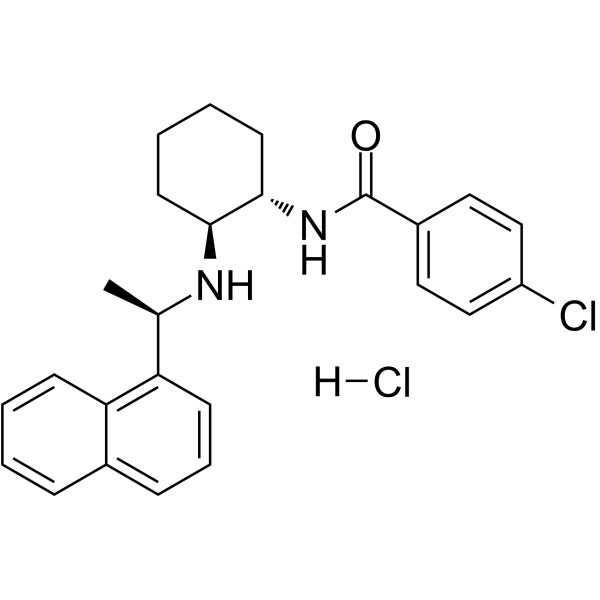
Physicochemical Properties
| Molecular Formula | C25H28CL2N2O |
| Molecular Weight | 443.4086 |
| Exact Mass | 442.157 |
| CAS # | 2387505-78-2 |
| Related CAS # | (1R,2R)-Calhex 231 hydrochloride |
| PubChem CID | 11849513 |
| Appearance | White to off-white solid powder |
| Hydrogen Bond Donor Count | 3 |
| Hydrogen Bond Acceptor Count | 2 |
| Rotatable Bond Count | 5 |
| Heavy Atom Count | 30 |
| Complexity | 533 |
| Defined Atom Stereocenter Count | 3 |
| SMILES | ClC1C([H])=C([H])C(=C([H])C=1[H])C(N([H])[C@@]1([H])C([H])([H])C([H])([H])C([H])([H])C([H])([H])[C@]1([H])N([H])[C@]([H])(C([H])([H])[H])C1=C([H])C([H])=C([H])C2=C([H])C([H])=C([H])C([H])=C12)=O.Cl[H] |
| InChi Key | KZPHZSFSFANQIS-GRFVZBLOSA-N |
| InChi Code | InChI=1S/C25H27ClN2O.ClH/c1-17(21-10-6-8-18-7-2-3-9-22(18)21)27-23-11-4-5-12-24(23)28-25(29)19-13-15-20(26)16-14-19;/h2-3,6-10,13-17,23-24,27H,4-5,11-12H2,1H3,(H,28,29);1H/t17-,23+,24+;/m1./s1 |
| Chemical Name | 4-chloro-N-[(1S,2S)-2-[[(1R)-1-naphthalen-1-ylethyl]amino]cyclohexyl]benzamide;hydrochloride |
| Synonyms | Calhex231 HCl; Calhex-231 HCl |
| HS Tariff Code | 2934.99.9001 |
| Storage |
Powder-20°C 3 years 4°C 2 years In solvent -80°C 6 months -20°C 1 month Note: Please store this product in a sealed and protected environment, avoid exposure to moisture. |
| Shipping Condition | Room temperature (This product is stable at ambient temperature for a few days during ordinary shipping and time spent in Customs) |
Biological Activity
| ln Vitro | Treatment with Calhex 231 dramatically lowers the proliferation of cardiac fibroblasts [1]. Treatment with Calhex 231 markedly reduced the expression of MMP2/9, Col-I/III, α-SMA, and CaSR. In cardiac fibroblasts, calhex231 attenuates high glucose-induced heart fibrosis [1]. Calhex 231 has the ability to suppress the Itch (atropin-1 interacting protein 4)-ubiquitin proteasome and TGF-β1/Smads pathways. This means that it can lessen the effects of glucose-induced myocardial fibrosis, reduce collagen deposition, and stop the growth of cardiac fibroblasts [1]. |
| ln Vivo | In type 1 diabetes model (T1D) rats, intraperitoneal injection of Calhex 231 (4.07 mg/kg (10 µmol/kg) given daily for 12 weeks; male Wistar rats) ameliorates diabetic myocardium fibrosis [1]. |
| Cell Assay |
Cell proliferation assay[1] Cell Types: Primary neonatal rat cardiac fibroblasts (CF) Tested Concentrations: 3 µM Incubation Duration: 24 hrs (hours) Experimental Results: Dramatically diminished cardiac fibroblast proliferation. Western Blot Analysis [1] Cell Types: primary neonatal rat cardiac fibroblasts (CFs) Tested Concentrations: 3 µM Incubation Duration: 48 hrs (hours) Experimental Results: CaSR, α-SMA, Col-I/III, and MMP2/9 were Dramatically expressed Downregulation. |
| Animal Protocol |
Animal/Disease Models: Male Wistar rats (8 weeks old) injected with streptozotocin [1] Doses: 4.07 mg/kg (10 µmol/kg) Route of Administration: intraperitoneal (ip) injection; daily; continued for 12 weeks Experimental Results: Type 1 Diabetic myocardial fibrosis is improved in diabetic rats. |
| References |
[1]. Modeling and mutagenesis of the binding site of Calhex 231, a novel negative allosteric modulator of the extracellular Ca(2+)-sensing receptor. J Biol Chem. 2003 Dec 5;278(49):49487-94. [2]. Modeling and mutagenesis of the binding site of Calhex 231, a novel negative allosteric modulator of the extracellular Ca(2+)-sensing receptor. J Biol Chem. 2003 Dec 5;278(49):49487-94. [3]. The Calcilytic Drug Calhex-231 Ameliorates Vascular Hyporesponsiveness in Traumatic Hemorrhagic Shock by Inhibiting Oxidative Stress and miR-208a-Mediated Mitochondrial Fission. Oxid Med Cell Longev. 2020 Dec 3:2020:4132785. |
Solubility Data
| Solubility (In Vitro) | DMSO : ~33.33 mg/mL (~75.17 mM) |
| Solubility (In Vivo) |
Solubility in Formulation 1: 2.5 mg/mL (5.64 mM) in 10% DMSO + 40% PEG300 + 5% Tween80 + 45% Saline (add these co-solvents sequentially from left to right, and one by one), suspension solution; with sonication. For example, if 1 mL of working solution is to be prepared, you can add 100 μL of 25.0 mg/mL clear DMSO stock solution to 400 μL PEG300 and mix evenly; then add 50 μL Tween-80 to the above solution and mix evenly; then add 450 μL normal saline to adjust the volume to 1 mL. Preparation of saline: Dissolve 0.9 g of sodium chloride in 100 mL ddH₂ O to obtain a clear solution. Solubility in Formulation 2: ≥ 2.5 mg/mL (5.64 mM) (saturation unknown) in 10% DMSO + 90% Corn Oil (add these co-solvents sequentially from left to right, and one by one), clear solution. For example, if 1 mL of working solution is to be prepared, you can add 100 μL of 25.0 mg/mL clear DMSO stock solution to 900 μL of corn oil and mix evenly. (Please use freshly prepared in vivo formulations for optimal results.) |
| Preparing Stock Solutions | 1 mg | 5 mg | 10 mg | |
| 1 mM | 2.2552 mL | 11.2762 mL | 22.5525 mL | |
| 5 mM | 0.4510 mL | 2.2552 mL | 4.5105 mL | |
| 10 mM | 0.2255 mL | 1.1276 mL | 2.2552 mL |