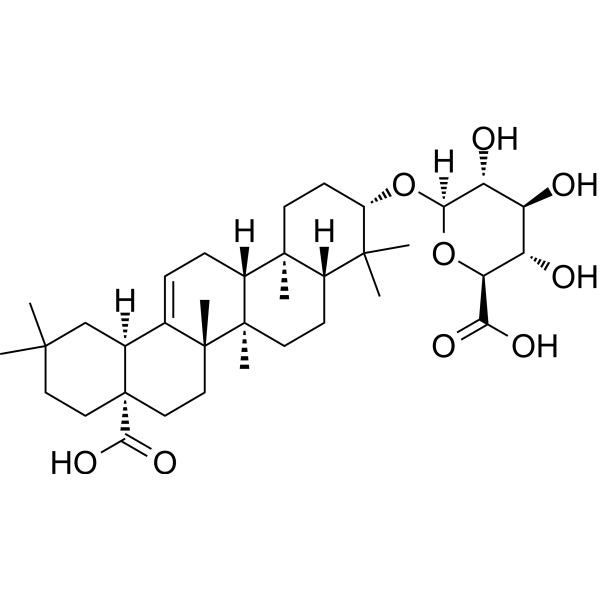
Physicochemical Properties
| Molecular Formula | C36H56O9 |
| Molecular Weight | 632.8245 |
| Exact Mass | 632.392 |
| CAS # | 26020-14-4 |
| PubChem CID | 176079 |
| Appearance | White to off-white solid powder |
| Density | 1.3±0.1 g/cm3 |
| Boiling Point | 750.8±60.0 °C at 760 mmHg |
| Melting Point | 243-245 ºC (decomp) |
| Flash Point | 228.6±26.4 °C |
| Vapour Pressure | 0.0±5.7 mmHg at 25°C |
| Index of Refraction | 1.590 |
| LogP | 7.04 |
| Hydrogen Bond Donor Count | 5 |
| Hydrogen Bond Acceptor Count | 9 |
| Rotatable Bond Count | 4 |
| Heavy Atom Count | 45 |
| Complexity | 1260 |
| Defined Atom Stereocenter Count | 13 |
| SMILES | C[C@]12CC[C@@H](C([C@@H]1CC[C@@]3([C@@H]2CC=C4[C@]3(CC[C@@]5([C@H]4CC(CC5)(C)C)C(=O)O)C)C)(C)C)O[C@H]6[C@@H]([C@H]([C@@H]([C@H](O6)C(=O)O)O)O)O |
| InChi Key | IUCHKMAZAWJNBJ-RCYXVVTDSA-N |
| InChi Code | InChI=1S/C36H56O9/c1-31(2)14-16-36(30(42)43)17-15-34(6)19(20(36)18-31)8-9-22-33(5)12-11-23(32(3,4)21(33)10-13-35(22,34)7)44-29-26(39)24(37)25(38)27(45-29)28(40)41/h8,20-27,29,37-39H,9-18H2,1-7H3,(H,40,41)(H,42,43)/t20-,21-,22+,23-,24-,25-,26+,27-,29+,33-,34+,35+,36-/m0/s1 |
| Chemical Name | (2S,3S,4S,5R,6R)-6-[[(3S,4aR,6aR,6bS,8aS,12aS,14aR,14bR)-8a-carboxy-4,4,6a,6b,11,11,14b-heptamethyl-1,2,3,4a,5,6,7,8,9,10,12,12a,14,14a-tetradecahydropicen-3-yl]oxy]-3,4,5-trihydroxyoxane-2-carboxylic acid |
| HS Tariff Code | 2934.99.9001 |
| Storage |
Powder-20°C 3 years 4°C 2 years In solvent -80°C 6 months -20°C 1 month |
| Shipping Condition | Room temperature (This product is stable at ambient temperature for a few days during ordinary shipping and time spent in Customs) |
Biological Activity
| ln Vitro |
Calenduloside E exhibited anti-apoptotic activity in H2O2-induced PC12 cells, inhibiting apoptosis in a dose-dependent manner (10, 20, 40 μM) [1] It significantly reduced the apoptotic rate of PC12 cells induced by H2O2, as detected by Annexin V-FITC/PI double staining [1] The compound upregulated the expression of anti-apoptotic protein Bcl-2 and downregulated the expression of pro-apoptotic proteins Bax and cleaved caspase-3 in H2O2-treated PC12 cells, as confirmed by Western blot analysis [1] The clickable activity-based probe derived from Calenduloside E specifically bound to its intracellular targets in PC12 cells, enabling target capture and identification via click chemistry and mass spectrometry [1] |
| Cell Assay |
PC12 cells were cultured in DMEM medium supplemented with fetal bovine serum and antibiotics, maintained at 37°C in a 5% CO2 incubator [1] Anti-apoptotic activity assay: PC12 cells were seeded in 6-well plates, allowed to adhere overnight, pretreated with Calenduloside E (10, 20, 40 μM) for 2 hours, then stimulated with H2O2 (200 μM) to induce apoptosis for 24 hours [1] - Flow cytometry analysis: Cells were harvested, washed with phosphate-buffered saline, stained with Annexin V-FITC and PI for 15 minutes in the dark, and apoptotic rate was detected by flow cytometer [1] - Western blot analysis: Cells were lysed in RIPA buffer containing protease inhibitors, protein concentrations were determined by BCA assay, equal amounts of protein were separated by SDS-PAGE, transferred to PVDF membranes, incubated with primary antibodies against Bcl-2, Bax, cleaved caspase-3, and β-actin (loading control) overnight at 4°C, followed by HRP-conjugated secondary antibodies, and protein bands were visualized using an enhanced chemiluminescence system [1] Clickable probe-based target capture assay: PC12 cells were incubated with the clickable activity-based probe of Calenduloside E for 4 hours at 37°C [1] - Cells were harvested, lysed, and the cell lysate was subjected to click reaction with a fluorescent tag under specific conditions [1] - The probe-target protein complexes were captured by immunoprecipitation, separated by SDS-PAGE, and the target proteins were identified by mass spectrometry [1] |
| References |
[1]. The clickable activity-based probe of anti-apoptotic calenduloside E. Pharm Biol. 2019 Dec;57(1):133-139. |
| Additional Infomation |
Oleanolic acid 3-O-beta-D-glucosiduronic acid is a beta-D-glucosiduronic acid. It is functionally related to an oleanolic acid. Calenduloside E has been reported in Chenopodium quinoa, Calendula officinalis, and other organisms with data available. See also: Calendula Officinalis Flower (part of). Calenduloside E is a natural bioactive compound with anti-apoptotic properties [1] The clickable activity-based probe designed based on Calenduloside E provides a tool for the identification and characterization of its intracellular molecular targets [1] Its anti-apoptotic mechanism is associated with the regulation of Bcl-2 family proteins and caspase-dependent apoptotic signaling pathway [1] |
Solubility Data
| Solubility (In Vitro) | DMSO : ~100 mg/mL (~158.02 mM) |
| Solubility (In Vivo) |
Solubility in Formulation 1: ≥ 2.5 mg/mL (3.95 mM) (saturation unknown) in 10% DMSO + 90% (20% SBE-β-CD in Saline) (add these co-solvents sequentially from left to right, and one by one), clear solution. For example, if 1 mL of working solution is to be prepared, you can add 100 μL of 25.0 mg/mL clear DMSO stock solution to 900 μL of 20% SBE-β-CD physiological saline solution and mix evenly. Preparation of 20% SBE-β-CD in Saline (4°C,1 week): Dissolve 2 g SBE-β-CD in 10 mL saline to obtain a clear solution. Solubility in Formulation 2: ≥ 2.5 mg/mL (3.95 mM) (saturation unknown) in 10% DMSO + 90% Corn Oil (add these co-solvents sequentially from left to right, and one by one), clear solution. For example, if 1 mL of working solution is to be prepared, you can add 100 μL of 25.0 mg/mL clear DMSO stock solution to 900 μL of corn oil and mix evenly. (Please use freshly prepared in vivo formulations for optimal results.) |
| Preparing Stock Solutions | 1 mg | 5 mg | 10 mg | |
| 1 mM | 1.5802 mL | 7.9011 mL | 15.8023 mL | |
| 5 mM | 0.3160 mL | 1.5802 mL | 3.1605 mL | |
| 10 mM | 0.1580 mL | 0.7901 mL | 1.5802 mL |