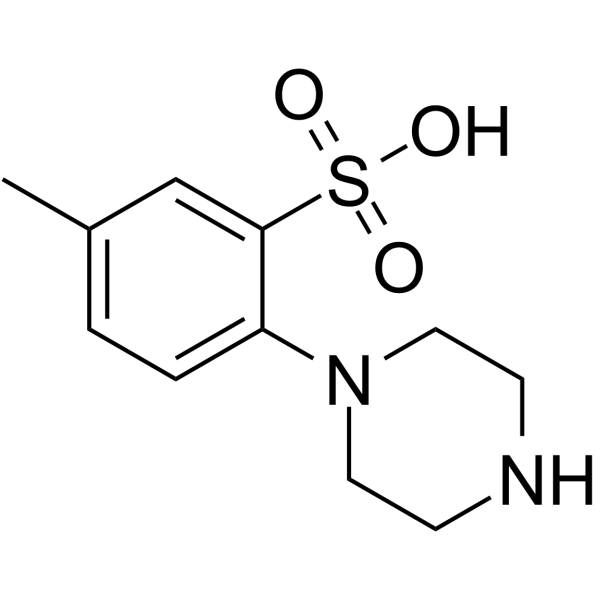
Physicochemical Properties
| Molecular Formula | C11H16N2O3S |
| Molecular Weight | 256.32 |
| Exact Mass | 256.088 |
| CAS # | 133804-44-1 |
| PubChem CID | 6433076 |
| Appearance | White to light yellow solid powder |
| Density | 1.302g/cm3 |
| Index of Refraction | 1.582 |
| LogP | 2.125 |
| Hydrogen Bond Donor Count | 2 |
| Hydrogen Bond Acceptor Count | 5 |
| Rotatable Bond Count | 2 |
| Heavy Atom Count | 17 |
| Complexity | 346 |
| Defined Atom Stereocenter Count | 0 |
| InChi Key | DCDFLGVJWQIRGH-UHFFFAOYSA-N |
| InChi Code | InChI=1S/C11H16N2O3S/c1-9-2-3-10(11(8-9)17(14,15)16)13-6-4-12-5-7-13/h2-3,8,12H,4-7H2,1H3,(H,14,15,16) |
| Chemical Name | 5-methyl-2-piperazin-1-ylbenzenesulfonic acid |
| Synonyms | MCC-135; MCC 135; Caldaret |
| HS Tariff Code | 2934.99.9001 |
| Storage |
Powder-20°C 3 years 4°C 2 years In solvent -80°C 6 months -20°C 1 month Note: This product requires protection from light (avoid light exposure) during transportation and storage. |
| Shipping Condition | Room temperature (This product is stable at ambient temperature for a few days during ordinary shipping and time spent in Customs) |
Biological Activity
| ln Vitro | In vitro studies using sarcoplasmic reticulum (SR) isolated from acute ischemia and reperfused myocardium have demonstrated that candaret (MCC-135) restores Ca2+-ATPase function [2]. |
| ln Vivo | The intracellular Ca2+ handling modulator caledaret reduces the size of infarcts in canine hearts that have been reperfused. The cardioprotective effects of caldaret, a novel modulator of intracellular Ca2+ handling that acts through reverse-mode inhibition of the Na+/Ca2+ exchanger and possible enhancement of the uptake of Ca2+ in the sarcoplasmic reticulum (SR), were investigated against reperfusion injury. Reperfusion and an intravenous infusion of Caldaret (3 or 30 mcg/kg per hour) into the left circumflex artery (LCX) for 30 minutes both significantly decreased the size of the infarct (51.3% and 71.9%, respectively). By addressing intracellular Ca2+ handling dysfunction, catalet can mitigate reperfusion injury following prolonged ischemia and have a cardioprotective effect [1]. Caldaret (MCC-135) is a new powerful drug that helps people with heart failure. Caldaret dramatically decreased TR80 in diabetic rats but had no discernible effect on developmental tone (DT). In normal rats, calidaret had little effect on SR Ca2+ uptake; at the maximum concentration of 10 μM, an increase in SR Ca2+ uptake was seen at uptake times of 20 and 30 seconds. Caldaret increases SR Ca2+ uptake in diabetic rats throughout the whole uptake period. Caldaret [2] raises the amount of Ca2+ accumulated in SR as the uptake time increases, in addition to increasing the initial uptake rate of SR Ca2+. |
| References |
[1]. Caldaret, an intracellular Ca2+ handling modulator, limits infarct size of reperfused canine heart. J Pharmacol Sci. 2007 Feb;103(2):222-33. [2]. Lusitropic effect of MCC-135 is associated with improvement of sarcoplasmic reticulum function in ventricular muscles of rats with diabetic cardiomyopathy. J Pharmacol Exp Ther. 2001 Sep;298(3):1161-6. |
| Additional Infomation |
Drug Indication Investigated for use/treatment in heart disease and myocardial infarction. Mechanism of Action Cardiac damage due to the buildup of sodium (Na+) ischemia and early reperfusion leads to increased calcium (Ca2+) through the reverse mode Na+/Ca2+(NCX) ion exchanger. Caldaret is an intracardiac calcium (Ca2+) handling modulator whose cardioprotective actions are presumed to be due to inhibition of the NCX exhanger and increasing the uptake of Ca2+ via the sarcoplasmic reticulum (SR). |
Solubility Data
| Solubility (In Vitro) | DMSO : ~4.81 mg/mL (~18.77 mM ) |
| Solubility (In Vivo) |
Note: Listed below are some common formulations that may be used to formulate products with low water solubility (e.g. < 1 mg/mL), you may test these formulations using a minute amount of products to avoid loss of samples. Injection Formulations (e.g. IP/IV/IM/SC) Injection Formulation 1: DMSO : Tween 80: Saline = 10 : 5 : 85 (i.e. 100 μL DMSO stock solution → 50 μL Tween 80 → 850 μL Saline) *Preparation of saline: Dissolve 0.9 g of sodium chloride in 100 mL ddH ₂ O to obtain a clear solution. Injection Formulation 2: DMSO : PEG300 :Tween 80 : Saline = 10 : 40 : 5 : 45 (i.e. 100 μL DMSO → 400 μLPEG300 → 50 μL Tween 80 → 450 μL Saline) Injection Formulation 3: DMSO : Corn oil = 10 : 90 (i.e. 100 μL DMSO → 900 μL Corn oil) Example: Take the Injection Formulation 3 (DMSO : Corn oil = 10 : 90) as an example, if 1 mL of 2.5 mg/mL working solution is to be prepared, you can take 100 μL 25 mg/mL DMSO stock solution and add to 900 μL corn oil, mix well to obtain a clear or suspension solution (2.5 mg/mL, ready for use in animals). Injection Formulation 4: DMSO : 20% SBE-β-CD in saline = 10 : 90 [i.e. 100 μL DMSO → 900 μL (20% SBE-β-CD in saline)] *Preparation of 20% SBE-β-CD in Saline (4°C,1 week): Dissolve 2 g SBE-β-CD in 10 mL saline to obtain a clear solution. Injection Formulation 5: 2-Hydroxypropyl-β-cyclodextrin : Saline = 50 : 50 (i.e. 500 μL 2-Hydroxypropyl-β-cyclodextrin → 500 μL Saline) Injection Formulation 6: DMSO : PEG300 : castor oil : Saline = 5 : 10 : 20 : 65 (i.e. 50 μL DMSO → 100 μLPEG300 → 200 μL castor oil → 650 μL Saline) Injection Formulation 7: Ethanol : Cremophor : Saline = 10: 10 : 80 (i.e. 100 μL Ethanol → 100 μL Cremophor → 800 μL Saline) Injection Formulation 8: Dissolve in Cremophor/Ethanol (50 : 50), then diluted by Saline Injection Formulation 9: EtOH : Corn oil = 10 : 90 (i.e. 100 μL EtOH → 900 μL Corn oil) Injection Formulation 10: EtOH : PEG300:Tween 80 : Saline = 10 : 40 : 5 : 45 (i.e. 100 μL EtOH → 400 μLPEG300 → 50 μL Tween 80 → 450 μL Saline) Oral Formulations Oral Formulation 1: Suspend in 0.5% CMC Na (carboxymethylcellulose sodium) Oral Formulation 2: Suspend in 0.5% Carboxymethyl cellulose Example: Take the Oral Formulation 1 (Suspend in 0.5% CMC Na) as an example, if 100 mL of 2.5 mg/mL working solution is to be prepared, you can first prepare 0.5% CMC Na solution by measuring 0.5 g CMC Na and dissolve it in 100 mL ddH2O to obtain a clear solution; then add 250 mg of the product to 100 mL 0.5% CMC Na solution, to make the suspension solution (2.5 mg/mL, ready for use in animals). Oral Formulation 3: Dissolved in PEG400 Oral Formulation 4: Suspend in 0.2% Carboxymethyl cellulose Oral Formulation 5: Dissolve in 0.25% Tween 80 and 0.5% Carboxymethyl cellulose Oral Formulation 6: Mixing with food powders Note: Please be aware that the above formulations are for reference only. InvivoChem strongly recommends customers to read literature methods/protocols carefully before determining which formulation you should use for in vivo studies, as different compounds have different solubility properties and have to be formulated differently. (Please use freshly prepared in vivo formulations for optimal results.) |
| Preparing Stock Solutions | 1 mg | 5 mg | 10 mg | |
| 1 mM | 3.9014 mL | 19.5069 mL | 39.0137 mL | |
| 5 mM | 0.7803 mL | 3.9014 mL | 7.8027 mL | |
| 10 mM | 0.3901 mL | 1.9507 mL | 3.9014 mL |