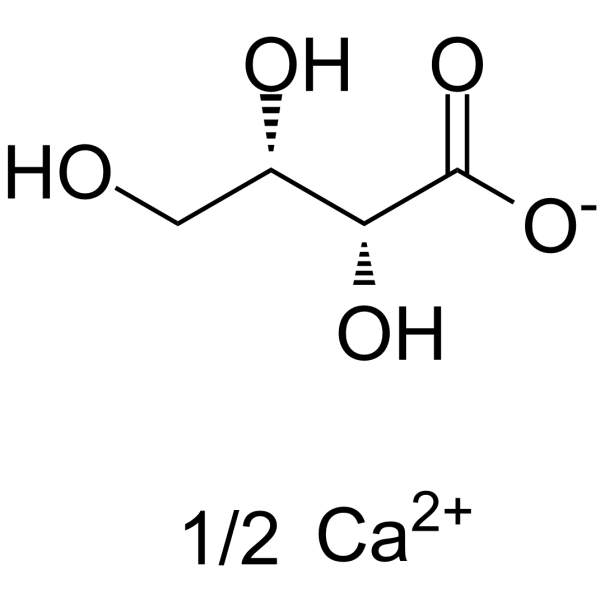
Physicochemical Properties
| Molecular Formula | C16H28CAO20 |
| Molecular Weight | 580.4595 |
| Exact Mass | 328.031 |
| CAS # | 70753-61-6 |
| PubChem CID | 13388558 |
| Appearance | White to off-white solid powder |
| Boiling Point | 518.9ºC at 760 mmHg |
| Melting Point | >300 °C(lit.) |
| Flash Point | 281.7ºC |
| Index of Refraction | 15 ° (C=1, H2O) |
| Hydrogen Bond Donor Count | 6 |
| Hydrogen Bond Acceptor Count | 10 |
| Rotatable Bond Count | 4 |
| Heavy Atom Count | 19 |
| Complexity | 95.6 |
| Defined Atom Stereocenter Count | 4 |
| SMILES | C([C@@H]([C@H](C(=O)[O-])O)O)O.C([C@@H]([C@H](C(=O)[O-])O)O)O.[Ca+2] |
| InChi Key | ZJXGOFZGZFVRHK-BALCVSAKSA-L |
| InChi Code | InChI=1S/2C4H8O5.Ca/c2*5-1-2(6)3(7)4(8)9;/h2*2-3,5-7H,1H2,(H,8,9);/q;;+2/p-2/t2*2-,3+;/m00./s1 |
| Chemical Name | calcium;(2R,3S)-2,3,4-trihydroxybutanoate |
| HS Tariff Code | 2934.99.9001 |
| Storage |
Powder-20°C 3 years 4°C 2 years In solvent -80°C 6 months -20°C 1 month Note: Please store this product in a sealed and protected environment, avoid exposure to moisture. |
| Shipping Condition | Room temperature (This product is stable at ambient temperature for a few days during ordinary shipping and time spent in Customs) |
Biological Activity
| ADME/Pharmacokinetics |
Absorption, Distribution and Excretion Human studies demonstrate that calcium from calcium L-threonate is absorbed. In an open-label, single- and multiple-dose study of healthy adult Chinese subjects receiving a single oral dose of 2025 mg calcium theronate, the peak plasma concentration (Cmax) was 32.3 mg/L. The time to reach peak plasma concentration (Tmax) was approximately 2 hours. The presence of threonic acid in human urine has been identified. In a pharmacokinetic study of rats receiving 200 mg/kg bw of calcium threonate orally, approximately 30% of the calcium was excreted in the urine, around 40% was eliminated in the faeces, and about 10 -20% remained in the blood and bone, and about 10% was stored in organs after 24 hours of administration. The apparent total volume of distribution following a single oral dose of 2025 mg calcium theronate in healthy adult Chinese subjects was approximately 53.6 L. Apparent total clearance following a single oral dose of 2025 mg calcium theronate in healthy adult Chinese subjects was approximately 14.5 L/h. Biological Half-Life The terminal-phase elimination half-life following a single oral dose of 2025 mg calcium theronate in healthy adult Chinese subjects was approximately 2.7 hours. |
| References |
[1]. Pharmacokinetics and safety of calcium L-threonate in healthy volunteers after single and multiple oral administrations. Acta Pharmacol Sin. 2011 Dec;32(12):1555-60. [2]. Stimulatory action of calcium L-threonate on ascorbic acid uptake by a human T-lymphoma cell line. Life Sci. 1991;49(19):1377-81. |
| Additional Infomation |
L-Threonic acid Calcium Salt is a L-alpha-D-Hepp-(1->7)-L-alpha-D-Hepp-(1->3)-L-alpha-D-Hepp-(1->5)-alpha-Kdo. Calcium threonate is a calcium salt of threnoic acid and a novel drug developed for the treatment of osteoporosis and as a calcium supplement. It is found in dietary supplements as a source of L-threonate used in the treatment of calcium deficiency and prevention of osteoporosis. The most common form is calcium L-threonate, or (2R,3S)-2,3,4-trihydroxy butyric acid calcium. L-threonate is an active metabolite of vitamin C that mediates a stimulatory action on vitamin C uptake. Therapeutic efficacy of calcium threonate in reducing was studied and investigated due to the hypothesis that it may play a role in the mineralization process through its positive action on vitamin C. Drug Indication No approved therapeutic indications. Mechanism of Action Once dissociated to calcium and L-theronic acid, L-threonic acid exhibits significant stimulatory action on vitamin C uptake and prolongs the retention of vitamin C in human T-lymphoma cells. Vitamin C is a marker for osteoblast formation and has been shown to stimulate procollagen and enhance collagen synthesis. Via stimulation of vitamin C uptake, L-threonic acid acts as a metabolite that influences the mineralization process. |
Solubility Data
| Solubility (In Vitro) | H2O : ~5 mg/mL (~16.01 mM) |
| Solubility (In Vivo) |
Note: Listed below are some common formulations that may be used to formulate products with low water solubility (e.g. < 1 mg/mL), you may test these formulations using a minute amount of products to avoid loss of samples. Injection Formulations (e.g. IP/IV/IM/SC) Injection Formulation 1: DMSO : Tween 80: Saline = 10 : 5 : 85 (i.e. 100 μL DMSO stock solution → 50 μL Tween 80 → 850 μL Saline) *Preparation of saline: Dissolve 0.9 g of sodium chloride in 100 mL ddH ₂ O to obtain a clear solution. Injection Formulation 2: DMSO : PEG300 :Tween 80 : Saline = 10 : 40 : 5 : 45 (i.e. 100 μL DMSO → 400 μLPEG300 → 50 μL Tween 80 → 450 μL Saline) Injection Formulation 3: DMSO : Corn oil = 10 : 90 (i.e. 100 μL DMSO → 900 μL Corn oil) Example: Take the Injection Formulation 3 (DMSO : Corn oil = 10 : 90) as an example, if 1 mL of 2.5 mg/mL working solution is to be prepared, you can take 100 μL 25 mg/mL DMSO stock solution and add to 900 μL corn oil, mix well to obtain a clear or suspension solution (2.5 mg/mL, ready for use in animals). Injection Formulation 4: DMSO : 20% SBE-β-CD in saline = 10 : 90 [i.e. 100 μL DMSO → 900 μL (20% SBE-β-CD in saline)] *Preparation of 20% SBE-β-CD in Saline (4°C,1 week): Dissolve 2 g SBE-β-CD in 10 mL saline to obtain a clear solution. Injection Formulation 5: 2-Hydroxypropyl-β-cyclodextrin : Saline = 50 : 50 (i.e. 500 μL 2-Hydroxypropyl-β-cyclodextrin → 500 μL Saline) Injection Formulation 6: DMSO : PEG300 : castor oil : Saline = 5 : 10 : 20 : 65 (i.e. 50 μL DMSO → 100 μLPEG300 → 200 μL castor oil → 650 μL Saline) Injection Formulation 7: Ethanol : Cremophor : Saline = 10: 10 : 80 (i.e. 100 μL Ethanol → 100 μL Cremophor → 800 μL Saline) Injection Formulation 8: Dissolve in Cremophor/Ethanol (50 : 50), then diluted by Saline Injection Formulation 9: EtOH : Corn oil = 10 : 90 (i.e. 100 μL EtOH → 900 μL Corn oil) Injection Formulation 10: EtOH : PEG300:Tween 80 : Saline = 10 : 40 : 5 : 45 (i.e. 100 μL EtOH → 400 μLPEG300 → 50 μL Tween 80 → 450 μL Saline) Oral Formulations Oral Formulation 1: Suspend in 0.5% CMC Na (carboxymethylcellulose sodium) Oral Formulation 2: Suspend in 0.5% Carboxymethyl cellulose Example: Take the Oral Formulation 1 (Suspend in 0.5% CMC Na) as an example, if 100 mL of 2.5 mg/mL working solution is to be prepared, you can first prepare 0.5% CMC Na solution by measuring 0.5 g CMC Na and dissolve it in 100 mL ddH2O to obtain a clear solution; then add 250 mg of the product to 100 mL 0.5% CMC Na solution, to make the suspension solution (2.5 mg/mL, ready for use in animals). Oral Formulation 3: Dissolved in PEG400 Oral Formulation 4: Suspend in 0.2% Carboxymethyl cellulose Oral Formulation 5: Dissolve in 0.25% Tween 80 and 0.5% Carboxymethyl cellulose Oral Formulation 6: Mixing with food powders Note: Please be aware that the above formulations are for reference only. InvivoChem strongly recommends customers to read literature methods/protocols carefully before determining which formulation you should use for in vivo studies, as different compounds have different solubility properties and have to be formulated differently. (Please use freshly prepared in vivo formulations for optimal results.) |
| Preparing Stock Solutions | 1 mg | 5 mg | 10 mg | |
| 1 mM | 1.7228 mL | 8.6139 mL | 17.2277 mL | |
| 5 mM | 0.3446 mL | 1.7228 mL | 3.4455 mL | |
| 10 mM | 0.1723 mL | 0.8614 mL | 1.7228 mL |