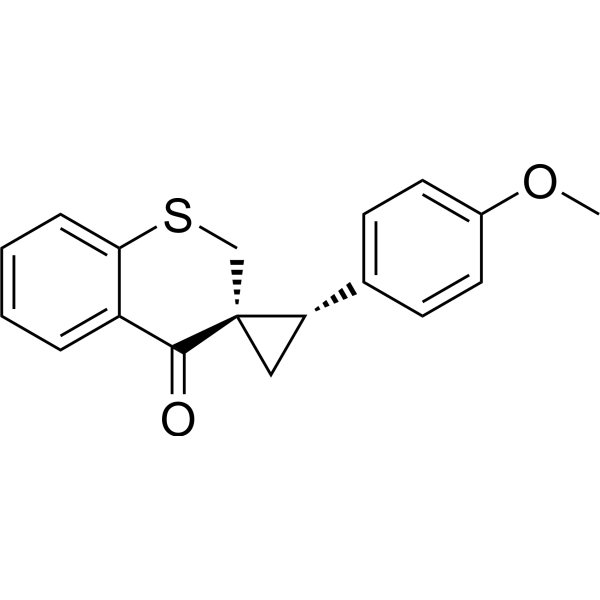
Physicochemical Properties
| Molecular Formula | C18H16O2S |
| Molecular Weight | 296.38 |
| CAS # | 1799392-31-6 |
| Appearance | Typically exists as solid at room temperature |
| HS Tariff Code | 2934.99.9001 |
| Storage |
Powder-20°C 3 years 4°C 2 years In solvent -80°C 6 months -20°C 1 month |
| Shipping Condition | Room temperature (This product is stable at ambient temperature for a few days during ordinary shipping and time spent in Customs) |
Biological Activity
| ln Vitro | By altering MEFs' chromatin, CYT296 (250 nM, 72 h) increases the accessibility of Yamanaka factors and facilitates the reprogramming process [1]. A tiny drug called CYT296 (250 nM, 72 hours) can greatly enhance the production of iPSCs by preventing heterochromatin assembly in MEFs [1]. |
| ln Vivo | The pluripotent CYT296 (10–15 4F– and 2F–iPSC clones, subcutaneous injection, once) iPSCs were produced in NOD-SCID animals[1]. |
| Cell Assay |
Immunofluorescence[1] Cell Types: MEFs Tested Concentrations: 250 nM Incubation Duration: 72 h Experimental Results: diminished the number and total intensity of HP1α+ and H3K9me3+ foci in the nuclei of MEFs. Western Blot Analysis[1] Cell Types: MEFs Tested Concentrations: 250 nM Incubation Duration: 72 h Experimental Results: Speeded up the expression of Nanog during 4F-mediated reprogramming and appeared as early as day 8. diminished the protein level of HP1α during reprogramming. |
| Animal Protocol |
Animal/Disease Models: 4F- and 2F-iPSC clones mice[1] Doses: 10-15 4F- and 2F -iPSC clones Route of Administration: subcutaneous (sc) injection Experimental Results: Obtained 6 out of 10 born mice from clone 4F-1 and 9 out of 15 born mice from clone 2F-1 were chimeras. |
| References | [1]. Wei X, et al. Small molecule compound induces chromatin de-condensation and facilitates induced pluripotent stem cell generation. J Mol Cell Biol. 2014 Oct;6(5):409-20. |
Solubility Data
| Solubility (In Vitro) | DMSO: 100 mg/mL (337.40 mM) |
| Solubility (In Vivo) |
Solubility in Formulation 1: 2.5 mg/mL (8.44 mM) in 10% DMSO + 40% PEG300 + 5% Tween80 + 45% Saline (add these co-solvents sequentially from left to right, and one by one), clear solution; with sonication. For example, if 1 mL of working solution is to be prepared, you can add 100 μL of 25.0 mg/mL clear DMSO stock solution to 400 μL PEG300 and mix evenly; then add 50 μL Tween-80 to the above solution and mix evenly; then add 450 μL normal saline to adjust the volume to 1 mL. Preparation of saline: Dissolve 0.9 g of sodium chloride in 100 mL ddH₂ O to obtain a clear solution. Solubility in Formulation 2: 2.5 mg/mL (8.44 mM) in 10% DMSO + 90% (20% SBE-β-CD in Saline) (add these co-solvents sequentially from left to right, and one by one), suspension solution; with ultrasonication. For example, if 1 mL of working solution is to be prepared, you can add 100 μL of 25.0 mg/mL clear DMSO stock solution to 900 μL of 20% SBE-β-CD physiological saline solution and mix evenly. Preparation of 20% SBE-β-CD in Saline (4°C,1 week): Dissolve 2 g SBE-β-CD in 10 mL saline to obtain a clear solution. Solubility in Formulation 3: 2.5 mg/mL (8.44 mM) in 10% DMSO + 90% Corn Oil (add these co-solvents sequentially from left to right, and one by one), clear solution; with ultrasonication. For example, if 1 mL of working solution is to be prepared, you can add 100 μL of 25.0 mg/mL clear DMSO stock solution to 900 μL of corn oil and mix evenly. (Please use freshly prepared in vivo formulations for optimal results.) |
| Preparing Stock Solutions | 1 mg | 5 mg | 10 mg | |
| 1 mM | 3.3740 mL | 16.8702 mL | 33.7405 mL | |
| 5 mM | 0.6748 mL | 3.3740 mL | 6.7481 mL | |
| 10 mM | 0.3374 mL | 1.6870 mL | 3.3740 mL |