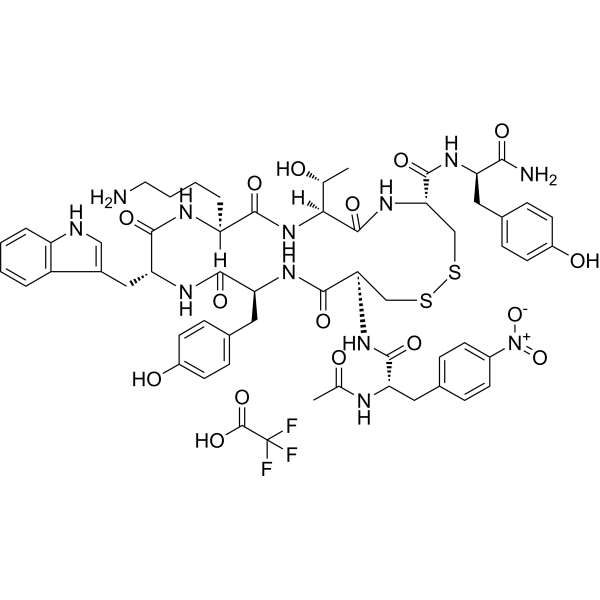
Physicochemical Properties
| Molecular Formula | C58H69F3N12O16S2 |
| Molecular Weight | 1311.36448168755 |
| Exact Mass | 1310.4348 |
| CAS # | 2828432-46-6 |
| Related CAS # | CYN 154806;183658-72-2 |
| PubChem CID | 71312046 |
| Sequence | XCYWKTCY; N-acetyl-4-nitro-L-phenylalanyl-D-cysteinyl-L-tyrosyl-D-tryptophyl-L-lysyl-L-threonyl-L-cysteinyl-D-tyrosinamide (2->7)-disulfide trifluoroacetic acid; Ac-Phe(4-NO2)-Cys-Tyr-Trp-Lys-Thr-Cys-Tyr-NH2 (Disulfide bridge: Cys2-Cys7) |
| SequenceShortening | Ac-F(4-NO2)CYWKTCY-NH2 (Disulfide bridge: Cys2-Cys7); Ac-Phe(4-NO2)-D-Cys(1)-Tyr-D-Trp-Lys-Thr-Cys(1)-D-Tyr-NH2.TFA |
| Appearance | White to light yellow solid powder |
| LogP | 4.8 |
| Hydrogen Bond Donor Count | 15 |
| Hydrogen Bond Acceptor Count | 22 |
| Rotatable Bond Count | 19 |
| Heavy Atom Count | 91 |
| Complexity | 2330 |
| Defined Atom Stereocenter Count | 9 |
| SMILES | C(F)(F)(F)C(=O)O.C([C@@H]1C(N[C@]([H])(C(N[C@]([H])(C(N[C@H](C(=O)N[C@@H](C(=O)N)CC2C=CC(O)=CC=2)CSSC[C@H](NC(=O)[C@@H](NC(=O)C)CC2C=CC(N(=O)=O)=CC=2)C(=O)N[C@@H](CC2C=CC(O)=CC=2)C(=O)N1)=O)[C@H](O)C)=O)CCCCN)=O)C1=CNC2=CC=CC=C12 |
| InChi Key | FYVCFCQFOBEWIO-GVGJFGMUSA-N |
| InChi Code | InChI=1S/C56H68N12O14S2.C2HF3O2/c1-30(69)48-56(80)66-47(54(78)62-42(49(58)73)23-33-12-18-37(71)19-13-33)29-84-83-28-46(65-51(75)43(60-31(2)70)24-32-10-16-36(17-11-32)68(81)82)55(79)63-44(25-34-14-20-38(72)21-15-34)52(76)64-45(26-35-27-59-40-8-4-3-7-39(35)40)53(77)61-41(50(74)67-48)9-5-6-22-57;3-2(4,5)1(6)7/h3-4,7-8,10-21,27,30,41-48,59,69,71-72H,5-6,9,22-26,28-29,57H2,1-2H3,(H2,58,73)(H,60,70)(H,61,77)(H,62,78)(H,63,79)(H,64,76)(H,65,75)(H,66,80)(H,67,74);(H,6,7)/t30-,41+,42-,43+,44+,45-,46-,47+,48+;/m1./s1 |
| Chemical Name | (4R,7S,10S,13R,16S,19S)-19-[[(2S)-2-acetamido-3-(4-nitrophenyl)propanoyl]amino]-10-(4-aminobutyl)-N-[(2R)-1-amino-3-(4-hydroxyphenyl)-1-oxopropan-2-yl]-7-[(1R)-1-hydroxyethyl]-16-[(4-hydroxyphenyl)methyl]-13-(1H-indol-3-ylmethyl)-6,9,12,15,18-pentaoxo-1,2-dithia-5,8,11,14,17-pentazacycloicosane-4-carboxamide;2,2,2-trifluoroacetic acid |
| Synonyms | YN 154806 (TFA); CYN 154806 TFA; CYN 154806 trifluoroacetate salt; FYVCFCQFOBEWIO-GVGJFGMUSA-N; 2828432-46-6; |
| HS Tariff Code | 2934.99.9001 |
| Storage |
Powder-20°C 3 years 4°C 2 years In solvent -80°C 6 months -20°C 1 month Note: Please store this product in a sealed and protected environment, avoid exposure to moisture. |
| Shipping Condition | Room temperature (This product is stable at ambient temperature for a few days during ordinary shipping and time spent in Customs) |
Biological Activity
| Targets | SSTR2; Somatostatin sst2 receptor |
| ln Vitro | In CHO-K1 cells expressing human sst2 receptors, CYN 154806 TFA prevents SRIF-induced increases in extracellular acidification (EAR) (pKB 7.92). Additionally, in CHO-K1 cell membranes expressing human SST2 receptors as well as rat SST2(a) and rat SST2(b) receptors (pKB 7.81, 7.68, and 7.96, respectively), CYN 154806 TFA inhibits SRIF-induced increases in [35S]-GTPγS binding[2]. |
| ln Vivo | CYN 154806 TFA (0.1 mg/kg; ip; 20 min before carbachol (CCh) injection (30 μg/kg) in M4 KO mice) substantially and dose-dependently reverses the reduction in M4 but not M3 KO mice's acid response to CCh[3]. |
| Enzyme Assay | The functional properties of these peptides have been determined in radioligand binding assays, in functional coupling of the SST2 subtype to yeast pheromone response pathway, and in cAMP accumulations. One peptide antagonist [Ac-4-NO2-Phe-c(D-Cys-Tyr-D-Trp-Lys-Thr-Cys)-D-Tyr-NH2](CYN 154806) displays a binding affinity to SST2 comparable with that observed for the native hormone (Ki = 0.2 nM) and reverses somatostatin-mediated inhibition of cAMP accumulation in rat somatomammotroph GH4C1 cells, cells transfected with the SST2 and SST5 subtypes, as well as somatostatin-stimulated growth of yeast cells expressing the SST2 subtype. This class of somatostatin antagonists, which are the first to be described, should be useful for determination of somatostatin's diverse functions in vivo and in vitro[1]. |
| Cell Assay | The cyclic octapeptide, CYN-154806, inhibited specific [(125)I]-[Tyr(11)]-SRIF binding to CHO-K1 cell membranes expressing human recombinant somatostatin (SRIF) sst(2) receptors (pIC(50) 8. 58) or rat sst(2(a)) and rat sst(2(b)) receptors (pIC(50) 8.35 and 8. 10, respectively). The affinity of CYN-154806 at other human somatostatin receptor types was at least 100 times lower (pIC(50) 5. 41-6.48). In functional studies, CYN-154806 inhibited SRIF-induced increases in extracellular acidification (EAR) in CHO-K1 cells expressing h sst(2) receptors (pK(B) 7.92) but had no effect on UTP-induced increases in EAR. CYN-154806 also blocked SRIF-induced increases [(35)S]-GTPgammaS binding in CHO-K1 cell membranes expressing h sst(2) receptors as well as rat sst(2(a)) and rat sst(2(b)) receptors (pK(B) 7.81, 7.68 and 7.96, respectively). In marked contrast, no blockade was observed at h sst(5) receptors in concentrations as high 10 microM. The antagonistic activity of CYN-154806 was also studied in isolated tissue preparations that are known to express endogenous SRIF receptors. Thus CYN-154806 blocked SRIF, but not DAMGO-induced inhibition of neurogenic contractions in rat isolated vas deferens and guinea-pig ileum (pK(B) 7.79 and 7.49, respectively). CYN-154806 had no effect on SRIF-28 induced inhibition of neurogenic contractions in guinea-pig vas deferens. The results demonstrate that CYN-154806 is a highly potent specific and selective SRIF sst(2) receptor blocking drug. Furthermore, sst(2) receptors mediate SRIF-induced inhibition of neurogenic contractions in rat vas deferens and guinea-pig ileum but not guinea-pig vas deferens which is thought to be mediated by sst(5) receptors[2]. |
| Animal Protocol |
CYN154806 were dissolved in dimethyl sulfoxide (DMSO) and diluted with distilled water to desired concentrations. Each agent was prepared immediately before use and administered as a single injection s.c. or i.p. in a volume of 1 ml per 100 g body weight.
In some cases CYN154806 (a somatostatin SST2 receptor antagonist: 0.1 mg/kg; Feniuk et al., 2000) was given i.p. 20 min before the administration of octreotide (20 μg/kg) in WT mice or the administration of CCh (30 μg/kg) in M4 KO mice. Control animals received saline or vehicle in place of the active agent. The doses of atropine, octreotide or CYN154806 were selected in order to induce the respective pharmacological actions according to the findings of previously published studies [3].
C57BL/6J mice of wild-type (WT) and M1-M5 KO were used. Under urethane anesthesia, acid secretion was measured in the stomach equipped with an acute fistula. CCh (30 μg/kg) was given subcutaneously (s.c.) to stimulate acid secretion. Atropine or octreotide (a somatostatin analog) was given s.c. 20 min before the administration of CCh. CYN154806 (a somatostatin SST2 receptor antagonist) was given i.p. 20 min before the administration of octreotide or CCh.[3] Results: CCh caused an increase of acid secretion in WT mice, and the effect was totally inhibited by prior administration of atropine. The effect of CCh was similarly observed in the animals lacking M1, M2 or M5 receptors but significantly decreased in M3 or M4 KO mice. CYN154806, the SST2 receptor antagonist, dose-dependently and significantly reversed the decreased acid response to CCh in M4 but not M3 KO mice. Octreotide, the somatostatin analog, inhibited the secretion of acid under CCh-stimulated conditions in WT mice. The immunohistochemical study showed the localization of M4 receptors on D cells in the stomach. Serum somatostatin levels in M4 KO mice were higher than WT mice under basal conditions, while those in WT mice were significantly decreased in response to CCh.[3] Conclusions: These results suggest that under cholinergic stimulation the acid secretion is directly mediated by M3 receptors and indirectly modified by M4 receptors. It is assumed that the activation of M4 receptors inhibits the release of somatostatin from D cells and minimizes the acid inhibitory effect of somatostatin through SST2 receptors, resulting in enhancement of the acid response mediated by M3 receptors on parietal cells.[3] |
| References |
[1]. Identification and characterization of novel somatostatin antagonists. Mol Pharmacol. 1996 Oct;50(4):709-15. [2]. Selective somatostatin sst(2) receptor blockade with the novel cyclic octapeptide, CYN-154806. Neuropharmacology. 2000 Jun 8;39(8):1443-50. [3]. Activation of Muscarinic Acetylcholine Receptor Subtype 4 Is Essential for Cholinergic Stimulation of Gastric Acid Secretion: Relation to D Cell/Somatostatin. Front Pharmacol. 2016 Aug 30;7:278. |
| Additional Infomation | Researchers also found that the suppressed acid response to CCh in M4 KO mice was significantly restored by the prior application of the somatostatin SST2 antagonist, CYN 154806. In addition, it was found that serum somatostatin levels were significantly increased in M4 KO mice under CCh-stimulated conditions. These results strongly support our hypothesis that the decrease of CCh-induced acid response in M4 KO mice is explained by the inhibitory effect of somatostatin mediated by SST2 receptors. It is therefore assumed that the activation of M4 receptors inhibits somatostatin release from D cells and negates the negative influence of this peptide on acid secretion, resulting in a potentiation of the acid response to CCh. Certainly, more studies are needed to clarify the regulatory mechanisms of somatostatin secretion from D cells. Finally, it remains undefined whether M4 receptors are really expressed on D cells? We performed the immunostaining of the gastric mucosa with anti-somatostatin and anti-M4 receptor antibodies in WT mice. The histological observation showed that M4 receptors were co-expressed with somatostatin, indicating the expression of M4 receptors on D cells. We confirmed that M4 receptors were not observed in the stomachs of M4 KO mice. These results strongly suggest that CCh inhibits somatostatin release from D cells via the activation of M4 receptors. The present study was performed in mice anesthetized with urethane. Since this anesthetic is known to promote the secretion of somatostatin from D cells (Saito et al., 1979), the results obtained in this study might differ from those obtained under normal physiological conditions. However, since CYN 154806 by itself had no effect on basal acid secretion, it is assumed that the interpretation of the present results is not affected by urethane anesthesia.[3] |
Solubility Data
| Solubility (In Vitro) | H2O: 25 mg/mL (19.06 mM) |
| Solubility (In Vivo) |
Note: Listed below are some common formulations that may be used to formulate products with low water solubility (e.g. < 1 mg/mL), you may test these formulations using a minute amount of products to avoid loss of samples. Injection Formulations (e.g. IP/IV/IM/SC) Injection Formulation 1: DMSO : Tween 80: Saline = 10 : 5 : 85 (i.e. 100 μL DMSO stock solution → 50 μL Tween 80 → 850 μL Saline) *Preparation of saline: Dissolve 0.9 g of sodium chloride in 100 mL ddH ₂ O to obtain a clear solution. Injection Formulation 2: DMSO : PEG300 :Tween 80 : Saline = 10 : 40 : 5 : 45 (i.e. 100 μL DMSO → 400 μLPEG300 → 50 μL Tween 80 → 450 μL Saline) Injection Formulation 3: DMSO : Corn oil = 10 : 90 (i.e. 100 μL DMSO → 900 μL Corn oil) Example: Take the Injection Formulation 3 (DMSO : Corn oil = 10 : 90) as an example, if 1 mL of 2.5 mg/mL working solution is to be prepared, you can take 100 μL 25 mg/mL DMSO stock solution and add to 900 μL corn oil, mix well to obtain a clear or suspension solution (2.5 mg/mL, ready for use in animals). Injection Formulation 4: DMSO : 20% SBE-β-CD in saline = 10 : 90 [i.e. 100 μL DMSO → 900 μL (20% SBE-β-CD in saline)] *Preparation of 20% SBE-β-CD in Saline (4°C,1 week): Dissolve 2 g SBE-β-CD in 10 mL saline to obtain a clear solution. Injection Formulation 5: 2-Hydroxypropyl-β-cyclodextrin : Saline = 50 : 50 (i.e. 500 μL 2-Hydroxypropyl-β-cyclodextrin → 500 μL Saline) Injection Formulation 6: DMSO : PEG300 : castor oil : Saline = 5 : 10 : 20 : 65 (i.e. 50 μL DMSO → 100 μLPEG300 → 200 μL castor oil → 650 μL Saline) Injection Formulation 7: Ethanol : Cremophor : Saline = 10: 10 : 80 (i.e. 100 μL Ethanol → 100 μL Cremophor → 800 μL Saline) Injection Formulation 8: Dissolve in Cremophor/Ethanol (50 : 50), then diluted by Saline Injection Formulation 9: EtOH : Corn oil = 10 : 90 (i.e. 100 μL EtOH → 900 μL Corn oil) Injection Formulation 10: EtOH : PEG300:Tween 80 : Saline = 10 : 40 : 5 : 45 (i.e. 100 μL EtOH → 400 μLPEG300 → 50 μL Tween 80 → 450 μL Saline) Oral Formulations Oral Formulation 1: Suspend in 0.5% CMC Na (carboxymethylcellulose sodium) Oral Formulation 2: Suspend in 0.5% Carboxymethyl cellulose Example: Take the Oral Formulation 1 (Suspend in 0.5% CMC Na) as an example, if 100 mL of 2.5 mg/mL working solution is to be prepared, you can first prepare 0.5% CMC Na solution by measuring 0.5 g CMC Na and dissolve it in 100 mL ddH2O to obtain a clear solution; then add 250 mg of the product to 100 mL 0.5% CMC Na solution, to make the suspension solution (2.5 mg/mL, ready for use in animals). Oral Formulation 3: Dissolved in PEG400 Oral Formulation 4: Suspend in 0.2% Carboxymethyl cellulose Oral Formulation 5: Dissolve in 0.25% Tween 80 and 0.5% Carboxymethyl cellulose Oral Formulation 6: Mixing with food powders Note: Please be aware that the above formulations are for reference only. InvivoChem strongly recommends customers to read literature methods/protocols carefully before determining which formulation you should use for in vivo studies, as different compounds have different solubility properties and have to be formulated differently. (Please use freshly prepared in vivo formulations for optimal results.) |
| Preparing Stock Solutions | 1 mg | 5 mg | 10 mg | |
| 1 mM | 0.7626 mL | 3.8128 mL | 7.6256 mL | |
| 5 mM | 0.1525 mL | 0.7626 mL | 1.5251 mL | |
| 10 mM | 0.0763 mL | 0.3813 mL | 0.7626 mL |