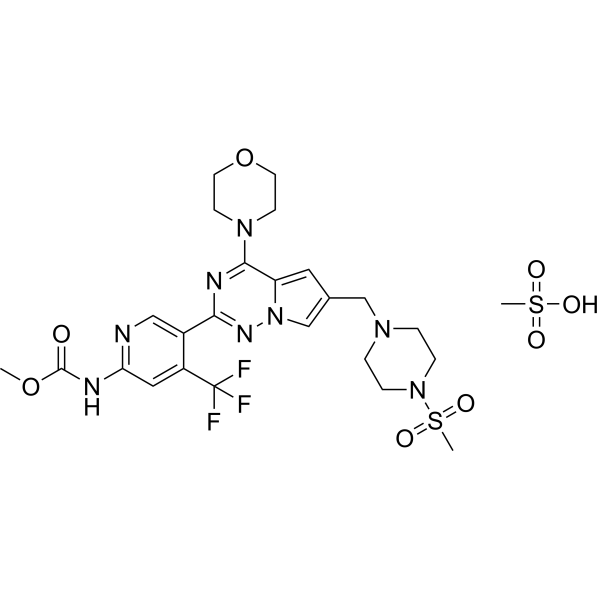
Physicochemical Properties
| Molecular Formula | C25H33F3N8O8S2 |
| Molecular Weight | 694.703532934189 |
| Exact Mass | 694.181 |
| CAS # | 1494684-33-1 |
| Related CAS # | Risovalisib;1494684-28-4 |
| PubChem CID | 72550229 |
| Appearance | Off-white to light yellow solid powder |
| Hydrogen Bond Donor Count | 2 |
| Hydrogen Bond Acceptor Count | 17 |
| Rotatable Bond Count | 7 |
| Heavy Atom Count | 46 |
| Complexity | 1100 |
| Defined Atom Stereocenter Count | 0 |
| SMILES | S(C)(N1CCN(CC2=CN3C(C(=NC(C4C=NC(=CC=4C(F)(F)F)NC(=O)OC)=N3)N3CCOCC3)=C2)CC1)(=O)=O.S(C)(=O)(=O)O |
| InChi Key | CYWUJTNXNJVGLY-UHFFFAOYSA-N |
| InChi Code | InChI=1S/C24H29F3N8O5S.CH4O3S/c1-39-23(36)29-20-12-18(24(25,26)27)17(13-28-20)21-30-22(33-7-9-40-10-8-33)19-11-16(15-35(19)31-21)14-32-3-5-34(6-4-32)41(2,37)38;1-5(2,3)4/h11-13,15H,3-10,14H2,1-2H3,(H,28,29,36);1H3,(H,2,3,4) |
| Chemical Name | methanesulfonic acid;methyl N-[5-[6-[(4-methylsulfonylpiperazin-1-yl)methyl]-4-morpholin-4-ylpyrrolo[2,1-f][1,2,4]triazin-2-yl]-4-(trifluoromethyl)pyridin-2-yl]carbamate |
| HS Tariff Code | 2934.99.9001 |
| Storage |
Powder-20°C 3 years 4°C 2 years In solvent -80°C 6 months -20°C 1 month Note: Please store this product in a sealed and protected environment, avoid exposure to moisture. |
| Shipping Condition | Room temperature (This product is stable at ambient temperature for a few days during ordinary shipping and time spent in Customs) |
Biological Activity
| Targets | PI3Kα 5.9 nM (IC50) PI3Kβ 598 nM (IC50) PI3Kδ 78.7 nM (IC50) PI3Kγ 225 nM (IC50) |
| ln Vitro | In 56% (18/32) of the breast cancer cell lines, CYH33 methanesulfonate inhibits cell growth with IC50s less than 1 μM[2]. T47D and MCF7 cells are significantly arrested in the G1 phase by CYH33 (0.012-1 μM) methanesulfonate in a concentration-dependent manner[2]. T47D and MCF7 cells' phosphorylation of ERK and Akt is concurrently inhibited by CYH33 (4-1000 nM; 1-hour) methanesulfonate[2]. In MCF7 and MDA-MB-231 cells, CYH33 (0.11-1 μM; 24 hours) methanesulfonate is unable to cause apoptosis[2]. |
| ln Vivo | In mice with human breast cancer cell xenografts, CYH33 (2–20 mg/kg; oral; once daily for 21 days) methanesulfonate considerably inhibits tumor growth[2]. To demonstrate the suppression of PI3K signaling in nude mice, a single oral dose of CYH33 (20 mg/kg) methanesulfonate dramatically reduces the level of phosphorylated Akt in tumor tissues[2]. Blood glucose restoration is delayed in T47D xenografts and R26-Pik3caH1047R;MMTV-Cre mice treated with CYH33 (10 mg/kg; oral; once daily for 18-d or 20-d, respectively). The blood glucose area under the curve (AUC) increased after CYH33 treatment[2]. |
| Cell Assay |
Cell Cycle Analysis[2] Cell Types: Sensitive T47D, MCF7 and resistant MDA-MB-231 cells Tested Concentrations: 0.012, 0.037, 0.11, 0.33, 1 μM Incubation Duration:For 24 hrs (hours) Experimental Results: Arrested T47D and MCF7 cells in G1 phase in a concentration-dependent manner, accompanied with concomitant diminished cell population in S phase. Had little effect on cell cycle distribution in resistant MDA-MB-231 cells. Western Blot Analysis [2] Cell Types: Sensitive T47D, MCF7 and resistant MDA-MB-231 cells Tested Concentrations: 4, 12, 37, 111, 333, 1000 nM Incubation Duration: 1 hour Experimental Results: Concurrently inhibited phosphorylation of ERK and Akt in both T47D and MCF7 cells, whereas it had little effect on phosphorylated ERK (pERK) in MDA-MB-231 cells up to 1 μM. |
| Animal Protocol |
Animal/Disease Models: SCID (severe combined immunodeficient) mouse aged 4-6 weeks bearing human breast cancer T47D xenografts[2] Doses: 2, 5, 10, 20 mg/kg Route of Administration: Oral; one time/day for 21 days Experimental Results: Displayed marginal inhibitory effect on the tumor growth at lower doses (2 and 5 mg/kg) and Dramatically attenuated tumor growth at the dose of 10 or 20 mg/kg, yielding T/C values of 58.36% and 49.42% respectively. |
| References |
[1]. Abstract LB-268: Discovery of clinical candidate methyl (5-(6-((4-(methylsulfonyl)piperazin-1-yl)methyl)-4-morpholinopyrrolo[2,1-f][1,2,4]triazin-2-yl)-4-(trifluoromethyl)pyridin-2-yl)carbamate (CYH33) : A highly potent and selective PI3K alpha inhibitor for the treatment of advanced solid tumors. AACR Annual Meeting 2018; April 14-18, 2018. [2]. Decrease in Phosphorylated ERK Indicates the Therapeutic Efficacy of a Clinical PI3Kα-selective Inhibitor CYH33 in Breast Cancer. Cancer Lett. 2018 Oct 1;433:273-282. [3]. Simultaneous inhibition of PI3Kα and CDK4/6 synergistically suppresses KRAS-mutated non-small cell lung cancer. Cancer Biol Med. 2019 Feb;16(1):66-83. |
Solubility Data
| Solubility (In Vitro) | May dissolve in DMSO (in most cases), if not, try other solvents such as H2O, Ethanol, or DMF with a minute amount of products to avoid loss of samples |
| Solubility (In Vivo) |
Note: Listed below are some common formulations that may be used to formulate products with low water solubility (e.g. < 1 mg/mL), you may test these formulations using a minute amount of products to avoid loss of samples. Injection Formulations (e.g. IP/IV/IM/SC) Injection Formulation 1: DMSO : Tween 80: Saline = 10 : 5 : 85 (i.e. 100 μL DMSO stock solution → 50 μL Tween 80 → 850 μL Saline) *Preparation of saline: Dissolve 0.9 g of sodium chloride in 100 mL ddH ₂ O to obtain a clear solution. Injection Formulation 2: DMSO : PEG300 :Tween 80 : Saline = 10 : 40 : 5 : 45 (i.e. 100 μL DMSO → 400 μLPEG300 → 50 μL Tween 80 → 450 μL Saline) Injection Formulation 3: DMSO : Corn oil = 10 : 90 (i.e. 100 μL DMSO → 900 μL Corn oil) Example: Take the Injection Formulation 3 (DMSO : Corn oil = 10 : 90) as an example, if 1 mL of 2.5 mg/mL working solution is to be prepared, you can take 100 μL 25 mg/mL DMSO stock solution and add to 900 μL corn oil, mix well to obtain a clear or suspension solution (2.5 mg/mL, ready for use in animals). Injection Formulation 4: DMSO : 20% SBE-β-CD in saline = 10 : 90 [i.e. 100 μL DMSO → 900 μL (20% SBE-β-CD in saline)] *Preparation of 20% SBE-β-CD in Saline (4°C,1 week): Dissolve 2 g SBE-β-CD in 10 mL saline to obtain a clear solution. Injection Formulation 5: 2-Hydroxypropyl-β-cyclodextrin : Saline = 50 : 50 (i.e. 500 μL 2-Hydroxypropyl-β-cyclodextrin → 500 μL Saline) Injection Formulation 6: DMSO : PEG300 : castor oil : Saline = 5 : 10 : 20 : 65 (i.e. 50 μL DMSO → 100 μLPEG300 → 200 μL castor oil → 650 μL Saline) Injection Formulation 7: Ethanol : Cremophor : Saline = 10: 10 : 80 (i.e. 100 μL Ethanol → 100 μL Cremophor → 800 μL Saline) Injection Formulation 8: Dissolve in Cremophor/Ethanol (50 : 50), then diluted by Saline Injection Formulation 9: EtOH : Corn oil = 10 : 90 (i.e. 100 μL EtOH → 900 μL Corn oil) Injection Formulation 10: EtOH : PEG300:Tween 80 : Saline = 10 : 40 : 5 : 45 (i.e. 100 μL EtOH → 400 μLPEG300 → 50 μL Tween 80 → 450 μL Saline) Oral Formulations Oral Formulation 1: Suspend in 0.5% CMC Na (carboxymethylcellulose sodium) Oral Formulation 2: Suspend in 0.5% Carboxymethyl cellulose Example: Take the Oral Formulation 1 (Suspend in 0.5% CMC Na) as an example, if 100 mL of 2.5 mg/mL working solution is to be prepared, you can first prepare 0.5% CMC Na solution by measuring 0.5 g CMC Na and dissolve it in 100 mL ddH2O to obtain a clear solution; then add 250 mg of the product to 100 mL 0.5% CMC Na solution, to make the suspension solution (2.5 mg/mL, ready for use in animals). Oral Formulation 3: Dissolved in PEG400 Oral Formulation 4: Suspend in 0.2% Carboxymethyl cellulose Oral Formulation 5: Dissolve in 0.25% Tween 80 and 0.5% Carboxymethyl cellulose Oral Formulation 6: Mixing with food powders Note: Please be aware that the above formulations are for reference only. InvivoChem strongly recommends customers to read literature methods/protocols carefully before determining which formulation you should use for in vivo studies, as different compounds have different solubility properties and have to be formulated differently. (Please use freshly prepared in vivo formulations for optimal results.) |
| Preparing Stock Solutions | 1 mg | 5 mg | 10 mg | |
| 1 mM | 1.4395 mL | 7.1974 mL | 14.3947 mL | |
| 5 mM | 0.2879 mL | 1.4395 mL | 2.8789 mL | |
| 10 mM | 0.1439 mL | 0.7197 mL | 1.4395 mL |