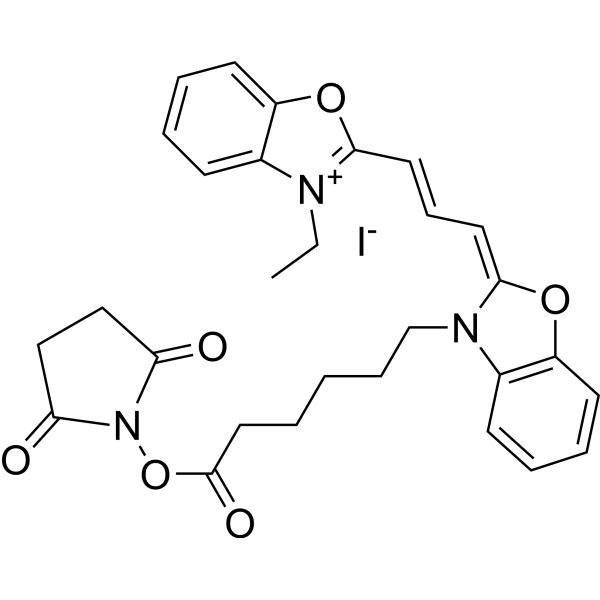
Physicochemical Properties
| Molecular Formula | C29H30IN3O6 |
| Molecular Weight | 643.469480037689 |
| Exact Mass | 643.117 |
| CAS # | 186205-33-4 |
| PubChem CID | 121596142 |
| Appearance | Orange to red solid powder |
| Hydrogen Bond Donor Count | 0 |
| Hydrogen Bond Acceptor Count | 8 |
| Rotatable Bond Count | 11 |
| Heavy Atom Count | 39 |
| Complexity | 919 |
| Defined Atom Stereocenter Count | 0 |
| SMILES | CCN\1C2=CC=CC=C2O/C1=C\C=C\C3=[N+](C4=CC=CC=C4O3)CCCCCC(=O)ON5C(=O)CCC5=O.[I-] |
| InChi Key | RQYPAAVMQSMNBY-UHFFFAOYSA-M |
| InChi Code | InChI=1S/C29H30N3O6.HI/c1-2-30-21-11-5-7-13-23(21)36-27(30)15-10-16-28-31(22-12-6-8-14-24(22)37-28)20-9-3-4-17-29(35)38-32-25(33)18-19-26(32)34;/h5-8,10-16H,2-4,9,17-20H2,1H3;1H/q+1;/p-1 |
| Chemical Name | (2,5-dioxopyrrolidin-1-yl) 6-[2-[(E,3Z)-3-(3-ethyl-1,3-benzoxazol-2-ylidene)prop-1-enyl]-1,3-benzoxazol-3-ium-3-yl]hexanoate;iodide |
| HS Tariff Code | 2934.99.9001 |
| Storage |
Powder-20°C 3 years 4°C 2 years In solvent -80°C 6 months -20°C 1 month Note: Please store this product in a sealed and protected environment (e.g. under nitrogen), avoid exposure to moisture and light. |
| Shipping Condition | Room temperature (This product is stable at ambient temperature for a few days during ordinary shipping and time spent in Customs) |
Biological Activity
| ln Vitro | Plan 1. Optimal protein preparation: 1) Please prepare the protein (antibody) concentration to 2 mg/mL in order to acquire the labeling effect. 2) The protein solution has a pH of 8.5±0.5. 3) 1M protein should be utilized if the pH is less than 8.0. If the protein concentration is less than 2 mg/mL, the labeling efficiency will be significantly decreased. The range of suggested final protein concentration is 2–10 mg/mL for best labeling efficiency. 4) Birmingham 2 must be transparent for the protein. Preparation of the dye (using CY3-NHS ester as an example): Pour 10 3 of anhydrous DMSO into the CY3-NHS ester vial. The amount of dye (CY3-NHS ester) needed for the reaction is determined by the ideal molar ratio of CY3-NHS to protein as well as the amount of labeled protein. Example: Dissolve 1 mg of CY3-NHS ester in 100 μL of DMSO, assuming that the required labeled protein is 500 μL of 2 mg/mL IgG (MW=150,000). This yields the necessary volume of CY3-NHS ester, which is 5.05 μL. The steps involved in the calculation are as follows: 1) mmol (IgG) = mg/mL (IgG) × mL (IgG)/MW (IgG) = 2 mg/mL × 0.5 mL/150, 000 mg/mmol = 6.7×10 -6 mmol 2) mmol (CY3-NHS ester) = mmol (IgG) × 10=6.7×10⁻⁶ mmol×10=6.7 × 10⁻⁵ mmol 3) uL (CY3-NHS ester) = mmol (CY3-NHS ester)ester) ×MW (CY3-NHS ester)/mg/μL (CY3-NHS ester) =6.7 ×10⁻⁵ mmol ×753.88 mg/mmol/0.01 mg/μL=5.05 μL (CY3-NHS ester) 4. Execute the coupling reaction 1: Gradually incorporate the recently synthesized 10 mg/mL CY3-NHS ester into the 0.5 mL protein sample solution, give it a gentle shake to combine, quickly centrifuge, and retrieve the sample from the bottom of the reaction tube. 2) For the following sixty minutes, gently flip the reaction tube while keeping it in a dark location. Reverse reaction 5 gradually after ten to fifteen minutes. Conjugates: Using a SepHadex G-25 column, the following methodology demonstrates how to block a dye-conjugate. 1) Assemble the SepHadex G-25 column in accordance with the manufacturer's guidelines. 2) Fill the SepHadex G-25 column with the reaction mixture (from the "Run conjugation reaction"). 3) Add PBS (pH 7.2–7.4) as soon as the sample is running below the top resin surface. 4) To complete column extrusion, add extra PBS (pH 7.2–7.4) to the appropriate sample. Mix the fractions that have the desired conjugate material of dye and protein. |
| References |
[1]. Ptaszek M. Rational design of fluorophores for in vivo applications. Prog Mol Biol Transl Sci. 2013;113:59-108. [2]. Shindy, H. A. (2017). Fundamentals in the chemistry of cyanine dyes: A review. Dyes and Pigments, 145, 505–513. doi:10.1016/j.dyepig.2017.06.029. |
Solubility Data
| Solubility (In Vitro) | DMSO : ~62.5 mg/mL (~97.13 mM) |
| Solubility (In Vivo) |
Solubility in Formulation 1: 3.13 mg/mL (4.86 mM) in 10% DMSO + 90% (20% SBE-β-CD in Saline) (add these co-solvents sequentially from left to right, and one by one), suspension solution; with sonication. For example, if 1 mL of working solution is to be prepared, you can add 100 μL of 31.3 mg/mL clear DMSO stock solution to 900 μL of 20% SBE-β-CD physiological saline solution and mix evenly. Preparation of 20% SBE-β-CD in Saline (4°C,1 week): Dissolve 2 g SBE-β-CD in 10 mL saline to obtain a clear solution. (Please use freshly prepared in vivo formulations for optimal results.) |
| Preparing Stock Solutions | 1 mg | 5 mg | 10 mg | |
| 1 mM | 1.5541 mL | 7.7704 mL | 15.5407 mL | |
| 5 mM | 0.3108 mL | 1.5541 mL | 3.1081 mL | |
| 10 mM | 0.1554 mL | 0.7770 mL | 1.5541 mL |