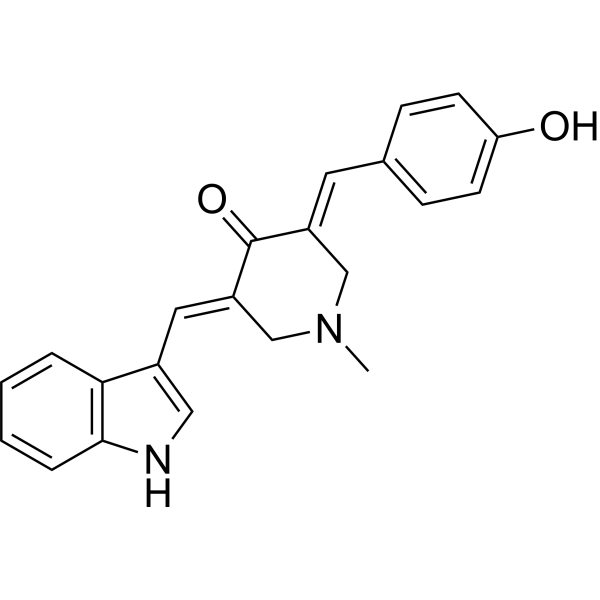
Physicochemical Properties
| Molecular Formula | C22H20N2O2 |
| Molecular Weight | 344.406405448914 |
| Exact Mass | 344.152 |
| CAS # | 1370032-20-4 |
| PubChem CID | 57341149 |
| Appearance | Yellow to brown solid powder |
| LogP | 3.4 |
| Hydrogen Bond Donor Count | 2 |
| Hydrogen Bond Acceptor Count | 3 |
| Rotatable Bond Count | 2 |
| Heavy Atom Count | 26 |
| Complexity | 589 |
| Defined Atom Stereocenter Count | 0 |
| SMILES | CN1C/C(=C\C2=CC=C(C=C2)O)/C(=O)/C(=C/C3=CNC4=CC=CC=C43)/C1 |
| InChi Key | JMVVTYLZZDOERS-ODPUSEOTSA-N |
| InChi Code | InChI=1S/C22H20N2O2/c1-24-13-17(10-15-6-8-19(25)9-7-15)22(26)18(14-24)11-16-12-23-21-5-3-2-4-20(16)21/h2-12,23,25H,13-14H2,1H3/b17-10+,18-11+ |
| Chemical Name | (3E,5E)-3-[(4-hydroxyphenyl)methylidene]-5-(1H-indol-3-ylmethylidene)-1-methylpiperidin-4-one |
| HS Tariff Code | 2934.99.9001 |
| Storage |
Powder-20°C 3 years 4°C 2 years In solvent -80°C 6 months -20°C 1 month |
| Shipping Condition | Room temperature (This product is stable at ambient temperature for a few days during ordinary shipping and time spent in Customs) |
Biological Activity
| ln Vitro | In cancer cells, CUR5g (0–40 μM, 0–24 h) specifically causes autophagosome accumulation [1]. The levels of sequestosome 1 (SQSTM1) and LC3B-II are upregulated by CUR5g (0-40 μM, 0-24 hours) [1]. A549 cell migration and proliferation are inhibited by CUR5g (0–40 μM, 24 h), but neither necrosis nor apoptosis are brought on [1]. CUR5g Cell Autophagy Assay[1] Cell Line: A549 cells Concentration: 0, 1, 5, 10, 20, and 40 μM Incubation Time: 3, 6, 12, and 24 h Outcome: Decreased diffuse cytosolic staining of GFP-LC3B signal to a punctate pattern encircling autophagosomes. Induced widespread cytoplasmic vacuolization. |
| ln Vivo | In vivo autophagic flux is inhibited by CUR5g (40 mg/kg, tail vein injection, once every two days for 15 days) and cisplatin (HY-17394) (1 mg/kg), which work in concert to combat cancer [1]. |
| Cell Assay |
Western Blot Analysis[1] Cell Types: A549 cells Tested Concentrations: 0, 1, 5, 10, 20, and 40 μM Incubation Duration: 0, 1, 3, 6, 12, and 24 h Experimental Results: Up-regulated LC3B-II and sequestosome 1 (SQSTM1) levels time- and dose-dependently. This increase was not the result of enhanced transcription, as mRNA expression of SQSTM1 and LC3B were not increased within CUR5g-exposed cells, suggesting that CUR5g might block autophagic flux rather than increase autophagosome formation. Cell Proliferation Assay[1] Cell Types: A549 cells Tested Concentrations: 0, 1, 5, 10, 20, and 40 μM Incubation Duration: 24 h Experimental Results: demonstrated great toxicity to A549 cells at 20 μM. Slightly diminished A549 cell number at 10 μM, while diminished the number of A549 cells Dramatically at 20 μM. demonstrated no discernable activity in healthy human umbilical vein endothelial cell (HUVEC) viability at 40 µM. |
| Animal Protocol |
Animal/Disease Models: BALB/c nude mice (4weeks old, A549 cells were subcutaneously (sc) injected into the right scapula of each nude mouse)[1] Doses: 40 mg/kg, CUR5g (40 mg/kg) and Cisplatin (1 mg/kg) Route of Administration: Injected via caudal vein, once every 2 days for up to 15 days Experimental Results: Retarded the growth of xenografted tumors, whereas the combination treatment with Cisplatin almost completely inhibited tumor growth. Promoted the cisplatin sensitivity of A549 cells by inhibiting autophagic flux. |
| References | [1]. Chen J, et al. CUR5g, a novel autophagy inhibitor, exhibits potent synergistic anticancer effects with cisplatin against non-small-cell lung cancer. Cell Death Discov. 2022 Oct 31;8(1):435. |
Solubility Data
| Solubility (In Vitro) | DMSO : 41.67 mg/mL (120.99 mM) |
| Solubility (In Vivo) |
Solubility in Formulation 1: ≥ 2.5 mg/mL (7.26 mM) (saturation unknown) in 10% DMSO + 40% PEG300 +5% Tween-80 + 45% Saline (add these co-solvents sequentially from left to right, and one by one), clear solution. For example, if 1 mL of working solution is to be prepared, you can add 100 μL of 25.0 mg/mL clear DMSO stock solution to 400 μL PEG300 and mix evenly; then add 50 μL Tween-80 + to the above solution and mix evenly; then add 450 μL normal saline to adjust the volume to 1 mL. Preparation of saline: Dissolve 0.9 g of sodium chloride in 100 mL ddH₂ O to obtain a clear solution. (Please use freshly prepared in vivo formulations for optimal results.) |
| Preparing Stock Solutions | 1 mg | 5 mg | 10 mg | |
| 1 mM | 2.9035 mL | 14.5176 mL | 29.0352 mL | |
| 5 mM | 0.5807 mL | 2.9035 mL | 5.8070 mL | |
| 10 mM | 0.2904 mL | 1.4518 mL | 2.9035 mL |