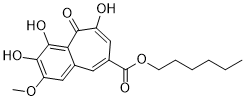
CU-CPT22 (CU-CPT-22) is a novel and potent TLR1/2 inhibitor, used as a probe for the complex between toll-like receptors TLR1 and TLR2. The protein complex of toll-like receptor 1 and 2 (TLR1/2) is an important regulator of innate immunity, and therefore provides an attractive target for the treatment of various immune disordres.
Physicochemical Properties
| Molecular Formula | C19H22O7 |
| Molecular Weight | 362.378 |
| Exact Mass | 362.137 |
| CAS # | 1416324-85-0 |
| Appearance | Yellow to orange solid powder |
| LogP | 3.062 |
| Synonyms | CU-CPT-22 CU-CPT 22 CU-CPT22 |
| HS Tariff Code | 2934.99.9001 |
| Storage |
Powder-20°C 3 years 4°C 2 years In solvent -80°C 6 months -20°C 1 month |
| Shipping Condition | Room temperature (This product is stable at ambient temperature for a few days during ordinary shipping and time spent in Customs) |
Biological Activity
| ln Vitro | CU-CPT22 is a Toll-like device 1 and 2 (TLR1/2) dual with an IC50 of 0.58±0.09 μM. The results reveal that CU-CPT22 is able to compete with Pam3CSK4 for binding to TLR1/2 at a concentration (Ki) of 0.41±0.07 μM, which is comparable with the effect found in whole-cell experiments. Increasing the concentration of CU-CPT22 to 6 μM reduces the background level of anisotropy. CU-CPT22 was discovered to suppress TLR1/2 signaling without impacting other TLRs, showing that it is extremely selective in intact cells. CU-CPT22 was reported to have no significant cytotoxicity in RAW 264.7 cells at varied doses up to 100 μM. The results demonstrate that CU-CPT22 can block approximately 60% of TNF-α and 95% of IL-1β at 8 μM [1]. |
| References |
[1]. Discovery of small-molecule inhibitors of the TLR1/TLR2 complex. Angew Chem Int Ed Engl. 2012 Dec 3;51(49):12246-9. |
Solubility Data
| Solubility (In Vitro) | DMSO : ≥ 125 mg/mL (~344.95 mM) |
| Solubility (In Vivo) |
Solubility in Formulation 1: ≥ 2.5 mg/mL (6.90 mM) (saturation unknown) in 10% DMSO + 40% PEG300 + 5% Tween80 + 45% Saline (add these co-solvents sequentially from left to right, and one by one), clear solution. For example, if 1 mL of working solution is to be prepared, you can add 100 μL of 25.0 mg/mL clear DMSO stock solution to 400 μL PEG300 and mix evenly; then add 50 μL Tween-80 to the above solution and mix evenly; then add 450 μL normal saline to adjust the volume to 1 mL. Preparation of saline: Dissolve 0.9 g of sodium chloride in 100 mL ddH₂ O to obtain a clear solution. Solubility in Formulation 2: 2.5 mg/mL (6.90 mM) in 10% DMSO + 90% (20% SBE-β-CD in Saline) (add these co-solvents sequentially from left to right, and one by one), suspension solution; with ultrasonication. For example, if 1 mL of working solution is to be prepared, you can add 100 μL of 25.0 mg/mL clear DMSO stock solution to 900 μL of 20% SBE-β-CD physiological saline solution and mix evenly. Preparation of 20% SBE-β-CD in Saline (4°C,1 week): Dissolve 2 g SBE-β-CD in 10 mL saline to obtain a clear solution. Solubility in Formulation 3: 2.5 mg/mL (6.90 mM) in 10% DMSO + 90% Corn Oil (add these co-solvents sequentially from left to right, and one by one), suspension solution; with ultrasonication. For example, if 1 mL of working solution is to be prepared, you can add 100 μL of 25.0 mg/mL clear DMSO stock solution to 900 μL of corn oil and mix evenly. (Please use freshly prepared in vivo formulations for optimal results.) |
| Preparing Stock Solutions | 1 mg | 5 mg | 10 mg | |
| 1 mM | 2.7595 mL | 13.7977 mL | 27.5953 mL | |
| 5 mM | 0.5519 mL | 2.7595 mL | 5.5191 mL | |
| 10 mM | 0.2760 mL | 1.3798 mL | 2.7595 mL |