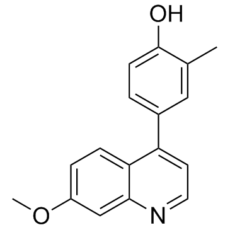
CU-CPT-9b, an analog of CU-CPT-8m and CU-CPT-9a, is a specific antagonist of TLR8 (Toll-like receptor 8) with IC50 of 0.7 nM. Endosomal Toll-like receptors (TLR3, TLR7, TLR8, and TLR9) are highly analogous sensors for various viral or bacterial RNA and DNA molecular patterns. Nonetheless, few small molecules can selectively modulate these TLRs. ITC experiments have confirmed the strong binding of CU-CPT-9b with a Kdof 21 nM. It is shown that CU-CPT-9b binds to the inactive TLR8 dimer in a similar way to CU-CPT8m. CU-CPT9b utilizes hydrogen bonds with G351 and V520*, which are conserved among TLR8/antagonist structures. Additionally, CU-CPT-9b forms water-mediated contacts with S516* and Q519*, which are not observed in TLR8/CU-CPT8m structure, suggesting that the enhanced potency of CU-CPT-9b derives from the new interactions with these polar residues. The orientation of Y567* also changes to facilitate van der Waals interactions with CU-CPT-9b as compared to TLR8/CU-CPT8m.
Physicochemical Properties
| Molecular Formula | C16H13NO2 | |
| Molecular Weight | 251.279924154282 | |
| Exact Mass | 251.094 | |
| CAS # | 2162962-69-6 | |
| Related CAS # |
|
|
| PubChem CID | 135567366 | |
| Appearance | White to yellow solid powder | |
| LogP | 3.5 | |
| Hydrogen Bond Donor Count | 2 | |
| Hydrogen Bond Acceptor Count | 3 | |
| Rotatable Bond Count | 1 | |
| Heavy Atom Count | 19 | |
| Complexity | 309 | |
| Defined Atom Stereocenter Count | 0 | |
| SMILES | OC1C=CC(=CC=1C)C1C=CN=C2C=C(C=CC=12)O |
|
| InChi Key | QXFYDRYRLOHSBD-UHFFFAOYSA-N | |
| InChi Code | InChI=1S/C16H13NO2/c1-10-8-11(2-5-16(10)19)13-6-7-17-15-9-12(18)3-4-14(13)15/h2-9,18-19H,1H3 | |
| Chemical Name |
|
|
| Synonyms |
|
|
| HS Tariff Code | 2934.99.9001 | |
| Storage |
Powder-20°C 3 years 4°C 2 years In solvent -80°C 6 months -20°C 1 month |
|
| Shipping Condition | Room temperature (This product is stable at ambient temperature for a few days during ordinary shipping and time spent in Customs) |
Biological Activity
| ln Vitro | CU-CPT9b is a selective TLR8 antagonist, with an IC50 of 0.7±0.2 nM. ITC studies have demonstrated the robust binding of CU-CPT9b with a Kd of 21 nM. It is proven that CU-CPT-9b attaches to the inactive TLR8 dimer in a similar way to CU-CPT8m. CU-CPT9b exploits hydrogen bonds with G351 and V520*, which are conserved among TLR8/antagonist structures. Additionally, CU-CPT9b develops water-mediated contacts with S516* and Q519*, which are not detected in TLR8/CU-CPT8m structure, suggesting that the higher potency of CU-CPT9b arises from the novel interactions with these polar residues. The orientation of Y567* also alters to enhance van der Waals interactions with CU-CPT9b as compared to TLR8 /CU-CPT8m[1]. | ||
| ln Vivo |
|
||
| Animal Protocol |
|
||
| References |
[1]. Small-molecule inhibition of TLR8 through stabilization of its resting state. Nat Chem Biol. 2018 Jan;14(1):58-64. |
Solubility Data
| Solubility (In Vitro) |
|
|||
| Solubility (In Vivo) |
Solubility in Formulation 1: ≥ 2.08 mg/mL (8.28 mM) (saturation unknown) in 10% DMSO + 40% PEG300 + 5% Tween80 + 45% Saline (add these co-solvents sequentially from left to right, and one by one), clear solution. For example, if 1 mL of working solution is to be prepared, you can add 100 μL of 20.8 mg/mL clear DMSO stock solution to 400 μL PEG300 and mix evenly; then add 50 μL Tween-80 to the above solution and mix evenly; then add 450 μL normal saline to adjust the volume to 1 mL. Preparation of saline: Dissolve 0.9 g of sodium chloride in 100 mL ddH₂ O to obtain a clear solution. Solubility in Formulation 2: ≥ 2.08 mg/mL (8.28 mM) (saturation unknown) in 10% DMSO + 90% (20% SBE-β-CD in Saline) (add these co-solvents sequentially from left to right, and one by one), clear solution. For example, if 1 mL of working solution is to be prepared, you can add 100 μL of 20.8 mg/mL clear DMSO stock solution to 900 μL of 20% SBE-β-CD physiological saline solution and mix evenly. Preparation of 20% SBE-β-CD in Saline (4°C,1 week): Dissolve 2 g SBE-β-CD in 10 mL saline to obtain a clear solution. Solubility in Formulation 3: ≥ 2.08 mg/mL (8.28 mM) (saturation unknown) in 10% DMSO + 90% Corn Oil (add these co-solvents sequentially from left to right, and one by one), clear solution. For example, if 1 mL of working solution is to be prepared, you can add 100 μL of 20.8 mg/mL clear DMSO stock solution to 900 μL of corn oil and mix evenly. (Please use freshly prepared in vivo formulations for optimal results.) |
| Preparing Stock Solutions | 1 mg | 5 mg | 10 mg | |
| 1 mM | 3.9796 mL | 19.8981 mL | 39.7962 mL | |
| 5 mM | 0.7959 mL | 3.9796 mL | 7.9592 mL | |
| 10 mM | 0.3980 mL | 1.9898 mL | 3.9796 mL |