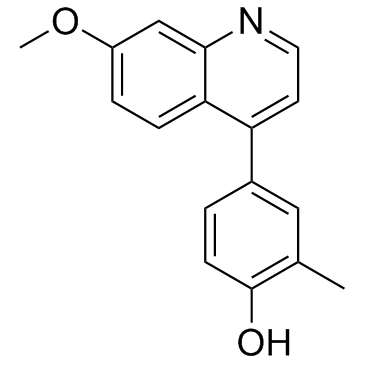
CU-CPT-9a, an analog of CU-CPT-8m, is a potent and specific antagonist/inhibitor of TLR8 (Toll-like receptor 8) (IC50 = 0.5 nM) with the potential to be used for treating autoimmune diseases.
Physicochemical Properties
| Molecular Formula | C17H15NO2 | |
| Molecular Weight | 265.306504487991 | |
| Exact Mass | 265.11 | |
| CAS # | 2165340-32-7 | |
| Related CAS # |
|
|
| PubChem CID | 135567383 | |
| Appearance | Light yellow to yellow solid powder | |
| LogP | 3.8 | |
| Hydrogen Bond Donor Count | 1 | |
| Hydrogen Bond Acceptor Count | 3 | |
| Rotatable Bond Count | 2 | |
| Heavy Atom Count | 20 | |
| Complexity | 322 | |
| Defined Atom Stereocenter Count | 0 | |
| SMILES | O(C)C1C=CC2C(C=1)=NC=CC=2C1C=CC(=C(C)C=1)O |
|
| InChi Key | HNYBTVKYLVLWCB-UHFFFAOYSA-N | |
| InChi Code | InChI=1S/C17H15NO2/c1-11-9-12(3-6-17(11)19)14-7-8-18-16-10-13(20-2)4-5-15(14)16/h3-10,19H,1-2H3 | |
| Chemical Name |
|
|
| Synonyms |
|
|
| HS Tariff Code | 2934.99.9001 | |
| Storage |
Powder-20°C 3 years 4°C 2 years In solvent -80°C 6 months -20°C 1 month |
|
| Shipping Condition | Room temperature (This product is stable at ambient temperature for a few days during ordinary shipping and time spent in Customs) |
Biological Activity
| ln Vitro | CU-CPT-9a is a selective TLR8 antagonist with an IC50 of 0.5±0.1 nM. The rise in downstream protein levels generated by R848 could be reversed by CU-CPT-9a in a dose-dependent manner. In contrast, expression of TRIF and IRF3 (cytoplasmic and nuclear) was only responsive to TLR4 and TLR3 and not to TLR837. The expression levels of TRIF and IRF3 did not reveal significant changes in THP-1 cells following R848 therapy, nor did they change after CU-CPT-9a treatment. Both CU-CPT8m and CU-CPT-9a strongly decreased TNF-α levels in a dose-dependent manner, which is consistent with prior observations on the involvement of TLR8 in these autoimmune disorders [1]. | ||
| ln Vivo |
|
||
| Animal Protocol |
|
||
| References |
[1]. Small-molecule inhibition of TLR8 through stabilization of its resting state. Nat Chem Biol. 2018 Jan;14(1):58-64. |
Solubility Data
| Solubility (In Vitro) |
|
|||
| Solubility (In Vivo) |
Solubility in Formulation 1: ≥ 2.5 mg/mL (9.42 mM) (saturation unknown) in 10% DMSO + 40% PEG300 + 5% Tween80 + 45% Saline (add these co-solvents sequentially from left to right, and one by one), clear solution. For example, if 1 mL of working solution is to be prepared, you can add 100 μL of 25.0 mg/mL clear DMSO stock solution to 400 μL PEG300 and mix evenly; then add 50 μL Tween-80 to the above solution and mix evenly; then add 450 μL normal saline to adjust the volume to 1 mL. Preparation of saline: Dissolve 0.9 g of sodium chloride in 100 mL ddH₂ O to obtain a clear solution. Solubility in Formulation 2: ≥ 2.5 mg/mL (9.42 mM) (saturation unknown) in 10% DMSO + 90% (20% SBE-β-CD in Saline) (add these co-solvents sequentially from left to right, and one by one), clear solution. For example, if 1 mL of working solution is to be prepared, you can add 100 μL of 25.0 mg/mL clear DMSO stock solution to 900 μL of 20% SBE-β-CD physiological saline solution and mix evenly. Preparation of 20% SBE-β-CD in Saline (4°C,1 week): Dissolve 2 g SBE-β-CD in 10 mL saline to obtain a clear solution. Solubility in Formulation 3: ≥ 2.5 mg/mL (9.42 mM) (saturation unknown) in 10% DMSO + 90% Corn Oil (add these co-solvents sequentially from left to right, and one by one), clear solution. For example, if 1 mL of working solution is to be prepared, you can add 100 μL of 25.0 mg/mL clear DMSO stock solution to 900 μL of corn oil and mix evenly. (Please use freshly prepared in vivo formulations for optimal results.) |
| Preparing Stock Solutions | 1 mg | 5 mg | 10 mg | |
| 1 mM | 3.7692 mL | 18.8459 mL | 37.6918 mL | |
| 5 mM | 0.7538 mL | 3.7692 mL | 7.5384 mL | |
| 10 mM | 0.3769 mL | 1.8846 mL | 3.7692 mL |